
















Duckpin Bowling Rules: The Complete Guide to Scoring, Gameplay & Equipment
Duckpin bowling offers a distinct challenge that sets it apart from its ten-pin cousin. By understanding the unique 3-roll structure, mastering the precise scoring system, and adhering to the specific equipment regulations, players can appreciate the skill required for this nostalgic game. Whether you are aiming for a rare Strike or simply trying to convert a 'Break,' knowing the official rules ensures a fair and competitive match.
- What is Duckpin Bowling?
- Brief History and Origin
- The Core Objective of the Game
- Why It Is Considered Harder Than Standard Ten-Pin Bowling
- Equipment Specifications: Size Matters
- Duckpin Ball Dimensions
- Pin Specifications
- Lane Dimensions
- The Gameplay Structure
- The 10-Frame Format Explained
- The 3-Roll Rule: The Defining Difference
- Resetting Pins
- Detailed Scoring System Explained
- How to Score a Strike (X)
- How to Score a Spare (/)
- Scoring the 'Break' or 'Ten'
- Open Frames
- The 10th Frame
- Common Fouls and Violations
- Foul Line Rules
- Deadwood Rules
- Illegal Delivery
- Duckpin vs. Ten-Pin Bowling
- Comparison Table
- Difficulty Comparison: The Impossible 300
- Strategy Differences: Accuracy vs. Power
- Conclusion
- FAQ
Duckpin bowling is often mistakenly viewed merely as "miniature bowling," but players who step onto the lane quickly realize it is a distinct, highly skillful, and notoriously difficult sport. Originating from the mid-Atlantic United States, this variation of the sport has retained a cult following due to its demanding precision and unique mechanics.
For beginners and seasoned ten-pin converts alike, understanding the duckpin bowling rules is the first step toward mastering the game. Unlike its big brother, where power often translates to strikes, duckpin requires finesse, strategic angle management, and a deep understanding of its specific scoring quirks. This guide serves as the definitive resource on how to score duckpin bowling, equipment standards, and the nuances that make a perfect game practically impossible.
What is Duckpin Bowling?
To the untrained eye, duckpin bowling looks like a shrunken version of traditional bowling. However, the physics and the gameplay loop create an entirely different competitive experience.
Brief History and Origin
The origins of duckpin bowling are often traced back to Baltimore, Maryland, around 1900. Legends suggest that baseball Hall of Famers John McGraw and Wilbert Robinson, who owned a bowling alley, wanted a version of the game that could be played during the summer or when shorter on time. They trimmed down damaged ten-pins to a smaller size, and the "duckpin" was born—so named because the pins looked like a flock of flying ducks when scattered by the ball.
Since the founding of the National Duckpin Bowling Congress (NDBC) in 1927, the sport has codified its regulations, preserving a tradition that prioritizes accuracy over sheer force.
The Core Objective of the Game
The primary objective remains the same as all bowling variants: roll a ball down a lane to knock down ten pins arranged in a triangular formation. However, the path to achieving a high score is vastly different. In duckpin, the bowler is not just battling the pins; they are battling the probabilities created by the equipment size. The goal is to maximize pinfall over ten frames, utilizing up to three balls per frame—a key distinction we will explore later.
Why It Is Considered Harder Than Standard Ten-Pin Bowling
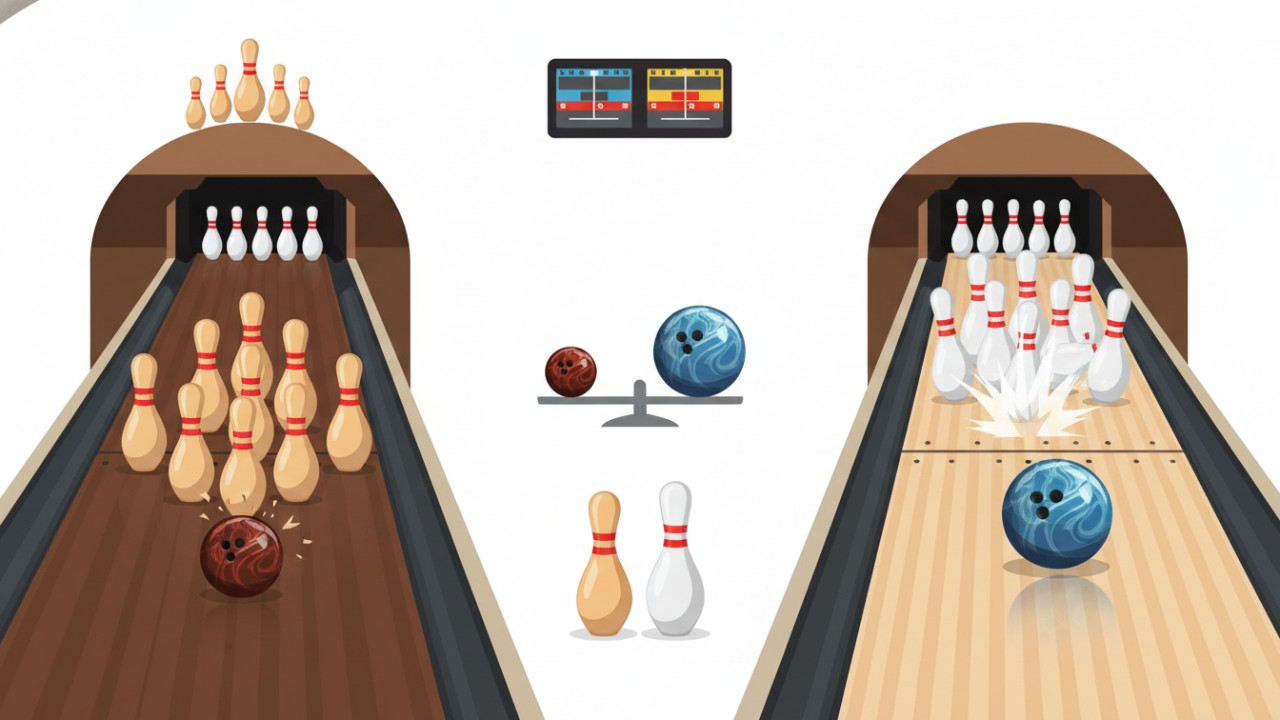
Duckpin bowling is widely considered the most difficult bowling variation. In ten-pin bowling, the ball is massive relative to the pins, and the pins are taller and prone to "chain reactions" (domino effects).
In duckpin, the ball is small, and the pins are short and squat. Because the ball is lighter and has a smaller diameter, it can easily pass through the "pocket" (the space between the head pin and the adjacent pin) without knocking down the surrounding pins. This is known as "chopping." Furthermore, the pins have a lower center of gravity, meaning they don't fly around as violently to take out their neighbors. This difficulty curve is why understanding the duckpin vs ten pin bowling dynamic is essential for setting realistic score expectations.
Equipment Specifications: Size Matters
The difficulty and charm of duckpin bowling are dictated entirely by the equipment. Adhering to the official regulations is vital for standards in sanctioned play.
Duckpin Ball Dimensions
The most visually striking difference for new players is the ball.
· Size: Duckpin ball dimensions are strictly regulated. The ball must be between 4.75 and 5.00 inches in diameter.
· Weight: The maximum weight allowed is 3 pounds, 12 ounces (approx. 1.7 kg).
· Construction: Crucially, duckpin balls have no finger holes. Players must palm the ball, which changes the mechanics of the delivery entirely. You cannot generate the same high-rev hooking action seen in modern ten-pin bowling; instead, players often use a "finger-tip" grip or a flat palm release to generate forward roll.
Pin Specifications
The pins are the defensive line of the game. They are significantly shorter and squatter than standard pins.
· Height: approximately 9 and 13/32 inches tall.
· Shape: Due to their stout nature, they are harder to tip over. A glancing blow that would topple a ten-pin might merely wobble a duckpin.
· Arrangement: They are set in a 12-inch equilateral triangle, identical in spacing to ten-pins, but because the pins are smaller, the gaps between them are proportionally much larger.
Lane Dimensions
While the equipment is smaller, the playing field is not.
· Length: The lane is 60 feet from the foul line to the headpin, identical to ten-pin bowling.
· Width: The lane is 41 to 42 inches wide.
· Surface: While ten-pin lanes rely heavily on complex oil patterns to facilitate hook shots, duckpin lanes are generally conditioned differently. The focus is less on oil pattern manipulation and more on a consistent, flat surface, as the lack of finger holes limits the ability to throw varied hooks.
The Gameplay Structure
A standard game of duckpin bowling follows a rhythm that is faster-paced yet more forgiving in terms of volume of play than ten-pin.
The 10-Frame Format Explained
A game consists of 10 frames. In each frame, the bowler attempts to knock down all ten pins. The cumulative score determines the winner. Players usually alternate lanes or bowl a full frame before yielding the lane to the next player, depending on the league rules or casual setting.
The 3-Roll Rule: The Defining Difference
This is the most critical rule for newcomers to grasp. In ten-pin bowling, you get two attempts to clear the deck. However, due to the difficulty of the sport, the duckpin 3rd ball rule allows for a third delivery if pins remain standing after the second roll.
· Roll 1: Attempt to get a Strike.
· Roll 2: If pins remain, attempt to get a Spare.
· Roll 3: If pins still remain, attempt to knock down the rest for a count of ten.
This third roll changes the strategy significantly. It means an "open frame" (where pins are left standing) is less common than in ten-pin, but achieving a "mark" (Strike or Spare) is exponentially harder.
Resetting Pins
Understanding when pins are reset is vital for flow:
1. Strike: If all 10 pins fall on the first ball, the frame is over, and the pins are reset for the next frame.
2. Spare: If all remaining pins fall on the second ball, the frame is over, and pins are reset.
3. Ten: If the remaining pins fall on the third ball, the frame is over.
4. Open: If pins remain standing after the third ball, the score is recorded, and the pins are reset.
5. Between Balls: Pins are not reset between balls 1, 2, and 3. However, "deadwood" (fallen pins) must be removed from the lane and gutters before the next ball is rolled.
Detailed Scoring System Explained
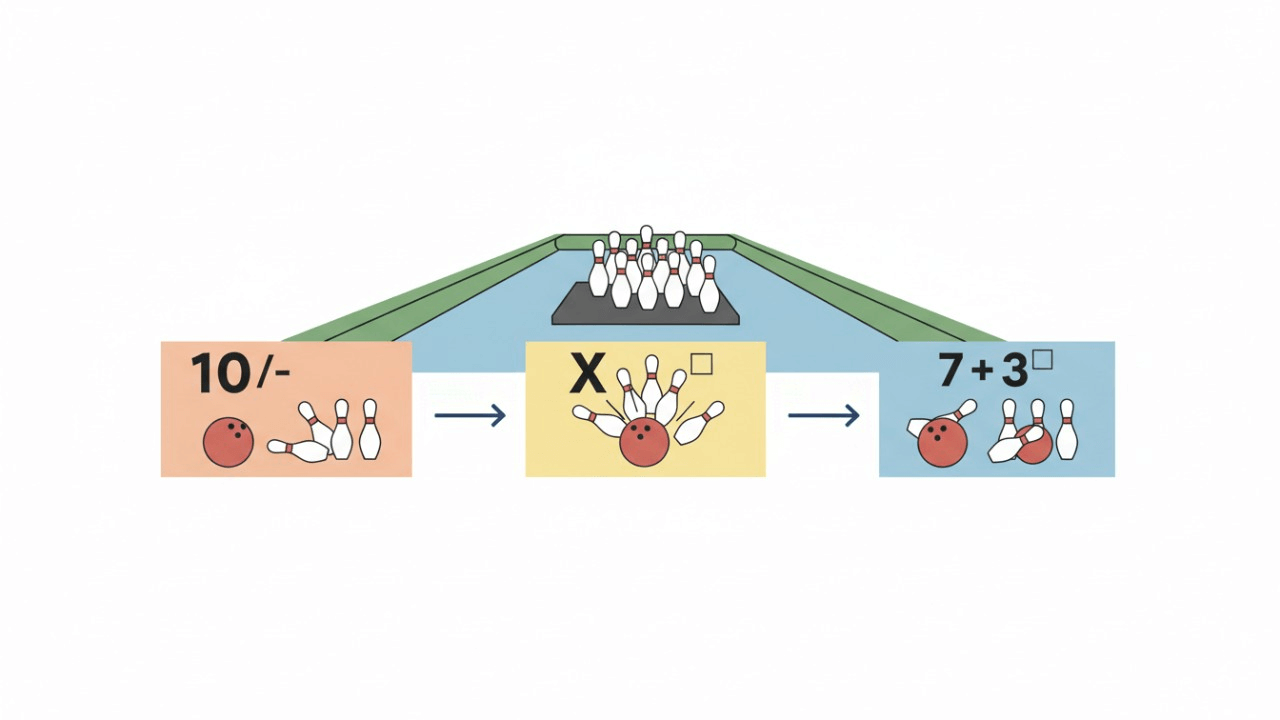
Learning how to score duckpin bowling can be confusing because of the third ball. The scoring sheet looks similar to traditional bowling, but the math handles the third ball uniquely.
How to Score a Strike (X)
A Strike occurs when you knock down all 10 pins with your first ball.
· Symbol: An 'X' on the scorecard.
· Value: 10 points plus the total pinfall of your next two balls.
· Example: You roll a Strike in Frame 1. In Frame 2, you roll a 3 on the first ball and a 4 on the second ball.
o Frame 1 Score: 10 + 3 + 4 = 17.
o Frame 2 Score: 17 + 7 = 24.
How to Score a Spare (/)
A Spare occurs when you knock down all 10 pins using two balls.
· Symbol: A '/' on the scorecard.
· Value: 10 points plus the pinfall of your next one ball.
· Example: You roll a 7 then a 3 (Spare) in Frame 1. In Frame 2, you roll a 4 on the first ball.
o Frame 1 Score: 10 + 4 = 14.
o Frame 2 Score starts at 14 and adds the total pinfall of Frame 2.
Scoring the 'Break' or 'Ten'
This is the unique scenario created by the duckpin 3rd ball rule. If it takes you three balls to knock down all 10 pins, it is not a spare.
· Symbol: Usually a '10' or sometimes a specific mark like a box with a line, depending on the alley's software.
· Value: Exactly 10 points. There is no bonus from the next frame.
· Strategy: While less desirable than a Spare, converting a "Ten" is crucial for maintaining a respectable average. It prevents the frame from being an error.
Open Frames
If pins are still standing after the third ball, you simply count the total number of pins knocked down.
· Example: Roll 1 (5 pins), Roll 2 (2 pins), Roll 3 (1 pin). Total score for the frame is 8.
The 10th Frame
The 10th frame operates under special rules to accommodate the bonus calculations for marks:
· Strike in 10th: You get two extra balls to finish the score calculation.
· Spare in 10th: You get one extra ball to finish the score calculation.
· Ten (3 balls) in 10th: The game ends; there are no extra balls because a "Ten" carries no bonus.
Common Fouls and Violations
To maintain the integrity of the game (and your score), you must be aware of standard fouls.
Foul Line Rules
Like all bowling, there is a foul line separating the approach from the lane.
· The Rule: If any part of the bowler's body (usually the foot or hand) touches or crosses the foul line during delivery, a foul is called.
· The Penalty: The delivery counts as a zero. If it was the first ball, the pins are reset (if any fell), and you move to the second ball. You essentially lose that opportunity to score points, even if you knocked down pins.
Deadwood Rules
"Deadwood" refers to pins that have been knocked down but remain on the lane or in the gutter.
· Wood-off-the-deck: In sanctioned duckpin bowling, deadwood must be removed after every throw.
· Violation: If you roll your second or third ball and it hits a fallen pin (deadwood) that wasn't cleared, the shot may be declared a "dead ball," and you might have to re-roll, or the pins knocked down by the flying deadwood won't count.
· Note: Some casual "candlepin" variants allow deadwood play, but official duckpin rules require a clear deck.
Illegal Delivery
· Lofting: Throwing the ball excessively high so that it lands far down the lane is prohibited. It damages the lane surface.
· Interference: Players must not interfere with the ball return mechanism or other bowlers.
Duckpin vs. Ten-Pin Bowling
To truly understand the niche of this sport, a direct comparison is necessary. This section highlights the duckpin vs ten pin bowling differences.
Comparison Table
|
Feature |
Duckpin Bowling |
Ten-Pin Bowling |
|
Ball Size |
4.75 - 5.00 inches |
~8.5 inches |
|
Ball Weight |
Max 3 lbs 12 oz |
Max 16 lbs |
|
Finger Holes |
No |
Yes (usually 3) |
|
Pin Height |
~9.4 inches |
15 inches |
|
Rolls per Frame |
3 |
2 |
|
Strike Scoring |
10 + next 2 balls |
10 + next 2 balls |
|
Perfect Score |
300 (Theoretically) |
300 (Achieved often) |
Difficulty Comparison: The Impossible 300
Here is the most shocking statistic in bowling history: A sanctioned perfect 300 game has never been officially recorded in the history of duckpin bowling.
In ten-pin bowling, professionals bowl 300s regularly. In duckpin, the highest officially sanctioned game is in the 270s. The small ball simply passes through the pins too easily without carrying the strike. A "good" game in duckpin is often considered anything over 100, and a 150+ is considered elite.
Strategy Differences: Accuracy vs. Power
Ten-pin bowling has evolved into a power game where high-rev rates and reactive resin balls destroy the rack. Duckpin remains a game of pure accuracy. Because you cannot hook the ball aggressively without finger holes, you must rely on angle and speed control. The "3rd ball rule" shifts the mental strategy from "all or nothing" to "damage control"—constantly calculating how to clean up stray pins to save points.
Conclusion
Duckpin bowling offers a distinct challenge that sets it apart from its ten-pin cousin. It is a game where power is secondary to precision, and where a score of 120 can feel like a triumph. By understanding the unique duckpin 3rd ball rule, mastering the precise mechanics of how to score duckpin bowling, and adhering to the specific equipment regulations regarding duckpin ball dimensions, players can fully appreciate the immense skill required for this nostalgic game.
Whether you are aiming for that elusive, rare Strike or simply trying to convert a 'Break' to save your frame, knowing the official rules ensures a fair and competitive match. Next time you step up to the approach, palm that small ball, eye the squat pins, and remember: in duckpin, every pinfall is earned, not given.
FAQ
How many rolls do you get per frame in duckpin bowling?
Unlike traditional ten-pin bowling where you get two rolls, in duckpin bowling, a player is allowed up to three rolls per frame to knock down all ten pins.
How is a spare scored in duckpin bowling?
A spare is achieved when all ten pins are knocked down with two balls. It is scored as 10 points plus the number of pins knocked down with the very next ball rolled.
Has anyone ever bowled a perfect 300 game in duckpin?
No. Unlike ten-pin bowling, a sanctioned perfect 300 game has never been officially recorded in the history of duckpin bowling due to the difficulty of the game.
What happens if I knock down all pins on the third roll?
If you knock down all pins using all three balls, it is recorded as a score of 10 for that frame. There is no bonus added from subsequent rolls, unlike a Strike or Spare.
What counts as a foul in duckpin bowling?
A foul occurs if any part of the bowler's body touches or crosses the foul line during delivery. Any pins knocked down on that specific roll do not count toward the score.

Quality Bowling



Installations
How long does it take to install bowling equipment?
The installation process can take between 2-4 weeks, depending on the size of the project and the specific type of equipment being installed.
Service
How long do you provide warranty service?
The whole machine is under warranty for 2 years, and the core components (motor/mainboard) are extended to 3 years, and the maintenance is at cost price for life.
Do you provide regular maintenance services?
You can sign an annual maintenance agreement, which includes quarterly inspections, lubrication maintenance, system upgrades and other services.
Products
Are environmentally friendly materials used?
All wood products are USBC certified, the paint complies with EU REACH standards, and environmental testing reports are provided
Can I choose the color and brand logo of the equipment?
Personalized customization is supported, including lane color, LOGO, theme lighting system, etc.
You May Also Like
Flying Smart Duckpin Bowling
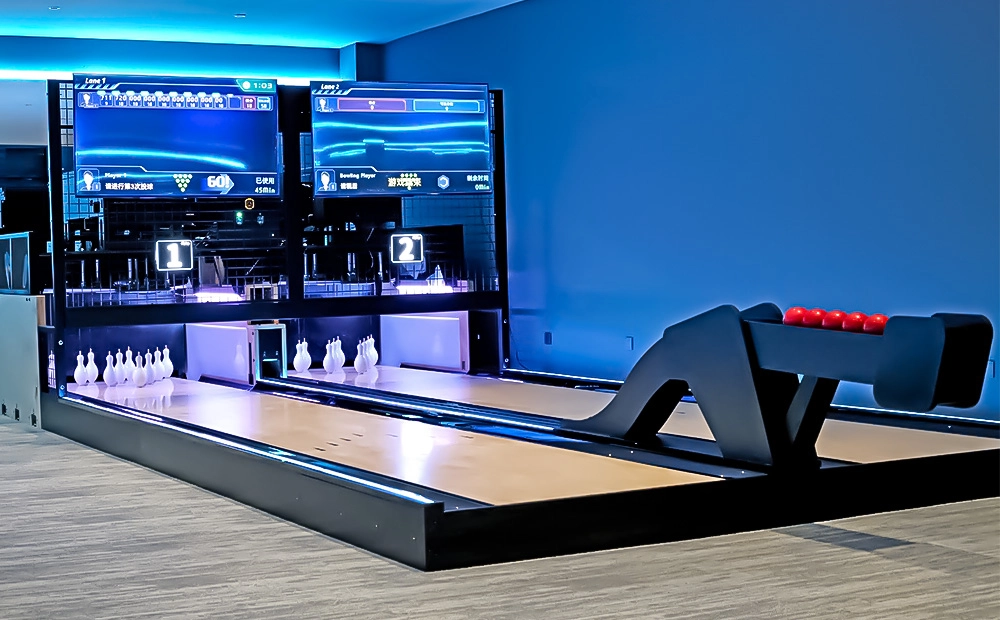
The innovative design of Flying Smart Duckpin Bowling (FSDB) makes it perfect for places like bars, billiard halls, and game centers. It makes people want to come back more often and spend more money. FSDB is fun and competitive, so it will become a new focus for social activities.

Flying Classic Standard Bowling
Flying Classic Standard Bowling (FCSB) employs the World Standard Competition Scoring System to deliver a more professional bowling experience, enabling bowlers to enjoy a professional-standard match at their convenience.
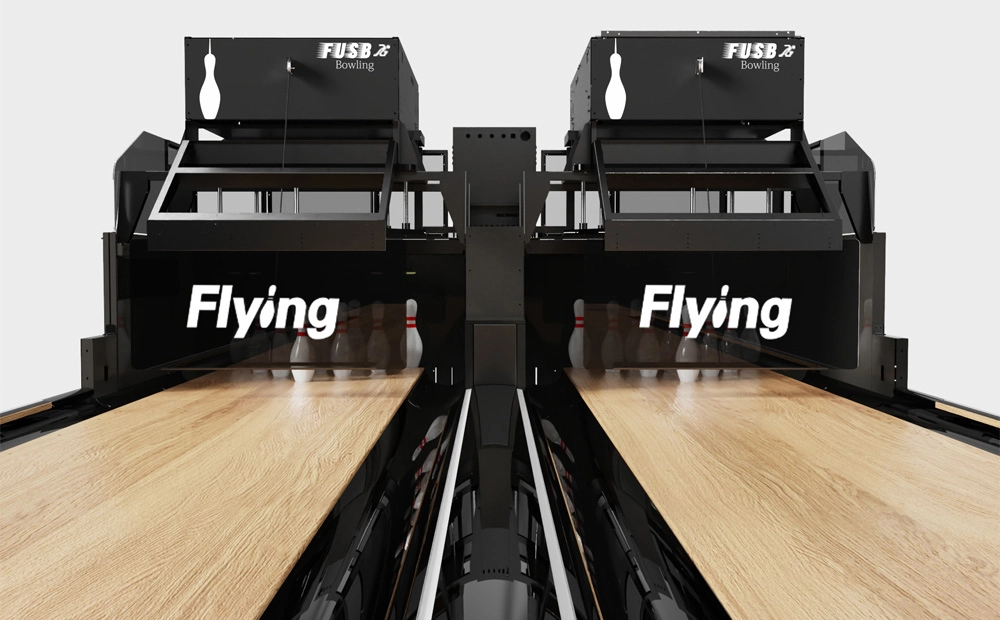
Flying Ultra Standard Bowling
Flying Ultra Standard Bowling (FUSB) Upgraded Version
The string pinsetter uses the latest technology. It offers a more enjoyable bowling experience thanks to its innovative designs and modern technology.

Get in touch
Contact us
If you contact us now for more details, we can provide you with a custom bowling alley service.
Our service team will get back to you within 24 hours, normally!



Professional Bowling Alley Equipment Manufacturer, a one-stop solution provider for bowling alleys.
Facebook
YouTube
Linkedin
Twitter