















Duckpin Bowling 101: Rules, History, and How to Play Like a Pro
Duckpin bowling offers a unique blend of accessibility and immense challenge. While the smaller balls make it easy for children to pick up, the physics of the squat pins and the deadwood rule make a perfect game nearly impossible—even for pros. Whether you are looking for a casual family night out or a competitive history lesson rooted in Baltimore, duckpin bowling delivers an experience distinct from its ten-pin cousin. Grab a ball, aim for the deadwood, and enjoy your three rolls!
- What is Duckpin Bowling?
- The "Grapefruit" Analogy: Understanding the Scale
- Why It Is Gaining Popularity
- History of the Game: Origins in Baltimore
- The Early 1900s: Robinson and McGraw
- Evolution from Pastime to Sport
- The Establishment of the NDBC
- Duckpin vs. Ten-Pin: Key Differences
- Equipment Specs: Ball and Pin Physics
- The "Squatty" Pin Difficulty
- Lane Dimensions: Debunking the Myth
- Number of Rolls: The Strategic Shift
- Detailed Rules and Scoring
- The 10-Frame Structure
- Scoring Terminology
- The 'Deadwood' Rule Explained
- Foul Line and Resetting
- Variations: Rubberband vs. Standard Duckpin
- The Distinct Band
- Physics and Scoring
- Regional Popularity
- Pro Tips and Techniques
- 1. The Grip: No Finger Holes? No Problem.
- 2. The Delivery: Approach and Tempo
- 3. Spin vs. Straight
- 4. Strategic Targeting of Deadwood
- Conclusion
- FAQ
Bowling is often viewed through the lens of the massive, crashing sounds of ten-pin bowling—heavy balls with finger holes, 15-pound projectiles, and frequent perfect games. However, there exists a cousin to the ten-pin game that is arguably more skillful, historically richer, and statistically much more difficult to master. Welcome to the world of duckpin bowling.
While it may look like a miniature version of the standard game, duckpin bowling is a beast of its own. It requires finesse over power, strategy over brute force, and offers a level of accessibility that makes it perfect for families while remaining tantalizingly impossible for professionals to "beat."
In this comprehensive guide, we will explore the rules, the rich history, and the distinct strategies ofduckpin bowling , helping you transition from a curious novice to a lane-commanding pro.
What is Duckpin Bowling?
At its core, duckpin bowling is a variation of ten-pin bowling, but with significant alterations to the equipment and gameplay mechanics that fundamentally change the physics of the sport. Often referred to as the "small ball" game, it retains the spirit of bowling—knocking down pins at the end of a lane—but the similarities largely end there.
The "Grapefruit" Analogy: Understanding the Scale
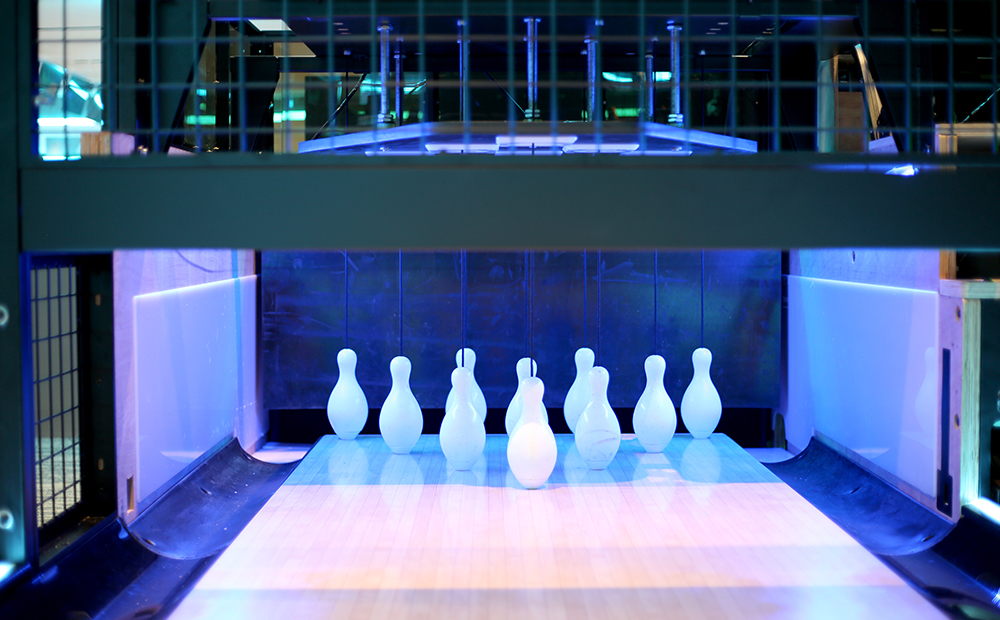
The most immediate difference a player notices is the ball. In standard ten-pin, balls are massive, weighing up to 16 pounds, and require finger holes to grip. In duckpin, the ball is roughly the size of a grapefruit. It has no finger holes and weighs a maximum of roughly 3 pounds, 12 ounces.
Because the ball is small and held in the palm of the hand, the mechanics of the throw are entirely different. You cannot rely on the pendulum weight of a heavy ball to generate momentum; you must generate the speed and spin through your wrist and arm action alone.
Why It Is Gaining Popularity
Duckpin bowling is currently enjoying a massive resurgence across the United States and beyond. The appeal lies in a unique dichotomy:
1. Accessibility for Families: Because the balls are light, small children and seniors can bowl without the physical strain associated with 15-pound ten-pin balls. It is an inclusive game where physical size offers little advantage.
2. Challenge for Pros: Despite being "easier" to physically play, it is significantly harder to score well. The gap between the pins and the size of the ball makes strikes rare and spares difficult. This high skill ceiling keeps competitive players addicted to the chase for a high score.
History of the Game: Origins in Baltimore
To understand the soul of duckpin bowling, one must look to the turn of the 20th century in Baltimore, Maryland. While bowling has ancient roots, the specific iteration of duckpin is an American invention born out of summer boredom and baseball legends.
The Early 1900s: Robinson and McGraw
The origin story of duckpin bowling is tied to two Hall of Fame baseball figures: Wilbert Robinson and John McGraw, both of whom were members of the Baltimore Orioles (and later managers for the Brooklyn Dodgers and NY Giants, respectively).
Around 1900, Robinson and McGraw owned a billiards and bowling parlor in Baltimore famously known as the "Diamond." During the summer, the standard ten-pin lanes were often too physically demanding in the heat, and the equipment took a beating. Legend has it that the two men, along with the parlor manager, decided to trim down the battered ten-pins to a smaller size to create a new game.
When the first ball was thrown at these smaller "squat" pins, onlookers remarked that the pins looked like a flock of flying ducks as they scattered. Thus, the name "duckpin" was coined.
Evolution from Pastime to Sport
What started as a way for baseball players to stay active in the off-season quickly morphed into a competitive phenomenon. The game spread rapidly up the East Coast, particularly entrenching itself in Maryland, Connecticut, Rhode Island, and parts of Canada.
Unlike other "mini-bowling" variations that faded away, duckpin developed a rigid structure. Leagues formed, and the casual nature of the game tightened into a pursuit of precision.
The Establishment of the NDBC
By 1927, the sport had grown enough to warrant a governing body. The National Duckpin Bowling Congress (NDBC) was founded to standardize rules, equipment specifications, and lane dimensions. This standardization was crucial; it ensured that a game played in Baltimore was identical to a game played in New Haven, allowing for national tournaments and recognized world records.
Duckpin vs. Ten-Pin: Key Differences
If you walk into a duckpin center expecting to use your ten-pin strategy, you will fail. The physics of the two games are vastly different. Here is a breakdown of the duckpin vs ten pin distinctions that matter most.
Equipment Specs: Ball and Pin Physics
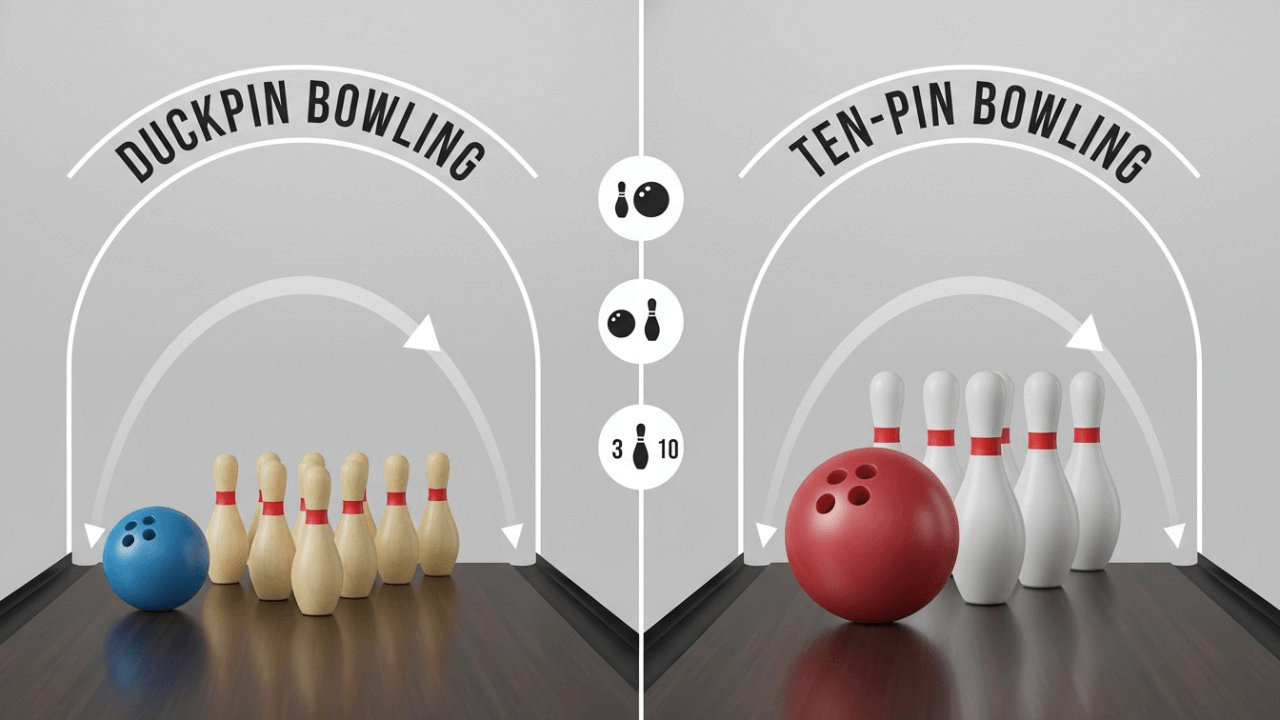
· The Ball: As mentioned, the duckpin ball is hole-less and tops out at approximately 3 lbs 12 oz, with a diameter of roughly 5 inches.
· The Pins: Duckpins are shorter and squatter than ten-pins. However, they are lighter, which makes them fly differently. In ten-pin, a heavy ball creates a "drive" that pushes pins into one another. In duckpin, the ball often deflects off the pins because the mass differential is not as great.
The "Squatty" Pin Difficulty
The pins in duckpin are spaced in a triangle identical to ten-pin, but because the ball is so small, it can physically pass through the gap between the 1-pin and the 3-pin (the "pocket") without knocking everything down. This is known as a "chop" or "punching out."
In ten-pin, a pocket hit usually results in a strike. In duckpin, a perfect pocket hit often leaves the back row standing. This makes strikes statistically much rarer in duckpin bowling.
Lane Dimensions: Debunking the Myth
There is a common misconception that duckpin is played on shorter lanes. This is generally false. Regulation duckpin bowling takes place on lanes that are the same length as standard ten-pin lanes—60 feet from the foul line to the head pin.
While some entertainment centers feature "mini-bowling" with scaled-down lanes, true NDBC-sanctioned duckpin utilizes the full 60-foot distance. This adds to the difficulty; you are throwing a grapefruit-sized ball at a target 60 feet away with no finger grips to stabilize your aim.
Number of Rolls: The Strategic Shift
The most significant rule change regarding gameplay is the number of rolls.
· Ten-Pin: 2 rolls per frame.
· Duckpin: 3 rolls per frame.
Because strikes are so rare and spares are so difficult, players are granted a third ball to clean up the remaining pins. This changes the scoring structure significantly, introducing a "ten score" (just knocking down 10 pins in 3 throws), which scores differently than a spare.
Detailed Rules and Scoring
To play like a pro, you must understand the duckpin bowling rules, specifically how scoring works and how to utilize the unique "deadwood" rule.
The 10-Frame Structure
A game consists of 10 frames. In each frame, a bowler has up to three chances to knock down all ten pins.
Scoring Terminology
1. Strike (X): You knock down all 10 pins with your first ball. You score 10 plus the total of your next two balls rolled. (You do not roll the 2nd or 3rd ball in this frame).
2. Spare (/): You knock down all 10 pins using your first and second balls combined. You score 10 plus the pins from your next one ball rolled. (You do not roll the 3rd ball).
3. Ten (10): You knock down all 10 pins using all three balls. This counts simply as a score of 10 for that frame, with no bonus from future rolls.
4. Open Frame: If pins remain standing after three balls, your score is simply the total number of pins knocked down.
The 'Deadwood' Rule Explained
This is the single most important strategic element in duckpin bowling.
· The Rule: When pins are knocked down, they are often left lying on the lane ("deadwood") rather than being swept away immediately by the machine.
· The Strategy: Players can roll their ball into the deadwood. If a rolling ball hits a fallen pin, and that fallen pin slides into a standing pin and knocks it over, it counts!
· Exceptions: Deadwood is only removed if it is lying in the gutter or if it is touching the kickbacks (side walls) in front of the pin deck. The machine (or a pinsetter) will clear this "illegal" deadwood before the next throw.
Note: In ten-pin, deadwood is cleared after every throw. In duckpin, the deadwood is your best friend.
Foul Line and Resetting
Standard foul line rules apply: if you cross the line, you score zero for that delivery. Regarding resetting, since players get three throws, the pinsetter machine functions differently, only resetting the full rack after a Strike, Spare, Ten, or the third ball.
Variations: Rubberband vs. Standard Duckpin
While exploring the world of small-ball bowling, you may encounter a variation known as rubberband duckpin. This variant is particularly popular in Quebec, Canada, and certain areas of the northeastern United States.
The Distinct Band
The primary difference is visible on the pins themselves. Rubberband duckpins have a thick band of hard rubber circling the belly of the pin.
Physics and Scoring
The rubber band acts as a kinetic multiplier. When the ball hits a pin, or when pins hit each other, they bounce with significantly more energy than standard hard maple or plastic duckpins.
· Pin Action: The pins fly across the deck more violently.
· Scoring: Because of this "bounciness," strikes and spares are much easier to achieve in rubberband duckpin. Perfect games, while still rare, are more attainable in the rubberband variant than in the standard game.
Regional Popularity
If you are bowling in Montreal, you are likely playing rubberband duckpin (often just called "Petites Quilles"). If you are in Baltimore or Connecticut, you are likely playing standard duckpin.
Pro Tips and Techniques
You’ve learned the history and the rules. Now, how do you actually score? Because duckpin bowling lacks the high-tech balls of ten-pin, success comes down to pure physical consistency and smart play.
1. The Grip: No Finger Holes? No Problem.
Without finger holes, you cannot "hook" the ball using lift from your fingertips.
· The Claw/Palm: Hold the ball comfortably in your palm. Do not squeeze too hard, or you will lose accuracy.
· The Release: Focus on a smooth release off the fingertips. Avoid "lofting" (throwing the ball into the air); you want the ball to roll smoothly onto the lane to maintain its energy for the pins.
2. The Delivery: Approach and Tempo
Because the ball is light, many beginners make the mistake of running too fast or throwing too hard.
· Slow Down: A 3-pound ball thrown at 30 mph will likely deflect off the pins. A controlled throw allows the pins to "mix."
· The 3-Step or 4-Step Approach: Use a standard bowling approach, but keep your backswing lower than in ten-pin. Precision is the goal.
3. Spin vs. Straight
In ten-pin, the "hook" is king. In duckpin, a massive hook is difficult to control and often counter-productive.
· The Cross-Lane Shot: Many pros bowl a relatively straight ball but throw from the corner of the lane across to the pocket (1-3 pins). This angle helps reduce the chance of a "chop" (leaving the back pins standing).
4. Strategic Targeting of Deadwood
This cannot be overstated: Look at the floor, not just the standing pins.
· Use the Wood: If you have a 7-10 split (pins on opposite sides) but there is a piece of deadwood lying in the middle, aim for the wood. Hit the wood in the center, and it might spin out and take down both pins. This turns an impossible spare into a convertible one.
Conclusion
Duckpin bowling offers a unique blend of accessibility and immense challenge. While the smaller balls make it easy for children to pick up, the physics of the squat pins and the deadwood rule make a perfect game nearly impossible—even for pros.
It is a game that humbles the arrogant and rewards the patient. Whether you are looking for a casual family night out or a competitive history lesson rooted in Baltimore, duckpin bowling delivers an experience distinct from its ten-pin cousin. It is a reminder that bigger isn't always better, and sometimes, the smallest pins cast the longest shadows in the world of sports.
So, grab a ball, forget about your finger grips, aim for the deadwood, and enjoy your three rolls!
FAQ
What is the main difference between duckpin and regular bowling?
The main differences are the size of the equipment and the rules. Duckpin uses balls about the size of a grapefruit (approx. 3 lbs 12 oz) with no finger holes and shorter, squat pins. Players also get three rolls per frame instead of two.
What is the deadwood rule in duckpin bowling?
The deadwood rule states that pins knocked down usually remain on the lane during the frame (unless they block the pin deck or gutter). Players can strategically use these fallen pins ('deadwood') to help knock down standing pins on their subsequent rolls.
Has anyone ever bowled a perfect 300 game in duckpin bowling?
No, a sanctioned perfect 300 game has never been bowled in the history of duckpin bowling. The highest sanctioned game recorded is significantly lower (279), illustrating the high difficulty level of the sport. The spacing of the pins combined with the small size of the ball makes striking 12 times in a row statistically improbable.
Are duckpin bowling lanes shorter than standard lanes?
Generally, no. Regulation duckpin bowling is played on standard lanes that are roughly the same size (60 feet long) as ten-pin bowling lanes, though some modern 'mini-bowling' entertainment centers may use scaled-down lanes.
Why is there no hole in a duckpin ball?
The ball is small enough (roughly 5 inches in diameter) to be held comfortably in the palm of the hand. Finger holes are unnecessary for gripping a ball of this size and weight, and the lack of holes changes the release mechanics, focusing more on wrist action than finger lift.

Quality Bowling



Customer care
My room is only about 50 or 60 feet long. How short is too short" for bowling lanes?
That depends on what each person likes. It's like asking how low we can put a basketball goal so that it's still fun. If your bowlers are mostly kids or people who haven't bowled much, they might not mind extremely short lanes. But serious league and tournament bowlers won't like a lane that isn't the normal size.
Service
What are the free cases during the warranty period, and what are the cases that require additional charges?
Covering failures caused by material/workmanship defects, providing free labor and parts repairs; non-quality damage will be charged at cost, and a detailed quotation will be provided for confirmation before repair.
If there is a problem with the equipment, how long will it take you to respond?
We promise to provide a solution within 12 hours (24 hours for overseas customers), and serious failures will be handled first.
Installations
Do you provide technical support after the installation?
Absolutely. We offer ongoing technical support, including regular maintenance and emergency repair services.
Products
Are environmentally friendly materials used?
All wood products are USBC certified, the paint complies with EU REACH standards, and environmental testing reports are provided
You May Also Like
Flying Smart Duckpin Bowling
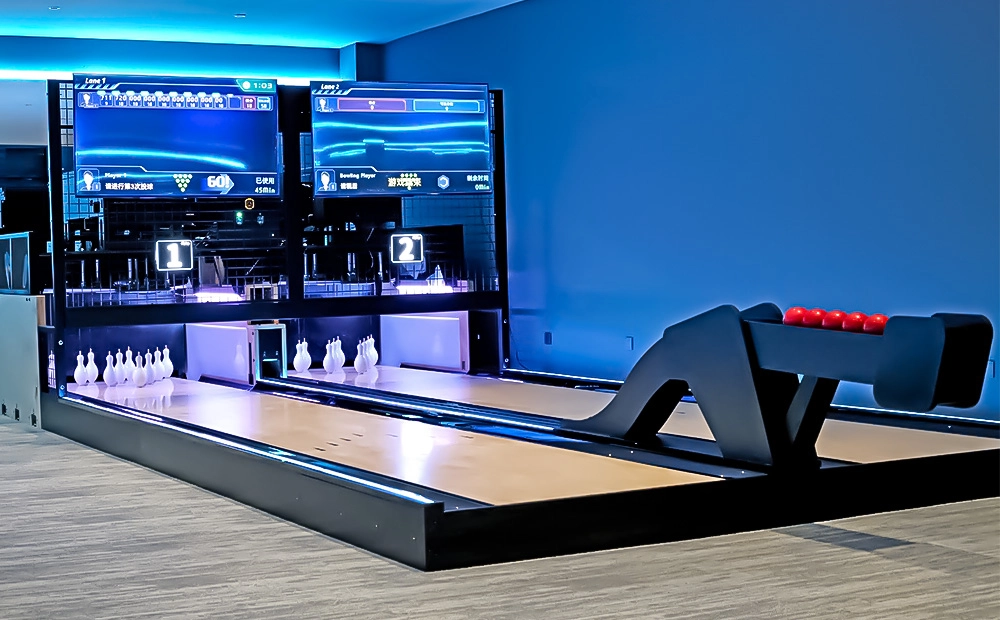
The innovative design of Flying Smart Duckpin Bowling (FSDB) makes it perfect for places like bars, billiard halls, and game centers. It makes people want to come back more often and spend more money. FSDB is fun and competitive, so it will become a new focus for social activities.

Flying Classic Standard Bowling
Flying Classic Standard Bowling (FCSB) employs the World Standard Competition Scoring System to deliver a more professional bowling experience, enabling bowlers to enjoy a professional-standard match at their convenience.
Flying Ultra Standard Bowling
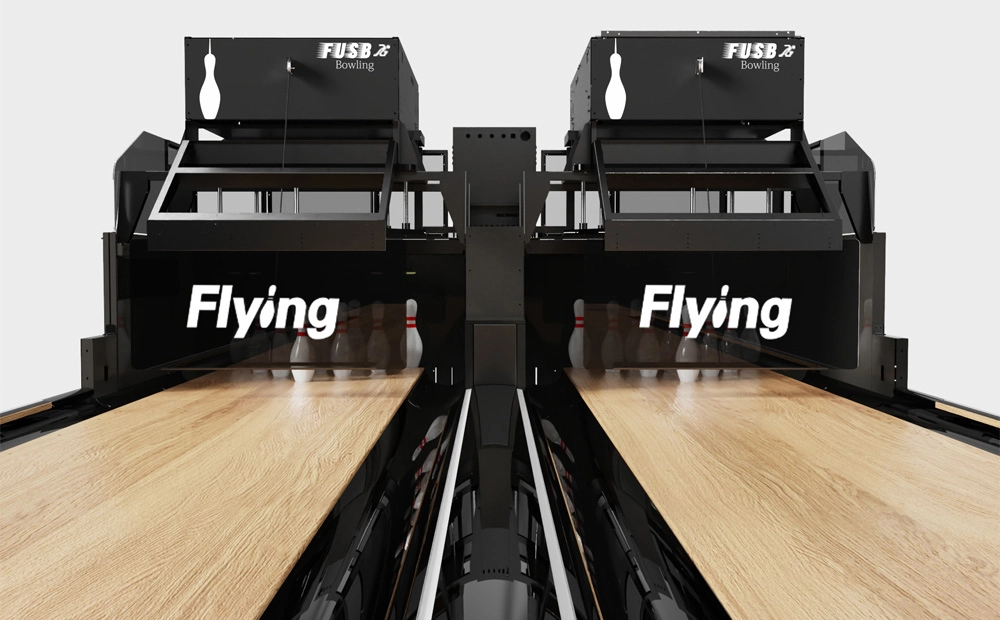
Flying Ultra Standard Bowling (FUSB) Upgraded Version
The string pinsetter uses the latest technology. It offers a more enjoyable bowling experience thanks to its innovative designs and modern technology.

Get in touch
Contact us
If you contact us now for more details, we can provide you with a custom bowling alley service.
Our service team will get back to you within 24 hours, normally!



Professional Bowling Alley Equipment Manufacturer, a one-stop solution provider for bowling alleys.
Facebook
YouTube
Linkedin
Twitter