













String Pinsetter vs Free-Fall: The Ultimate 2026 Guide for Bowling Center Owners & Bowlers
A comprehensive 2026 comparison of String vs. Free-Fall pinsetters. We analyze USBC certification rules, maintenance cost savings, pin action differences, and long-term ROI to help bowling center owners make the best investment decision.
- What is the Core Difference Between String Pinsetters and Free-Fall Pinsetters?
- Quick Comparison: String vs. Free-Fall Pinsetters (Key Takeaways)
- Deep Dive: String Pinsetters Explained
- Deep Dive: Free-Fall Pinsetters (Traditional) Explained
- The USBC Stance and Certification: What You Need to Know in 2026
- Impact on the Bowling Experience: For Owners & Bowlers
- Making the Right Choice: Expert Tips and Common Pitfalls in 2026
- Expert Tips
- Common Pitfalls
- The Future of Pinsetting: Innovations and Trends Beyond 2026
- FAQ
- Do string pinsetters affect your bowling score?
- Are string pinsetters allowed in USBC league play?
- Are string pinsetters cheaper to operate?
- What is the main difference in pin action between string and free-fall?
- Why are bowling alleys switching to string pinsetters?
- Are string pinsetters louder than traditional pinsetters?
- How does string length impact pin action?
- Can you still get 'messenger' strikes with string pinsetters?
- References
Are you grappling with the bowling alley investment decision of the decade? As we approach 2026, the debate between traditional free-fall machines and modern string technology has evolved from simple mechanics to a complex discussion involving USBC certification, bowler sentiment, and long-term profitability.
This guide cuts through the noise with data-backed analysis, helping you weigh the string pinsetter pros cons against the established free-fall pinsetter advantages.
What is the Core Difference Between String Pinsetters and Free-Fall Pinsetters?
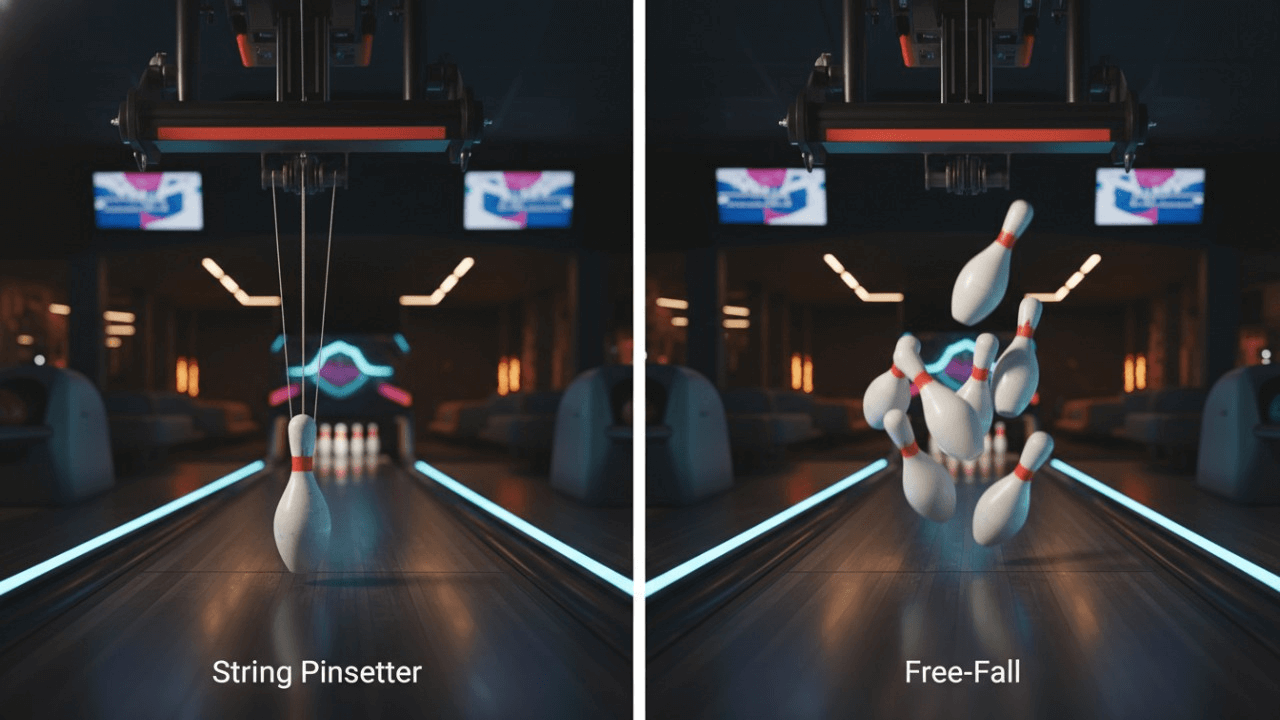
String pinsetters use a lightweight cord attached to the head of each pin to lift and reset them, whereas free-fall pinsetters rely on complex mechanical elevators and gravity to cycle pins.
While the end result—a full rack of ten pins—appears identical to the casual eye, the operational reality is vastly different. String pinsetter systems simplify the process by eliminating the need for pin elevators, shuttles, and diverse moving parts found in traditional machines. This fundamental mechanical difference is the primary driver behind the massive shift in bowling center operational efficiency and maintenance strategies.
· String Mechanics: Pins are attached to black nylon strings. When a ball hits, the machine pulls the strings to clear fallen pins and resets the standing ones.
· Free-Fall Mechanics: Pins are knocked into a pit, elevated by a wheel or conveyor, sorted, and placed back onto the deck by a mechanical arm or table.
· Impact: This difference dictates everything from noise levels to energy bills.
Quick Comparison: String vs. Free-Fall Pinsetters (Key Takeaways)
String pinsetters offer superior ROI and efficiency, while free-fall pinsetters provide the traditional, unencumbered pin action preferred by purist sport bowlers.
For a busy proprietor or investor, here is the high-level breakdown of how these technologies stack up in the current market.
· Maintenance & Costs: String machines reduce parts inventory and labor needs significantly.
· Energy Efficiency: String units consume up to 70-90% less energy than older free-fall motors.
· Bowler Perception: Free-fall is the gold standard for "pure" pin action; string is increasingly accepted but still debated among high-average bowlers.
· USBC Status: Both are certified for league play, provided specific string length requirements are met.
Deep Dive: String Pinsetters Explained
String pinsetters are electro-mechanical systems that utilize heavy-duty nylon cords to control pin movement, offering a streamlined solution with minimal moving parts.
The modern string pinsetter is not the toy-like version of the past. Manufacturers have engineered these systems to mimic traditional play closely. The reduction in mechanical complexity directly translates to lower string pinsetter maintenance costs, a critical factor for centers operating on thin margins.
· Mechanism: A motor-driven drum system controls the strings. Sensors detect pinfall based on string movement rather than physical impact plates.
· Key Advantages:
o Reduced Labor: No need for a specialized, high-salary mechanic on standby.
o Energy Savings: Operates on low-voltage power (often 24V DC), consuming a fraction of the electricity.
o Quiet Operation: The absence of a "pin elevator" significantly lowers the decibel level in the center.
· Potential Disadvantages:
o Pin Tangling: While rare in modern systems, strings can occasionally tangle, though software usually auto-corrects this.
o Perceived Action: Some bowlers dislike the visual of strings or feel the "carry" is different.
Deep Dive: Free-Fall Pinsetters (Traditional) Explained
Free-fall pinsetters are the traditional mechanical standard where pins function independently of any tether, relying solely on physics and gravity for movement.
For decades, these machines have been the heartbeat of the sport. Their complexity is often viewed as a badge of honor, providing the chaotic, loud, and unpredictable pin action difference string free-fall enthusiasts love. However, this authenticity comes at a premium price.
· Mechanism: A cycle involving a sweep, a pin wheel/elevator, a distributor belt, and a setting table. It involves thousands of moving parts.
· Key Advantages:
o Authenticity: The pins fly, scatter, and roll without any external resistance.
o Pro Preference: Essential for hosting high-level PBA-style tournaments or catering to purist leagues.
o Visual Appeal: No strings attached—literally.
· Potential Disadvantages:
o High Operational Cost: Requires constant lubrication, adjustment, and part replacement.
o Safety: The complex mechanics pose higher safety risks for untrained staff.
o Energy Hog: Multiple motors running constantly draw significant power.
The USBC Stance and Certification: What You Need to Know in 2026
As of the 2023-2024 season, the USBC certifies string pinsetters as an independent category, with research confirming no statistically significant difference in scoring pace.
This is the most critical update for any owner concerned about USBC string pinsetter rules 2026. Initially, there was skepticism, but extensive testing has solidified the string machine's place in sanctioned play.
· Certified Scoring: In November 2023, the USBC released a report stating that averages between certified string and free-fall machines are interchangeable. No conversion formula is needed.
· String Length Rule: To be certified, machines must maintain a minimum string length of 54 inches. This length was found to virtually eliminate "unnatural" spare conversions.
· Kickbacks: String machines must use standard kickbacks (2-3/4 inches thick) to ensure consistent pin rebound.
· Future Implications: With USBC validation, the barrier to entry for string machines in competitive centers has effectively vanished.
Impact on the Bowling Experience: For Owners & Bowlers
The shift to string technology alters the financial landscape for owners while requiring a slight psychological adjustment for seasoned bowlers.
When evaluating bowler experience string vs free-fall, it is essential to segment your audience. Casual customers rarely notice the difference, while league players are the ones who scrutinize the pin action difference string free-fall mechanics.
For Bowling Center Owners:
o ROI String Pinsetters: The Return on Investment is accelerated by operational savings. Data suggests replacement parts expenses can drop by 65-85% and labor by 80-90% compared to free-fall.
o Staffing: You can shift from hiring specialized mechanics to training general staff for basic error clearing.
o Investment: If you are calculating your total budget, check this guide on bowling lane cost to see how pinsetters fit into the bigger picture.
For Bowlers:
o Scoring Consistency: With the 54-inch rule, the "easy strikes" or "impossible spares" often cited in the past are largely normalized.
o The Messenger: The iconic "messenger" pin (sliding across the deck to hit a corner pin) happens less frequently or moves differently due to the subtle drag of the string.
o Pace of Play: String machines often reset faster, allowing for more frames per hour.
Making the Right Choice: Expert Tips and Common Pitfalls in 2026
The decision ultimately hinges on your business model: entertainment-focused centers benefit most from strings, while sport-focused centers may still need free-fall lanes.
To ensure a profitable bowling alley investment decision, avoid a one-size-fits-all approach.
Expert Tips
1. Analyze Your Demographics: If 80% of your revenue comes from open play and parties, string pinsetters are the logical financial choice.
2. Hybrid Models: Consider keeping 4-8 lanes as free-fall for serious leagues and converting the rest to string to maximize bowling center operational efficiency.
3. Check Certification: Ensure any machine you buy is UL-certified and meets the USBC 54-inch string requirement. Non-compliant machines cannot host sanctioned leagues.
Common Pitfalls
1. Ignoring the "Feel": Don't just swap machines without communicating with your league officers. Transition management is key.
2. Underestimating Power Savings: Many owners forget to factor in the long-term electricity reduction when calculating ROI. The savings can effectively pay for the lease on the new machines over time.
3. Cheap Installations: Poorly installed string machines can lead to tangling issues. Invest in reputable installers.
The Future of Pinsetting: Innovations and Trends Beyond 2026
The future of bowling pinsetters points toward smart, data-driven string systems that integrate with lane entertainment and predictive maintenance tools.
We are moving beyond the "string vs. free-fall" binary into an era of "smart lanes."
· Smart Pinsetters: New models are IoT-enabled, sending alerts to the front desk before a tangle becomes a stoppage.
· Gamification: String pinsetters integrate seamlessly with projection systems (like Spark) because they track pin data in real-time.
· Market Dominance: Industry trends suggest that by 2030, string machines could account for the majority of new installations due to the sustainability and cost benefits.
FAQ
Do string pinsetters affect your bowling score?
According to the latest USBC research, there is no statistically significant difference in scoring pace between certified string and free-fall pinsetters. While anecdotal reports suggest some difference in "pin carry," the official data supports interchangeable averages for league play.
Are string pinsetters allowed in USBC league play?
Yes, string pinsetters are fully certified for USBC league and tournament play as of August 2023. The machines must meet specific technical standards, including a minimum string length of 54 inches, to ensure fair competition.
Are string pinsetters cheaper to operate?
Yes, string pinsetters are drastically cheaper, offering up to 80-90% savings in maintenance labor and 70% in energy consumption. They have fewer moving parts, require no expensive mechanic to operate, and use low-voltage power.
What is the main difference in pin action between string and free-fall?
The main difference is the "scatter" effect; free-fall pins move randomly, while string pins have a tether that can subtly influence their trajectory. This can reduce the frequency of "messenger" strikes, though the impact on overall scoring is minimal on certified machines.
Why are bowling alleys switching to string pinsetters?
Centers are switching to improve profitability through lower overhead costs and increased reliability. The struggle to find qualified free-fall mechanics and the desire to reduce energy footprints are the primary catalysts for this industry-wide shift.
Are string pinsetters louder than traditional pinsetters?
No, string pinsetters are significantly quieter. They lack the loud mechanical elevators and metal-on-metal impact of traditional pin wheels, creating a more pleasant acoustic environment for conversation and socializing.
How does string length impact pin action?
String length is the critical factor in simulating natural physics; short strings prevent pins from falling naturally. The USBC mandated a 54-inch minimum length because testing showed this threshold allows pins to react almost identically to free-fall pins.
Can you still get 'messenger' strikes with string pinsetters?
Yes, messenger strikes still occur, but they may visually appear different or happen slightly less often. The string can sometimes restrict a pin from sliding across the entire width of the lane with the same velocity as a free pin.
References
· String Pinsetter Research Report
· USBC Certifies String Pin Bowling
· Game-Changer: The Business Case for String Machines
· Comparing String Pinsetter vs Traditional: ROI & Performance
· USBC String Pinsetter Rules & FAQ

Quality Bowling
Products
Can I customize the bowling equipment to fit my venue's theme?
Yes, we offer fully customized solutions, including lane colors, scoring systems, and pinsetter designs to match your venue’s theme.
Can I choose the color and brand logo of the equipment?
Personalized customization is supported, including lane color, LOGO, theme lighting system, etc.
Technology
What is the degree of automation of the equipment? Does it support automatic scoring, automatic ball return and other functions?
Fully automated. Our equipment is equipped with an independent intelligent scoring system, and also has automatic ball return and ball up functions to ensure that the game can proceed smoothly, which greatly improves the user experience and reduces labor costs and maintenance difficulties.
Company
Do you have internationally certified production qualifications?
Our factory has passed ISO 9001 quality management system certification, and our products meet ASTM international bowling equipment standards.
Are there any successful cases for reference?
We have built a variety of projects such as commercial venues, hotel entertainment centers, etc. for global customers. The case library can be provided in a targeted manner (including pictures/videos)
You May Also Like
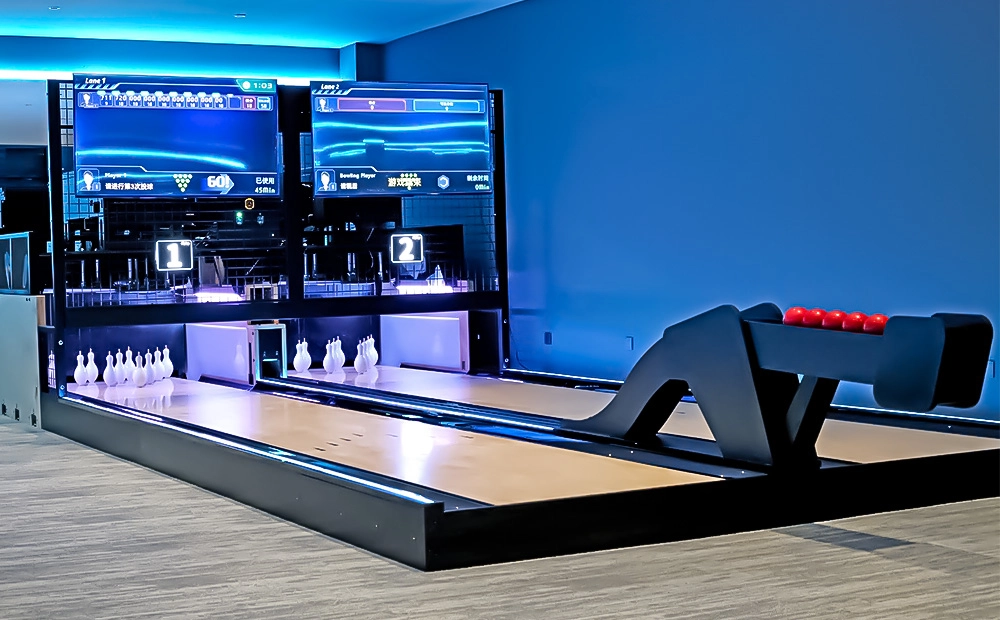
Flying Smart Duckpin Bowling
The innovative design of Flying Smart Duckpin Bowling (FSDB) makes it perfect for places like bars, billiard halls, and game centers. It makes people want to come back more often and spend more money. FSDB is fun and competitive, so it will become a new focus for social activities.
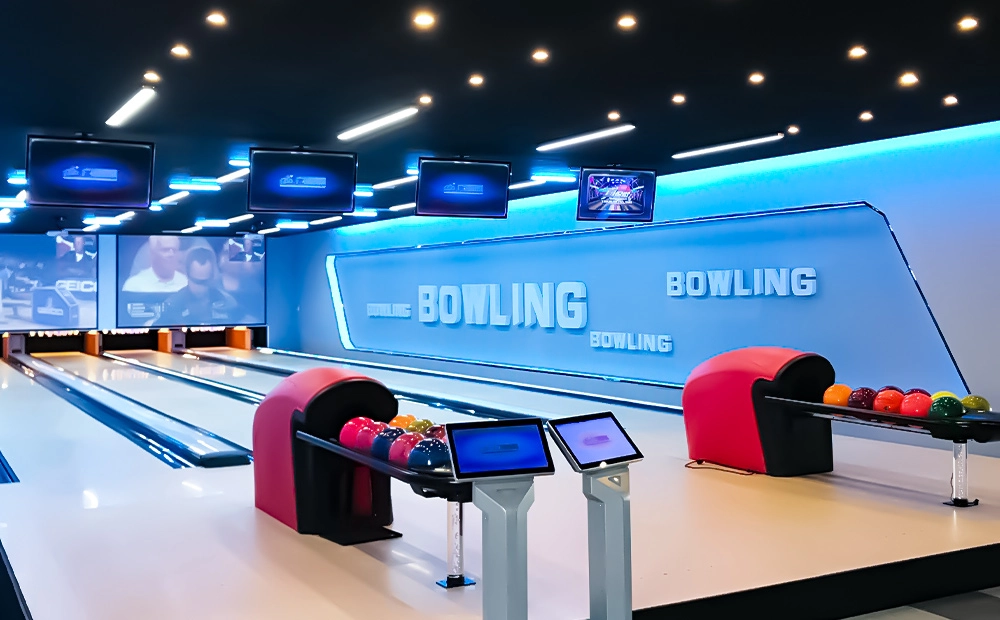
Flying Classic Standard Bowling
Flying Classic Standard Bowling (FCSB) employs the World Standard Competition Scoring System to deliver a more professional bowling experience, enabling bowlers to enjoy a professional-standard match at their convenience.
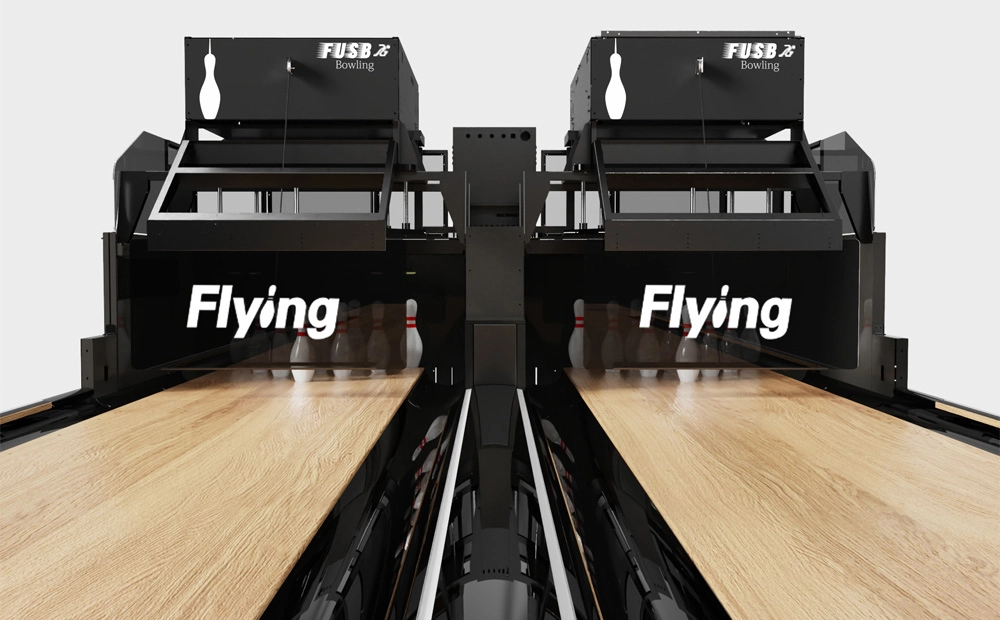
Flying Ultra Standard Bowling
Flying Ultra Standard Bowling (FUSB) Upgraded Version
The string pinsetter uses the latest technology. It offers a more enjoyable bowling experience thanks to its innovative designs and modern technology.

Get in touch
Contact us
If you contact us now for more details, we can provide you with a custom bowling alley service.
Our service team will get back to you within 24 hours, normally!



Professional Bowling Alley Equipment Manufacturer, a one-stop solution provider for bowling alleys.
Facebook
YouTube
Linkedin
Twitter