















The 2026 String Pinsetter Cost Guide: Pricing, ROI & USBC Standards
Investing in string pinsetters is no longer just about the initial price tag; it is a calculation of long-term efficiency and compliance. While the upfront cost ranges from $8,000 for basic models to over $30,000 for high-end USBC-certified units, the drastic reduction in energy consumption and maintenance labor offers a rapid ROI. Whether you are building a boutique home alley or a competitive league center, prioritizing USBC-approved technology ensures your investment remains future-proof in the evolving landscape of 2025.
- The 2026 String Pinsetter Cost Guide: Pricing, ROI & USBC Standards
- The Real Cost of String Pinsetters in 2026
- The Widened Price Spectrum: Entry-Level vs. Premium
- Breakdown of Costs: Beyond the Machine
- Comparing Costs of Major Competitors
- New vs. Used String Pinsetter Costs
- Price Analysis of Refurbished Units
- Hidden Risks: Warranty and Part Availability
- Long-Term Value: Efficiency vs. Savings
- The USBC Certification Factor: Is It Worth the Extra Cost?
- Understanding Post-2023 USBC Standards
- Revenue Through League Play
- PBA Recognition and Venue Reputation
- Operational ROI: String vs. Free-Fall Pinsetters
- Energy Consumption Data
- Maintenance Labor and Spare Parts
- Calculating Break-Even Point (BEP)
- Budgeting for Different Venues: Home vs. Commercial FEC
- Home Bowling Alley Costs
- Large Family Entertainment Centers (FEC)
- Hybrid Centers
- Conclusion
- FAQ
The 2026 String Pinsetter Cost Guide: Pricing, ROI & USBC Standards
The landscape of the bowling industry has shifted firmly toward efficiency and modernization. As we settle into 2026, the debate regarding "real" bowling versus string technology has largely been settled by data, acceptance, and official certification. For venue owners, Family Entertainment Centers (FECs), and home investors, the primary question is no longer "should I switch?" but rather "how much will it cost, and what is the return?"
Understanding the string pinsetter cost involves more than just looking at the sticker price of the machine. It requires a holistic view of installation, USBC compliance, energy consumption, and long-term maintenance. This guide provides a deep dive into the financial and operational realities of investing in string pinsetter technology in 2026.
The Real Cost of String Pinsetters in 2026
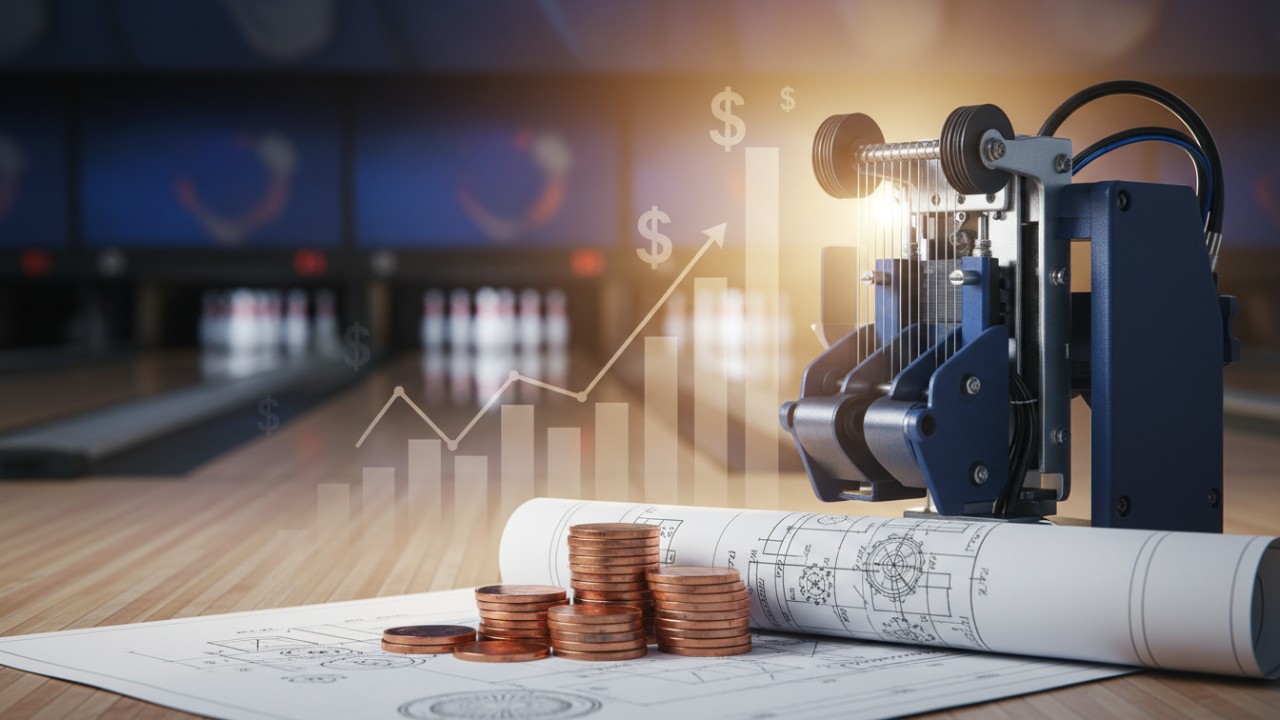
When evaluating a bowling alley equipment investment, the initial capital expenditure is the most visible hurdle. However, in 2026, the market has segmented significantly. Prices are no longer "one size fits all," but rather depend heavily on the intended use—whether for competitive league play or casual entertainment.
The Widened Price Spectrum: Entry-Level vs. Premium
The market for string machines has matured, creating distinct price tiers:
- Entry-Level ($8,000 - $12,000 per lane):
These units are typically targeted at residential installations or small entertainment venues where official certification is not a priority. Often manufactured by smaller competitors or imported, these machines provide the core functionality of resetting pins but may lack advanced scoring integration, heavy-duty durability for high-volume centers, or official USBC certification. - Mid-Range to Premium ($15,000 - $30,000+ per lane):
This category includes USBC approved string pinsetters. These machines are engineered to replicate the pin physics of free-fall machines almost perfectly to meet regulatory standards. The higher price point reflects robust engineering, advanced software compatibility (integrating with BES X or equivalent scoring systems), and extensive warranties. -
Breakdown of Costs: Beyond the Machine
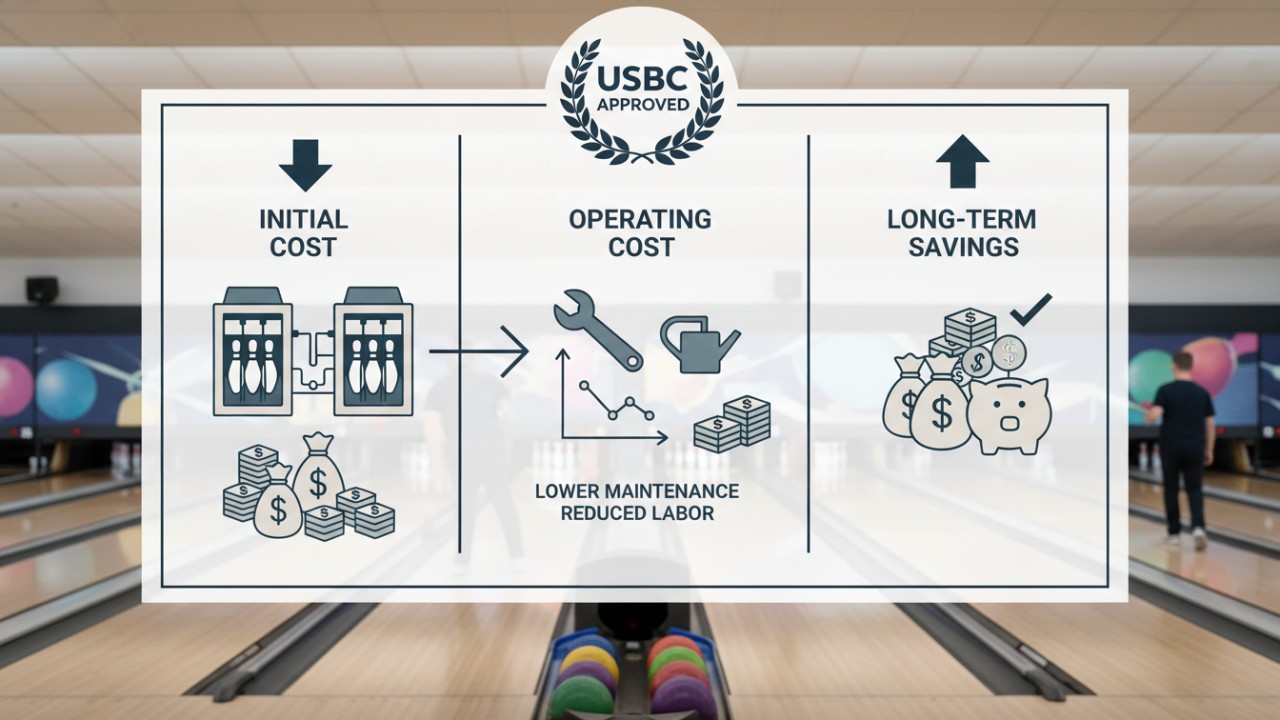
A common mistake in budgeting is assuming the unit price is the final price. A comprehensive budget must include:
- 1. Hardware: The physical pinsetter, pin deck, and ball return system.
- 2. Scoring System Integration: Modern string pinsetters must communicate seamlessly with scoring monitors. 3. Upgrading legacy scoring systems to match new pinsetters can add $3,000 to $5,000 per lane.
- 3. Shipping & Logistics: Due to the weight of the equipment, freight costs can be significant, especially for international shipments from major manufacturing hubs.
- 4. Installation Labor: Unlike plug-and-play appliances, string pinsetters require certified installers. While installation is faster than free-fall machines, it still accounts for roughly 10-15% of the total project cost.
Comparing Costs of Major Competitors
In 2026, three main players dominate the conversation, each with a different value proposition:
- QubicaAMF EDGE String: Often sits at the top of the price range (Premium). Known for its robust "Tech Wizard" app and high-end aesthetic, it commands a higher price but offers an extensive support network.
- Brunswick Boost ST: A direct competitor in the premium space, offering excellent durability and cloud-based management features. Pricing is generally competitive with QubicaAMF.
- Fly Bowling: An increasingly popular choice for those seeking a balance between cost and performance. Fly Bowling often provides a more aggressive price point for hardware that rivals the big two in durability and functionality, making them a strong contender for independent centers looking to maximize ROI.
New vs. Used String Pinsetter Costs
As string technology has been prevalent for over a decade now, a secondary market for used equipment has emerged. However, buying used requires a careful calculation of risk versus reward.
Price Analysis of Refurbished Units
Refurbished string pinsetters can generally be acquired for $5,000 to $8,000 per lane. This represents a 40-60% savings compared to new premium models. These units are often pulled from centers that are upgrading or closing down. While the upfront savings are attractive, the "total cost of ownership" often creeps up due to older technology.
Hidden Risks: Warranty and Part Availability
The primary downside of used equipment is the lack of a manufacturer's warranty. In 2026, new machines typically come with 2-3 year bumper-to-bumper warranties. A used machine leaves you vulnerable to immediate repair costs. Furthermore, earlier generations of string pinsetters (pre-2023) may not meet current USBC approved string pinsetters standards, rendering them ineligible for league play.
Long-Term Value: Efficiency vs. Savings
Newer models feature upgraded string materials (tangle-free technologies) and more efficient motors (24v DC vs older AC motors). The efficiency gains of new technology often outweigh the upfront savings of a used unit within 3 to 5 years. If your business model relies on high-volume traffic, the downtime associated with older, used machines can result in lost revenue that exceeds the price of a new unit.
The USBC Certification Factor: Is It Worth the Extra Cost?
Following the landmark decision in August 2023, the United States Bowling Congress (USBC) officially certifies specific string pinsetter models for competition. In 2026, this certification is a critical factor in pricing.
Understanding Post-2023 USBC Standards
To achieve certification, manufacturers had to modify string lengths, curtain positions, and pinsetter cycling speeds to ensure the "pin fall" data statistically matched free-fall machines. R&D costs to achieve this compliance are baked into the price of certified machines. Non-certified machines are cheaper because they do not adhere to these strict engineering tolerances.
Revenue Through League Play
Why pay more for certification? The answer is recurring revenue. League bowlers are the backbone of steady income for many centers, providing guaranteed foot traffic on weeknights. By installing USBC approved string pinsetters, a center retains its ability to host sanctioned leagues and tournaments.
PBA Recognition and Venue Reputation
With the Professional Bowlers Association (PBA) acknowledging string pinsetter events, the stigma surrounding the technology has evaporated. A venue boasting "USBC Certified Lanes" commands a higher reputation. It signals to serious bowlers that your equipment is tournament-grade, allowing you to charge premium prices for lane rentals compared to a generic "entertainment-only" venue.
Operational ROI: String vs. Free-Fall Pinsetters
This is where the math becomes undeniable. While the initial purchase price of string machines is comparable to (or slightly lower than) new free-fall machines, the string vs free-fall pinsetter ROI is drastically different when looking at operational expenditure (OpEx).
Energy Consumption Data
Traditional free-fall pinsetters are energy hogs, often running large 3-phase motors continuously. In contrast, string pinsetters utilize "on-demand" power.
- Free-Fall: Can consume 800-1000 kWh per lane annually.
- String: Consumes roughly 80-100 kWh per lane annually.
- Result: A reduction in power bills by up to 70-80%. For a 20-lane center, this translates to thousands of dollars in pure profit annually.
Maintenance Labor and Spare Parts
This is the single biggest differentiator.
- Mechanic: Free-fall machines require a specialized "B-Mechanic" or "A-Mechanic," whose salaries in 2026 can range from $60,000 to $90,000+. String pinsetters can be maintained by standard staff with minimal training.
- Parts: A traditional machine has over 2,000 moving parts. A string machine has fewer than 100.
- Comparison: To see a detailed breakdown of the mechanical differences and how they impact your bottom line, reviewing the technical comparison of String Pinsetter vs Free-Fall technology is essential for any investor finalizing their business plan.
Calculating Break-Even Point (BEP)
Because of the operational savings (approx. $5,000 - $8,000 savings per lane/year in maintenance and energy), the break-even point for replacing a free-fall machine with a string machine is often reached in 18 to 24 months. After this period, the operational savings contribute directly to net profit.
Budgeting for Different Venues: Home vs. Commercial FEC
Your bowling alley equipment investment strategy must align with your specific venue type.
Home Bowling Alley Costs
For residential installers, the string pinsetter cost is often lower because USBC certification is rarely required.
- Space: Home models are compact, requiring shorter back-ends (as little as 4-5 feet compared to 8+ feet for traditional).
- Power: Many run on standard residential 110v/220v power, eliminating the need for expensive electrical retrofits.
- Budget: A complete home lane (pinsetter, lane surface, scoring) typically costs between $35,000 and $55,000 (turnkey), with the pinsetter portion being roughly $10,000 of that total.
Large Family Entertainment Centers (FEC)
FECs benefit from volume pricing.
- Volume Discounts: Ordering 20+ lanes often secures a discount of 10-15% per unit.
- Maintenance Contracts: Commercial venues should budget for annual service contracts, though these are significantly cheaper than paying a full-time mechanic.
- Durability: FECs must prioritize heavy-duty, commercial-grade string pinsetters capable of handling thousands of frames per week without tangling.
Hybrid Centers
A trend in 2026 is the "Hybrid Center." Some proprietors keep 8-10 lanes of traditional free-fall for "purist" leagues and convert the remaining 20 lanes to string for open play and parties. This balances the string vs free-fall pinsetter ROI by reducing costs on the majority of lanes while maintaining tradition for a specific customer niche.
Conclusion
Investing in string pinsetters is no longer just about the initial price tag; it is a calculation of long-term efficiency and compliance. While the upfront cost ranges from $8,000 for basic models to over $30,000 for high-end USBC-certified units, the drastic reduction in energy consumption and maintenance labor offers a rapid ROI.
The industry in 2026 has validated this technology. Whether you are building a boutique home alley or a competitive league center, prioritizing USBC-approved technology ensures your investment remains future-proof. By moving away from the complex, high-maintenance mechanics of the past, venue owners secure a business model that is sustainable, profitable, and ready for the modern bowler.
FAQ
How much does a string pinsetter cost in 2026?
The cost varies by model and features. Entry-level units typically range from $8,000 to $12,000, while premium USBC-approved commercial models range from $15,000 to $30,000 per lane, including installation and scoring integration.
Are string pinsetters approved by the USBC?
Yes, as of August 2023, the USBC certifies specific string pinsetter models for standard league and tournament play, provided they meet strict technical specifications regarding string length and pin physics.
What is the ROI difference between string and free-fall pinsetters?
String pinsetters generally offer a faster ROI due to 75% fewer moving parts, significantly lower energy consumption (often using 1/10th the power), and reduced need for a specialized mechanic, leading to operational savings of thousands of dollars annually per lane.
Is a string pinsetter cheaper for a home bowling alley?
Yes, string pinsetters are the preferred choice for home alleys because they require less space, run on standard power, operate more quietly, and are significantly cheaper to maintain than traditional free-fall machines.
Buying Quality Bowling Equipment
Customer care
My room is only about 50 or 60 feet long. How short is too short" for bowling lanes?
That depends on what each person likes. It's like asking how low we can put a basketball goal so that it's still fun. If your bowlers are mostly kids or people who haven't bowled much, they might not mind extremely short lanes. But serious league and tournament bowlers won't like a lane that isn't the normal size.
Service
Do you provide regular maintenance services?
You can sign an annual maintenance agreement, which includes quarterly inspections, lubrication maintenance, system upgrades and other services.
Company
Do you have internationally certified production qualifications?
Our factory has passed ISO 9001 quality management system certification, and our products meet ASTM international bowling equipment standards.
Products
What material is used for the bowling lane? How long is its lifespan?
It is made of high-strength maple wood + synthetic composite material, and has been treated with anti-corrosion. Under normal use, its lifespan exceeds 15 years.
Can I choose the color and brand logo of the equipment?
Personalized customization is supported, including lane color, LOGO, theme lighting system, etc.
Flying Smart Duckpin Bowling
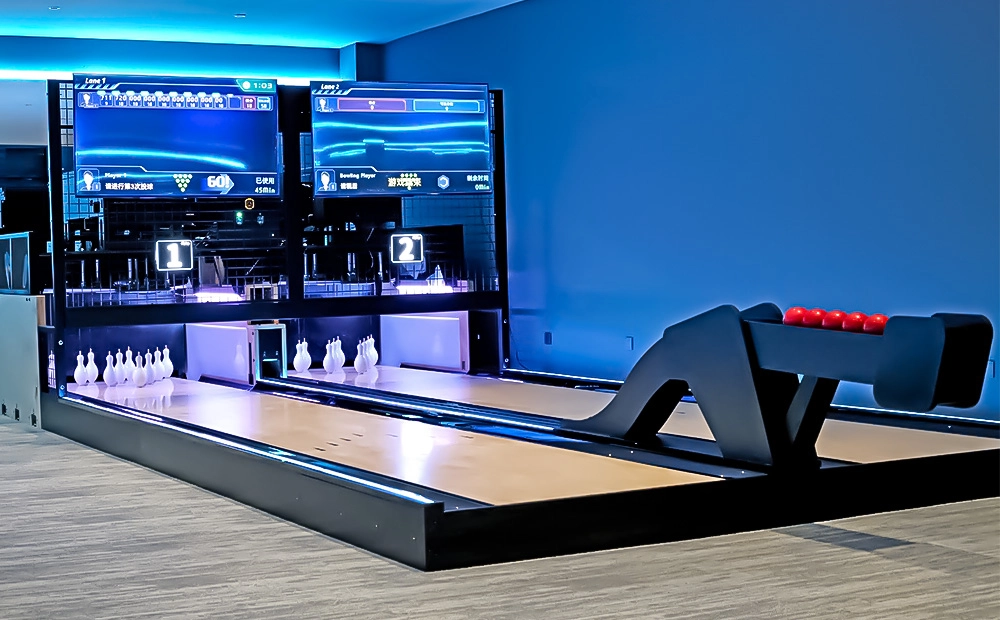
The innovative design of Flying Smart Duckpin Bowling (FSDB) makes it perfect for places like bars, billiard halls, and game centers. It makes people want to come back more often and spend more money. FSDB is fun and competitive, so it will become a new focus for social activities.
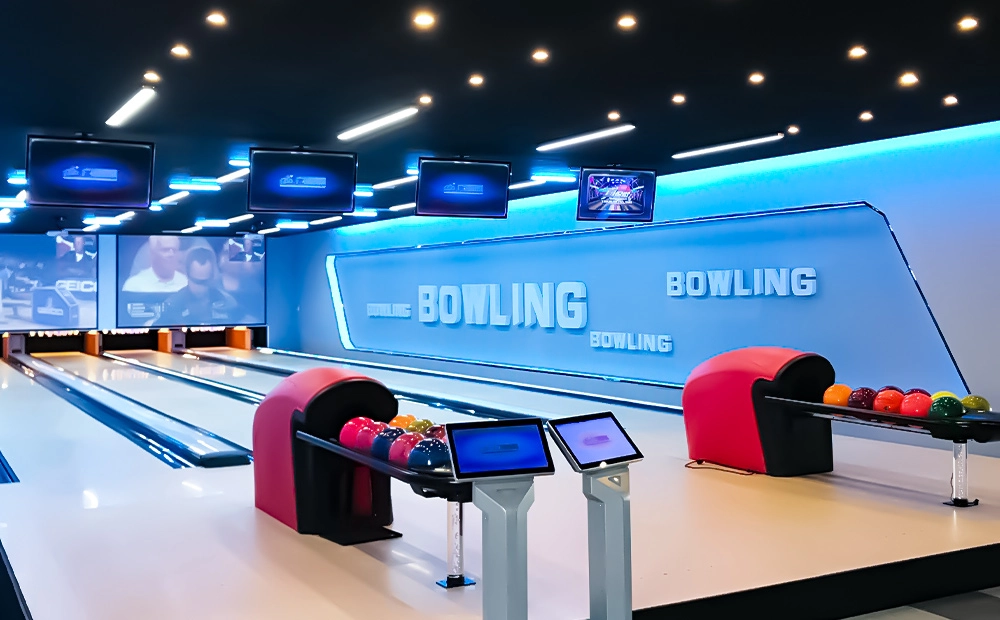
Flying Classic Standard Bowling
Flying Classic Standard Bowling (FCSB) employs the World Standard Competition Scoring System to deliver a more professional bowling experience, enabling bowlers to enjoy a professional-standard match at their convenience.
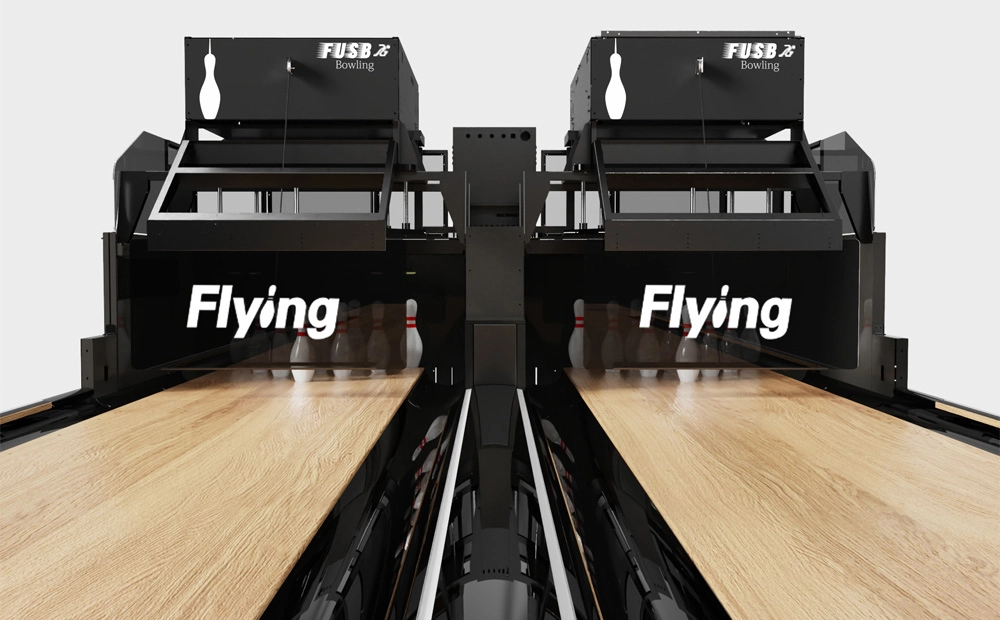
Flying Ultra Standard Bowling
Flying Ultra Standard Bowling (FUSB) Upgraded Version
The string pinsetter uses the latest technology. It offers a more enjoyable bowling experience thanks to its innovative designs and modern technology.
Ready to Build Your Bowling Center?
Share your details, and we’ll provide tailored solutions and expert guidance to help you take your bowling center to the next level.

Professional Bowling Alley Equipment Manufacturer, a one-stop solution provider for bowling alleys.
Facebook
YouTube
Linkedin
Twitter