














How much does it cost to Build a Bowling Alley in Switzerland | Flying Bowling Expert Guide

Thursday, June 11, 2026
Explore the essential considerations for building a bowling alley in Switzerland, including cost estimates, equipment requirements, and procurement strategies.

Building a Bowling Alley in Switzerland: Costs and Equipment Guide 2026

A practical planning reference for investors and operators considering a bowling facility project in Switzerland.

Sources: Construction cost benchmarks from Alpine Excellence Switzerland (BKP/CRB data, February 2026) and Swiss Federal Statistics Office Construction Price Index (bfs.admin.ch, June 2025). VAT rates from Swiss Federal Tax Administration (estv.admin.ch, 2025). Market data from Bowling Switzerland Inc. and Swiss Bowling Federation. Real project reference from Zug4You verified report on Cherry Bowl renovation, 2022.

Quick Answer: How Much Does a Bowling Alley Cost in Switzerland?

A bowling alley project in Switzerland usually requires a significantly higher budget than most European markets. A small boutique conversion with 4–6 lanes can require approximately CHF 2.5M–3M, while a mid-size 10–12 lane entertainment center can reach CHF 4.5M–7.5M+, depending on location, building condition, fit-out quality, and equipment specification.

The biggest cost drivers are Swiss construction labor, commercial rent, acoustic requirements, staff costs, and whether the project is a new build or a conversion of an existing retail or industrial space.

1. What Makes Building a Bowling Alley in Switzerland Different?

Switzerland is one of the most expensive construction markets in Europe—and one of the most expensive places in the world to operate a staffed entertainment venue. For investors coming from other European markets, the cost premium affects both the initial construction budget and the long-term operating model.

The governing body for bowling in Switzerland is the Schweizerischer Bowling Verband (SBV), operating through the Bowlez.ch league platform. Active venues hosting sanctioned competitions include Bowling Center Zürich, BSZ in der Beseco Bowlinghalle, and Bowland Lausanne-Vidy. Bowling Switzerland Inc. is one of the primary local suppliers for lane equipment, installation, and venue management services.

High Construction Cost

Swiss commercial fit-out and labor costs are among the highest in Europe, especially in Zurich and Geneva.

Strict Noise Control

Urban and mixed-use projects often require acoustic review and mitigation under Swiss noise protection rules.

Premium Operating Model

Lane pricing is higher than many EU markets, but staffing, rent, and utilities must be modeled carefully.

Switzerland has a modest but stable bowling community. Major cities such as Zurich, Geneva, Basel, and Bern can support commercial venues, but catchment area analysis is essential before committing to a site.

A useful real-world reference is Cherry Bowl in Baar, canton of Zug, which reopened in November 2022 after a prior bankruptcy. The renovation reportedly required approximately CHF 500,000 for 12 new lanes, 10 billiard tables, and food and beverage infrastructure. This is best understood as a light renovation benchmark for an existing facility—not a full new-build cost model.

2. What Does Construction Cost in Switzerland?

Switzerland uses the Baukostenplan (BKP) system, maintained by the Swiss Centre for Rationalisation in Building (CRB), as the standard structure for construction cost estimates. When comparing quotes, always confirm whether the figure covers only BKP 2 building costs or the wider BKP 1–9 project cost scope. The difference can easily amount to 25–35%.

Building Strategy Cost per m² (CHF) Notes
New construction CHF 3,500–5,500/m² Zurich and Geneva sit near the top of the range; Ticino and rural areas may be lower.
Retail or industrial conversion CHF 2,000–3,500/m² Usually the most practical option for new bowling projects.
Renovation of existing venue CHF 1,500–2,800/m² Highly dependent on the building condition and existing bowling infrastructure.

For a 1,500 m² facility, suitable for approximately 8–10 lanes with food and beverage space, a new construction project may require CHF 5.25M–8.25M. A retail conversion may fall closer to CHF 3M–5.25M, before land purchase and pre-opening working capital.

Commercial land in Switzerland varies widely, from roughly CHF 150–2,000/m² depending on canton and location. Most bowling operators lease rather than purchase. In suburban Zurich or Geneva, suitable entertainment spaces may lease for approximately CHF 200–400/m²/year. On a 1,500 m² facility, annual rent of CHF 300,000–600,000 becomes a major fixed cost.

3. What Does Bowling Equipment Cost in Switzerland?

Equipment is sourced primarily through local suppliers such as Bowling Switzerland Inc., European suppliers such as QubicaAMF, and direct-from-manufacturer providers including Flying Bowling. For commercial projects, all equipment should have the required CE documentation and should be evaluated based on purchase cost, installation cost, maintenance cost, and local service support.

Component Cost per Lane (CHF) Notes
Synthetic lane surface CHF 10,000–16,000 20–30 year lifespan; annual conditioning required.
String pinsetter CHF 8,000–12,500 Common for new projects; lower noise and maintenance demand.
Free-fall pinsetter CHF 15,000–25,000+ Traditional system; higher maintenance and technician requirements.
Ball return system CHF 3,000–6,500 Above-ground standard; concealed systems cost more.
Scoring system CHF 4,000–8,500 Touchscreen, mobile integration, and venue management functions.
Furniture and seating CHF 2,500–6,000 Premium lounge seating is more common at Swiss pricing levels.
Installation labor CHF 4,000–9,000 Swiss labor rates are among Europe’s highest.
Total per lane with string pinsetter CHF 35,000–60,000 Equipment plus Swiss installation; excludes building work.

Procurement note: CE certification is required for commercial equipment operated in Switzerland. Request the supplier’s declaration of conformity before signing a purchase agreement. Flying Bowling’s AEROPIN and FCSB systems carry CE certification for European market projects.

String vs. free-fall in Switzerland: String pinsetters are generally the practical choice for new commercial installations. Their noise reduction benefit is especially relevant in Switzerland, where mixed-use urban locations and strict noise protection rules can make acoustic control a decisive factor.

4. What Regulations and Cost Factors Are Specific to Switzerland?

VAT / MWST

Since January 1, 2024, Switzerland has used revised VAT rates following the AHV reform. Bowling lane rental and most services are generally subject to the standard 8.1% rate. Food and non-alcoholic beverages may fall under the reduced 2.6% rate, while construction services generally fall under 8.1%.

Switzerland’s standard VAT rate is much lower than Germany or France, which can be an operating cost advantage compared with EU-based competitors. VAT paid on construction and equipment is generally reclaimable for registered businesses.

Building Permit

A Baubewilligung is filed with the local municipality. Processing times vary by canton. Zurich and Geneva projects may require 3–6 months for commercial entertainment approvals, while smaller cantons may be faster. Permit fees are commonly around CHF 5,000–25,000, depending on scale and municipality.

Noise Protection

Switzerland’s Lärmschutzverordnung (LSV) sets strict noise emission limits. Bowling venues in urban or mixed-use zones may need a Lärmgutachten before permit approval. This assessment typically costs CHF 3,000–10,000, with acoustic mitigation costs added separately.

Restaurant or Bar License

A Gastgewerbebewilligung is required for venues serving food or alcohol. Requirements vary by canton, but the license is generally straightforward compared with many EU markets. Fees commonly range from CHF 200–1,500.

Labor Costs

Switzerland has some of the highest labor costs in Europe. A bowling center employee may cost approximately CHF 55,000–75,000 annually, including employer social contributions. A 10-lane venue open six days per week typically needs at least 3–4 staff members, making annual staffing costs of CHF 400,000–700,000 realistic for a mid-size facility.

5. What Does a Realistic Project Budget Look Like?

The following examples are illustrative all-in budgets excluding land purchase and pre-opening working capital. Add a 10–15% contingency to all estimates.

Project Type Main Cost Items Estimated Budget
Small boutique venue
4–6 lanes, retail conversion
Renovation, equipment, permits, professional fees, basic F&B fit-out ~CHF 2.5M–3M
Mid-size entertainment center
10–12 lanes
Construction or major renovation, equipment, permits, kitchen, AV, lounge areas CHF 4.5M–7.5M+
Existing venue renovation Lane replacement, billiards or entertainment upgrades, F&B improvements Highly variable; Cherry Bowl renovation was reported at CHF 500,000

The Cherry Bowl renovation should not be used as a new-build benchmark. It represents a renovation of an existing facility with infrastructure already in place. A raw-space conversion or ground-up build will cost substantially more.

6. Frequently Asked Questions

```

How much does it cost to build a bowling alley in Switzerland?

A commercial bowling project in Switzerland typically requires CHF 2.5M–7.5M+, depending on lane count, location, building condition, and whether the project is a retail conversion or new construction.

Is it cheaper to renovate an existing building or construct a new bowling center?

Renovating or converting an existing retail or industrial space is usually more cost-effective. Retail conversions generally cost CHF 2,000–3,500/m², compared with CHF 3,500–5,500/m² for new construction.

Are string pinsetters or free-fall pinsetters better for Swiss projects?

For most new Swiss bowling centers, string pinsetters are the preferred choice because they reduce maintenance demand, labor dependency, energy consumption, and noise impact. Free-fall systems are more suitable for traditional league-oriented venues.

What permits are required to open a bowling alley in Switzerland?

Most projects require a Baubewilligung from the municipality. Depending on the concept, operators may also need a Gastgewerbebewilligung for food or alcohol service and a Lärmgutachten for noise compliance.

How long does a bowling alley project take in Switzerland?

A typical project may take 9–18 months from site planning to opening. Timelines depend on permitting, building condition, equipment lead time, construction scope, and canton-specific approval speed.

What is the biggest operating cost for a Swiss bowling center?

Staffing is usually the largest ongoing cost. A mid-size venue can spend CHF 400,000–700,000 annually on wages and employer contributions, followed by rent, utilities, insurance, and equipment maintenance.

```

Planning a Bowling Project in Switzerland?

Flying Bowling manufactures CE-certified string pinsetters, synthetic lane surfaces, ball return systems, and scoring solutions, with European market support for Switzerland and neighboring countries.

For commercial projects, Flying Bowling can provide equipment specifications, CHF-based budget references, preliminary layout support, and project consultation based on your lane count, room dimensions, and venue concept.

Contact Flying Bowling

Quality Bowling

Flying Bowling - Best Bowling Equipment for Arcades Types, Cost & Buying Guide
Best Bowling Equipment for Arcades: Types, Cost & Buying Guide
Flying Bowling - Candlepin vs Duckpin Bowling Rules, Equipment & Key Differences
Candlepin vs Duckpin Bowling: Rules, Equipment & Key Differences
Flying Bowling - Duckpin Bowling Pinsetter How It Works, Cost & Buying Guide
Duckpin Bowling Pinsetter: How It Works, Cost & Buying Guide
Flying Bowling - Are String Pinsetters USBC Approved Costs, Mechanics & Approved Models
Are String Pinsetters USBC Approved? Costs, Mechanics & Approved Models

You May Also Like

Flying Bowling - STRING PINSETTER · AEROPIN-4

AEROPIN: USBC-Certified Commercial Bowling String Pinsetter for High-Traffic Venues

The AEROPIN is Flying Bowling's highest-specification string pinsetter, purpose-built for bowling center investors and operators who cannot afford downtime. Fully USBC-certified (Permit SP-11), it meets the strictest international competition standards while delivering the operational economics that protect your bottom line — a 10,000+ hour MTBF, sub-8-second pin cycle, and 15% lower energy consumption versus traditional systems.

Whether you are breaking ground on a new facility or modernizing an existing center, the AEROPIN integrates into your project as a complete, turnkey solution. Flying Bowling handles equipment supply, lane installation, commissioning, and after-sales support across 40+ countries — so your venue opens on schedule and runs without interruption from day one.

AEROPIN: USBC-Certified Commercial Bowling String Pinsetter for High-Traffic Venues
Flying Bowling - Duckpin bowling is a variation of bowling that uses smaller pins and a smaller ball.

Flying Smart Duckpin Bowling

The innovative design of Flying Smart Duckpin Bowling (FSDB) makes it perfect for places like bars, billiard halls, and game centers. It makes people want to come back more often and spend more money. FSDB is fun and competitive, so it will become a new focus for social activities.
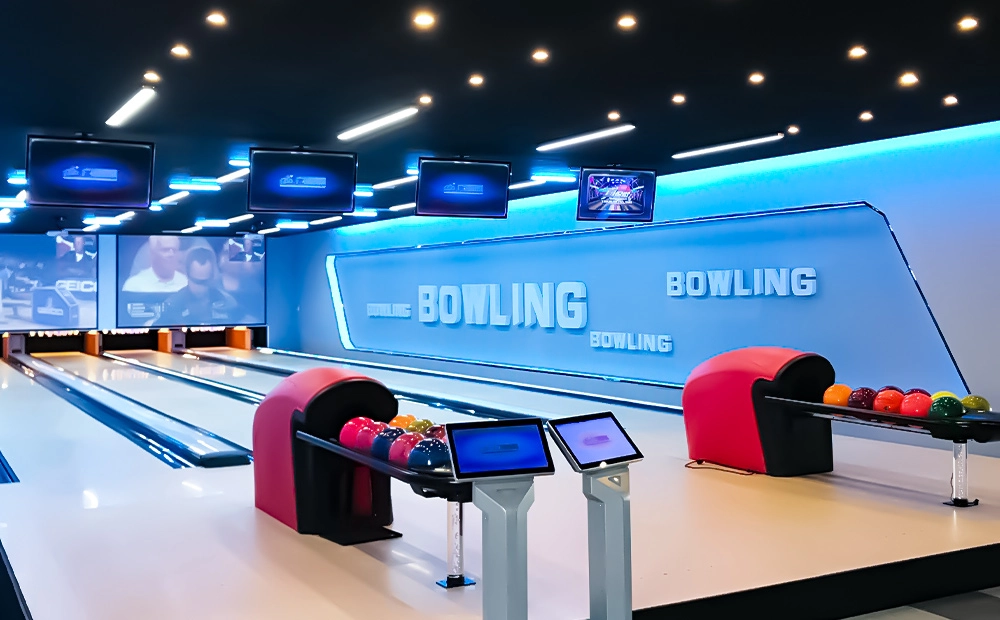
Flying Smart Duckpin Bowling
Flying Bowling - Standard Bowling Equipment Near me

Flying Classic Standard Bowling

Flying Classic Standard Bowling (FCSB) employs the World Standard Competition Scoring System to deliver a more professional bowling experience, enabling bowlers to enjoy a professional-standard match at their convenience.
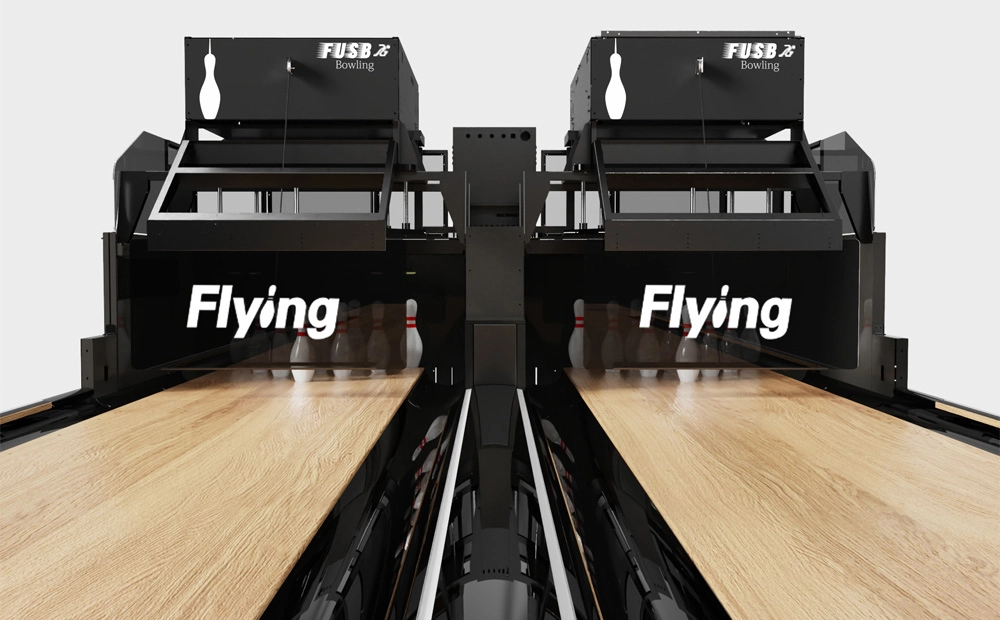
Flying Classic Standard Bowling
Flying Bowling - 8

Get in touch

Contact us

If you contact us now for more details, we can provide you with a custom bowling alley service.

Our service team will get back to you within 24 hours, normally!

Name must not exceed 100 characters.
Please enter a valid phone number!
Invalid email format or length exceeds 100 characters. Please re-enter.
Company Name must not exceed 150 characters.
Project Details must not exceed 3000 characters.

Let's Get Started

See for yourself. Book your personalized Flying Bowling demo today and see how we can elevate your venue!

Flying Bowling - phone (1)

0086 - 150 1310 7020

How can we help?

Hi,

If you are interested in our bowling equipment or have any questions, please be sure to let us know so we can serve you better.

×
Name must not exceed 100 characters.
Please enter a valid phone number!
Invalid email format or length exceeds 100 characters. Please re-enter.
Company Name must not exceed 150 characters.
Project Details must not exceed 3000 characters.

Send my project request

Hi,

If our bowling equipment meets your expectations, please leave me a message to get the best quote and product information.

×
Name must not exceed 100 characters.
Please enter a valid phone number!
Invalid email format or length exceeds 100 characters. Please re-enter.
Company Name must not exceed 150 characters.
Project Details must not exceed 3000 characters.

Build a center

Hi,

If you have a new project coming up or an old project that needs to be remodeled, or are interested in or have any questions about our bowling equipment, be sure to let us know so we can better serve you.

Name must not exceed 100 characters.
Please enter a valid phone number!
Invalid email format or length exceeds 100 characters. Please re-enter.
Company Name must not exceed 150 characters.
Project Details must not exceed 3000 characters.
×