


How much does it cost to Build a Bowling Alley in Germany | Flying Bowling Expert Guide

Thursday, June 11, 2026
Explore the essential considerations for building a bowling alley in Germany, including construction costs, equipment procurement, and operational insights to ensure a successful venture.


A practical planning reference for investors and operators considering a bowling facility project in Germany.

Sources: Construction cost benchmarks from Statistisches Bundesamt (Destatis) and EUROCONSTRUCT (2024–2025). GEMA fee structure from gema.de Tarif WR-Bowl. Regulatory requirements from Bundesverband Bowling e.V. (bowlingverband.de) and DKB (kegelnundbowling.de). Equipment pricing aligned with QubicaAMF, Brunswick, and Flying Bowling European market rates.


1. What makes building a bowling alley in Germany different from other markets?

Germany has one of Europe's largest and most organized bowling communities. The sport is governed by two main bodies: the Deutscher Kegler- und Bowlingbund (DKB) for competitive and club bowling, and the Bundesverband Bowling e.V. (based in Regensburg), which represents venue operators and the bowling industry. The DBV (Deutscher Bowling Verband) is described as Europe's largest recreational bowling association. Understanding this structure matters for licensing and sanctioning requirements.

Several factors make the German market distinct:

High construction and labor costs. Germany is among the most expensive construction markets in Europe. Destatis data for 2024 shows residential construction running €2,510/m² on average; commercial entertainment-grade fit-out runs higher, typically €2,000–€3,200/m² depending on specification and region. Munich and Frankfurt command a 20–30% premium over the national average; eastern German cities (Leipzig, Dresden) run 15–20% below it.

GEMA music licensing — a Germany-specific cost. GEMA (Gesellschaft für musikalische Aufführungs- und mechanische Vervielfältigungsrechte) is Germany's music rights collection society. Unlike most countries where background music licensing is straightforward, Germany has a dedicated tariff specifically for bowling venues: Tarif WR-Bowl (gema.de). Under this tariff, operators pay an annual fee based on the total floor area of the bowling facility. Radio playback is free under the tariff; DJs or live music events trigger separate event-based fees. Operators who are members of the Bundesverband Bowling benefit from a collective agreement discount. Ignoring GEMA is not an option — enforcement is active and non-compliance triggers a 100% surcharge plus potential legal action.

19% MwSt (VAT). Germany's standard VAT rate (Umsatzsteuer/Mehrwertsteuer) is 19%, applying to construction services, most equipment, and bowling lane revenue. Unlike Finland where bowling is classified as a sports service with a reduced rate, German bowling lane revenue is generally subject to the standard 19% rate. Food and non-alcoholic beverages are taxed at 7%; alcoholic beverages at 19%. These rates affect both your construction budget (VAT on contractor invoices is reclaimable for VAT-registered businesses) and your revenue model.

Lärmschutz (noise protection law). Germany's Bundesimmissionsschutzgesetz (BImSchG) and TA Lärm (Technical Instructions on Noise Abatement) set strict limits on noise emissions. Bowling centers in mixed-use or residential areas must commission a noise impact assessment (Schallgutachten) before construction approval. This adds €3,000–€10,000 in assessment costs and often requires substantial acoustic investment in walls, ceilings, and floor decoupling — particularly for venues adjacent to housing.


2. What does construction cost in Germany?

Building Strategy Cost per m² Notes
New construction (entertainment-grade) €2,000–€3,200/m² Munich/Frankfurt: add 20–30%
Retail/industrial conversion €1,200–€2,000/m² Most common path for new projects
Major renovation of existing venue €800–€1,500/m² Depends heavily on existing condition

For a 1,500 m² facility (approximately 8–10 lanes plus F&B):

  • New build: €3M–€4.8M in construction
  • Retail conversion: €1.8M–€3M

Land costs vary dramatically by location. German building land averaged €218/m² nationally as of 2023 (Statistisches Bundesamt), but this national average conceals enormous regional variation. Commercial land in Munich city limits runs €1,500–€4,000/m²; equivalent sites in Leipzig or Erfurt run €100–€400/m². Most bowling center operators in Germany lease rather than purchase — commercial lease rates for suitable entertainment spaces in suburban areas run approximately €10–€25/m²/month.

Total project budget estimates (equipment + construction, excluding land and pre-opening working capital):

  • Small boutique (4–6 lanes, conversion, leased): €900,000–€1.8M
  • Mid-size FEC (8–12 lanes, conversion or new build): €2M–€5M
  • Large traditional center (16–24 lanes, new construction): €4.5M–€10M+

Add 10–15% contingency to all estimates. Always.


3. What does equipment cost in the German market?

Equipment pricing for Germany is quoted in euros and sourced primarily from European distributors. Brunswick's European distribution operates out of Germany; QubicaAMF's European headquarters is in Italy with German market coverage; Flying Bowling supplies directly to German operators with CE-certified equipment.

Component Cost Per Lane (€) Notes
Synthetic lane surface €9,000–€14,000 20–30 yr lifespan
String pinsetter (new) €7,500–€11,000 QubicaAMF Frameworx, Flying AEROPIN
Free-fall pinsetter (new) €14,000–€23,000+ Brunswick GS Series
Ball return system €2,800–€5,500 Above-ground standard
Scoring system €3,700–€7,500 Touchscreen, mobile integration
Furniture and seating €1,800–€4,500 Standard to premium lounge
Total per lane (string pinsetter) €27,000–€50,000 Equipment + installation labor

String vs. free-fall in the German market: String pinsetters dominate new commercial installations across Germany, as they do elsewhere in Europe. The DKB and World Bowling have approved string pinsetters for sanctioned competition, removing the main barrier to adoption. Annual maintenance for string systems runs €200–€600/lane; free-fall systems require €1,500–€3,500/lane and a technician with certified training — Brunswick's German service network can provide this, but response time and cost vary by region.

CE certification is non-negotiable in Germany. All commercial bowling equipment operated in Germany must carry the CE mark, confirming compliance with EU machinery directive (Maschinenrichtlinie 2006/42/EG) and relevant safety standards. Flying Bowling's AEROPIN and FCSB carry CE certification. Request CE declaration of conformity (Konformitätserklärung) from any supplier before purchasing.


4. What are the regulatory and licensing requirements in Germany?

Business registration (Gewerbeanmeldung): Required before commencing operations. Filed with the local Gewerbeamt (trade office) of your municipality. Processing time: 1–3 weeks. Cost: approximately €20–€65 depending on municipality.

Building permit (Baugenehmigung): Required for new construction and significant renovation. Filed with the local Bauordnungsamt. Processing time varies significantly by municipality — Berlin and Munich are notoriously slow (4–12 months); smaller municipalities are typically faster (6–10 weeks). Budget €5,000–€20,000 in permit fees for a commercial entertainment project; more in complex cases.

Noise impact assessment (Schallgutachten): Required in most municipalities for entertainment venues, especially those adjacent to residential areas. Commission an accredited acoustics engineer (Sachverständiger für Schallschutz). Cost: €3,000–€10,000 for the assessment; mitigation measures (acoustic panels, floating subfloor, wall damping) are additional and can add €20,000–€80,000 depending on the building's existing condition.

Gaststättenkonzession / alcohol license: Germany's Gaststättengesetz (restaurant law) has been devolved to individual Länder, and requirements vary. Most states require a Gaststättenerlaubnis (restaurant permit) for premises serving alcohol. Cost and processing time vary by Land — Bavaria and Baden-Württemberg have stricter requirements than northern German states. Engaging a local Gastgewerbe attorney (€2,000–€5,000) is worthwhile for venues planning significant F&B operations.

GEMA registration (Tarif WR-Bowl): Register with GEMA at gema.de before the venue opens. Annual fees under Tarif WR-Bowl are calculated on total floor area; members of Bundesverband Bowling e.V. receive a collective agreement discount. Failure to register triggers enforcement action and a 100% surcharge on backdated fees.

DKB/DBV affiliation (optional but recommended for league operations): Venues seeking to host sanctioned competition must be affiliated with the relevant Land bowling association under the DKB. This is not required for purely recreational/FEC operations.


5. What are the ongoing operational costs in Germany?

Staffing is the largest ongoing cost and is higher in Germany than in most non-EU markets. The statutory minimum wage (Mindestlohn) was €12.82/hour in January 2025; actual wages for experienced hospitality and entertainment staff are typically €14–€20/hour. Employer social contributions (Sozialabgaben) add approximately 20–21% on top of gross wages. A 10-lane venue open 12 hours/day needs a minimum of 3–4 staff per shift. Expect annual staffing costs of €350,000–€650,000 for a mid-size facility.

Energy costs in Germany remain elevated after the 2021–2022 energy crisis. Industrial and commercial electricity prices have moderated from their 2022 peaks but remain among the highest in the EU. Budget €3,000–€12,000/month for electricity and heating depending on venue size and energy efficiency. District heating (Fernwärme) is available in most German cities and typically more cost-effective than gas or electric heating for large commercial spaces.

Equipment maintenance:

  • String pinsetter: €200–€600/lane/year
  • Free-fall pinsetter: €1,500–€3,500/lane/year (Brunswick service network available nationwide)
  • Lane conditioning (oil and cleaner): €500–€1,200/lane/year

GEMA annual fee (Tarif WR-Bowl): Calculated on total floor area of the bowling facility. Register via gema.de; Bundesverband Bowling members receive the negotiated collective agreement rate.

Insurance: Commercial liability (Betriebshaftpflicht) and property insurance for a bowling and entertainment venue in Germany: approximately €15,000–€45,000/year depending on coverage, venue size, and whether alcohol is served.


6. Key differences: Germany vs. a US or UK bowling project

Factor Germany USA (typical)
Construction cost €2,000–€3,200/m² (high) $150–$300/sq ft (variable)
Music licensing GEMA Tarif WR-Bowl (mandatory, specific to bowling) BMI/ASCAP flat blanket license
VAT on lane revenue 19% State sales tax (varies)
Alcohol licensing Gaststättenkonzession (Land-level, moderate cost) State liquor license ($5,000–$300,000)
Noise regulation TA Lärm (strict, requires Schallgutachten) Local ordinance (varies widely)
Equipment CE requirement Mandatory for all commercial equipment No equivalent federal requirement
Governing body for leagues DKB / DBV USBC

Before you commit capital: key questions for Germany specifically

  • Have you commissioned a Schallgutachten for your target site? Noise compliance can make or break a project in mixed-use locations.
  • Have you verified Baugenehmigung processing times with your target municipality? Timeline variance is extreme across Germany.
  • Is your preferred site zoned for entertainment use (Vergnügungsstätte or Freizeitanlage)? Many commercial zones restrict entertainment venues.
  • Have you confirmed CE certification documentation from your equipment supplier?
  • Have you registered with GEMA under Tarif WR-Bowl and considered Bundesverband Bowling membership for the collective discount?
  • Have you modeled 19% MwSt on lane revenue and its impact on your pricing strategy?

For equipment specifications, CE-certified product documentation, and project consultation for Germany and European market projects, contact Flying Bowling at flybowling.com.

You May Also Like

Flying Bowling - duckpin bowling (3)

Flying Smart Duckpin Bowling

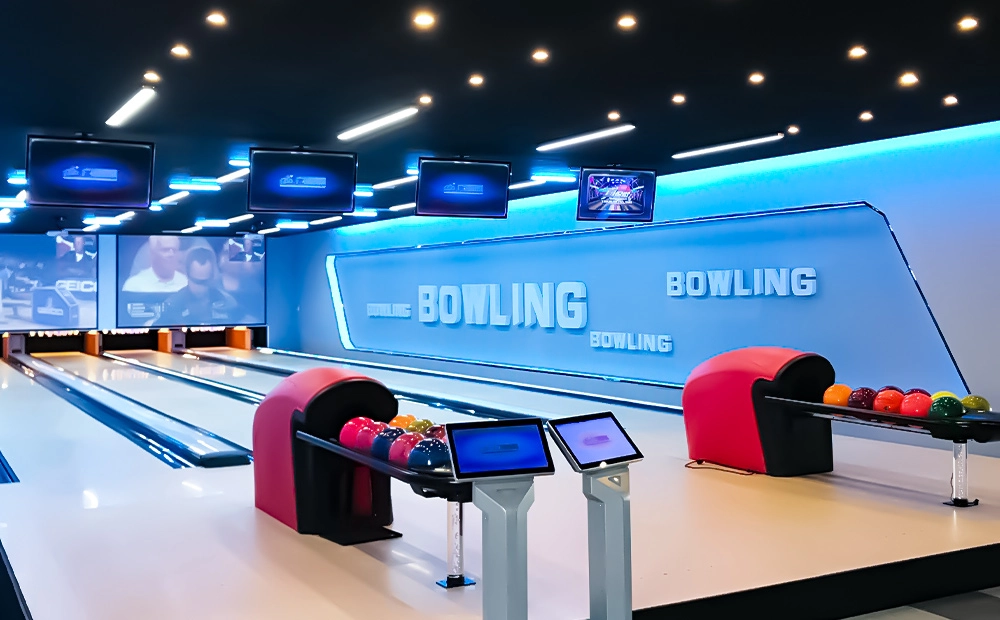
The innovative design of Flying Smart Duckpin Bowling (FSDB) makes it perfect for places like bars, billiard halls, and game centers. It makes people want to come back more often and spend more money. FSDB is fun and competitive, so it will become a new focus for social activities.
Flying Smart Duckpin Bowling
Flying Bowling - Standard Bowling equipment

Flying Classic Standard Bowling

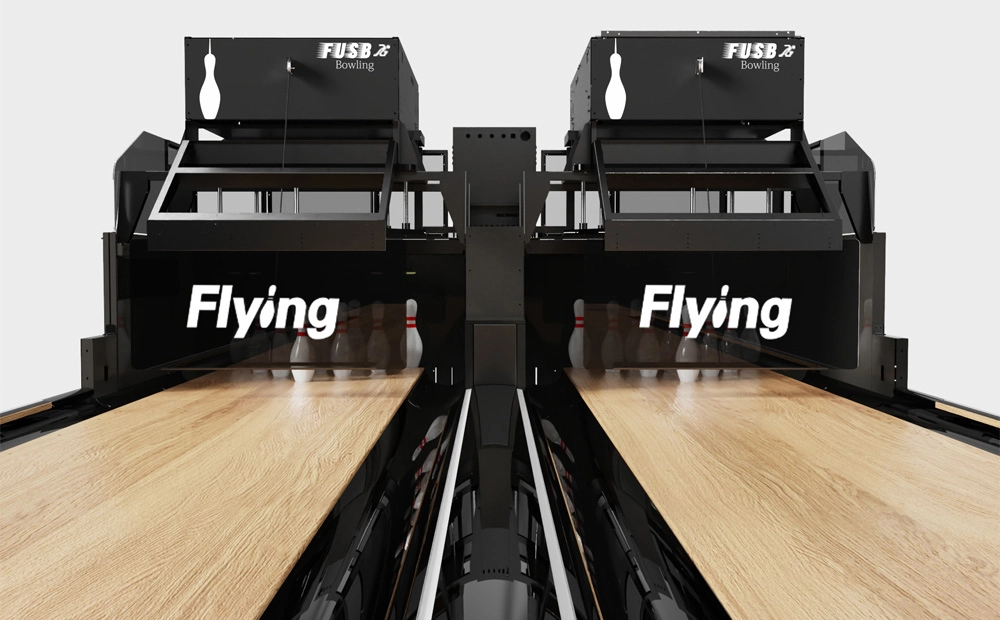
Flying Classic Standard Bowling (FCSB) employs the World Standard Competition Scoring System to deliver a more professional bowling experience, enabling bowlers to enjoy a professional-standard match at their convenience.
Flying Classic Standard Bowling
Flying Bowling - STRING PINSETTER · AEROPIN-4

AEROPIN: USBC-Certified Commercial Bowling String Pinsetter for High-Traffic Venues

The AEROPIN is Flying Bowling's highest-specification string pinsetter, purpose-built for bowling center investors and operators who cannot afford downtime. Fully USBC-certified (Permit SP-11), it meets the strictest international competition standards while delivering the operational economics that protect your bottom line — a 10,000+ hour MTBF, sub-8-second pin cycle, and 15% lower energy consumption versus traditional systems.

Whether you are breaking ground on a new facility or modernizing an existing center, the AEROPIN integrates into your project as a complete, turnkey solution. Flying Bowling handles equipment supply, lane installation, commissioning, and after-sales support across 40+ countries — so your venue opens on schedule and runs without interruption from day one.

AEROPIN: USBC-Certified Commercial Bowling String Pinsetter for High-Traffic Venues
Flying Bowling - 8

Get in touch

Contact us

If you contact us now for more details, we can provide you with a custom bowling alley service.

Our service team will get back to you within 24 hours, normally!

Name must not exceed 100 characters.
Please enter a valid phone number!
Invalid email format or length exceeds 100 characters. Please re-enter.
Company Name must not exceed 150 characters.
Project Details must not exceed 3000 characters.

Let's Get Started

See for yourself. Book your personalized Flying Bowling demo today and see how we can elevate your venue!

Flying Bowling - phone (1)

0086 - 150 1310 7020

How can we help?

Hi,

If you are interested in our bowling equipment or have any questions, please be sure to let us know so we can serve you better.

×
Name must not exceed 100 characters.
Please enter a valid phone number!
Invalid email format or length exceeds 100 characters. Please re-enter.
Company Name must not exceed 150 characters.
Project Details must not exceed 3000 characters.

Send my project request

Hi,

If our bowling equipment meets your expectations, please leave me a message to get the best quote and product information.

×
Name must not exceed 100 characters.
Please enter a valid phone number!
Invalid email format or length exceeds 100 characters. Please re-enter.
Company Name must not exceed 150 characters.
Project Details must not exceed 3000 characters.

Build a center

Hi,

If you have a new project coming up or an old project that needs to be remodeled, or are interested in or have any questions about our bowling equipment, be sure to let us know so we can better serve you.

Name must not exceed 100 characters.
Please enter a valid phone number!
Invalid email format or length exceeds 100 characters. Please re-enter.
Company Name must not exceed 150 characters.
Project Details must not exceed 3000 characters.
×