















How to estimate construction, equipment and soft costs for a new bowling alley
- Planning the Budget for Your New Bowling Venue
- Step 1 — Define scope and its impact on bowling alley cost
- Step 2 — Estimating hard construction costs and their share of bowling alley cost
- Regional drivers of bowling alley cost
- Step 3 — Estimating equipment costs within bowling alley cost
- Step 4 — Soft costs and their treatment in bowling alley cost estimates
- Example: Sample budget and bowling alley cost estimate for a 12-lane center
- Step 5 — Finance, revenue assumptions and payback considerations for bowling alley cost
- Comparing bowling alley cost choices: string pinsetters vs traditional pinsetters
- How to reduce and control bowling alley cost without sacrificing revenue potential
- Flying Bowling — equipment, manufacturing capacity and how we reduce your bowling alley cost
- Practical checklist to finalize your bowling alley cost estimate
- Frequently Asked Questions about bowling alley cost
- Q1: How much does it cost to build one bowling lane?
- Q2: Are string pinsetters a good way to reduce bowling alley cost?
- Q3: What percentage of the total budget should I reserve for contingencies and soft costs?
- Q4: How can I estimate operating revenue to determine if the bowling alley cost is justified?
- Q5: Where can I find reliable construction cost data for my city?
- Q6: Can I phase equipment purchases to reduce initial bowling alley cost?
- References and data sources
Planning the Budget for Your New Bowling Venue
Opening a new bowling center is capital-intensive and requires disciplined cost estimation to avoid surprises. This article explains how to estimate bowling alley cost across construction (hard costs), equipment (lanes, pinsetters, scoring), and soft costs (design, permits, pre-opening). You’ll get practical steps, a worked example budget for a 12-lane center, comparative cost tables, and guidance on contingencies and ROI assumptions. Wherever possible numeric ranges are provided and flagged as estimates — final costs depend on location, local labor and material pricing, product choices and regulatory requirements.
Step 1 — Define scope and its impact on bowling alley cost
Before you can estimate costs, define the project scope clearly. Scope determines land size, number of lanes, ancillary uses (food & beverage, arcade, event spaces), and finish level — all of which materially affect bowling alley cost.
- Number of lanes — primary driver of equipment and operational revenue. Typical new centers: 8–24 lanes.
- Footprint — lanes + circulation + F&B + storage; a 12-lane standard bowling alley typically requires 12,000–18,000 sq ft depending on amenities.
- Quality level — economy fit-out vs. High Quality entertainment center (craft F&B, High Quality seating, upgraded AV) can change costs by 30%+.
Start with a schematic program (lanes, seating, F&B area, back-of-house) and square footage; use that to develop per-square-foot and per-lane estimates.
Step 2 — Estimating hard construction costs and their share of bowling alley cost
Hard costs include land/site work, building shell, structural work, mechanical/electrical/plumbing (MEP), and interior build-out. For bowling centers, the building structure and MEP are a large portion because of long clear spans, high ceilings and specialized ventilation for lanes and food areas.
Typical distribution (percent of total project cost):
| Cost category | Typical % of total project |
|---|---|
| Hard construction (shell, MEP, interior) | 45%–65% |
| Equipment (lanes, pinsetters, scoring, F&B equipment) | 15%–30% |
| Soft costs (design, permits, legal, pre-opening) | 10%–20% |
| Contingency and owner’s reserve | 5%–15% |
Construction cost per square foot varies by region and finish. As an illustrative guide (U.S./Europe, 2025 market context):
| Finish level | Estimated construction cost / sqft |
|---|---|
| Basic economical shell & fit-out | $100–$160 / sqft |
| Mid-range entertainment center | $160–$240 / sqft |
| High Quality build (high-end finishes, AV, kitchens) | $240–$400+ / sqft |
Notes: these ranges include structure, MEP and interior finishes but exclude land acquisition and specialized bowling equipment.
Regional drivers of bowling alley cost
- Local labor rates and union requirements
- Material inflation and supply chain (timber, steel, HVAC)
- Seismic or code requirements that raise structural cost
Use local contractor bids or a local cost database (e.g., RSMeans / Gordian in the U.S.) to refine estimates.
Step 3 — Estimating equipment costs within bowling alley cost
Equipment includes lanes, lane surfaces (wood or synthetic), pinsetters (traditional or string pinsetters), ball return systems, scoring systems, pin decks, lane furniture (approach seating, ball racks), and arcade/F&B kitchen equipment. Equipment is usually budgeted per lane plus a lump sum for shared items (kitchen, POS, seating).
| Equipment item | Typical cost range |
|---|---|
| Lane system & surfacing (per lane) | $8,000–$18,000 |
| Pinsetters (per lane equivalent) — string vs. free-fall | String: $4,000–$8,000; Free-fall: $12,000–$25,000+ |
| Ball return & approach equipment (per lane) | $2,000–$6,000 |
| Scoring & display systems (per lane) | $1,500–$6,000 |
| Furniture & seating (per lane allocation) | $1,000–$4,000 |
| Back-of-house and arcade machines (lump sum) | $50,000–$250,000 |
Per-lane equipment totals typically range from $20,000 (economy, string pinsetter, basic scoring) up to $60,000+ (High Quality free-fall pinsetters, High Quality lane surfaces, advanced displays). Choosing string pinsetters can reduce upfront bowling alley cost and maintenance complexity — an important decision when optimizing capital outlay.
Step 4 — Soft costs and their treatment in bowling alley cost estimates
Soft costs are often overlooked but crucial for realistic budgeting. They include architectural and engineering fees, permits, project management, legal, insurance, financing fees, marketing and pre-opening staff hiring and training.
- Design & engineering: typically 6%–12% of hard construction cost depending on complexity.
- Permits, impact fees: variable; budget from a few thousand to tens of thousands depending on jurisdiction.
- Pre-opening marketing and staffing: $20,000–$150,000 depending on scale.
- Financing & contingency: lenders often require contingency reserves of 5%–10%.
Soft costs are commonly 10%–20% of the total project budget. Treat soft costs as non-negotiable line items when presenting project pro forma to investors or lenders.
Example: Sample budget and bowling alley cost estimate for a 12-lane center
The following worked example shows how to combine the components into a project-level estimate. This is illustrative — adjust for local conditions.
| Item | Assumption / Unit | Amount (USD) |
|---|---|---|
| Land acquisition & site prep | — | $300,000 |
| Building construction (15,000 sqft @ $160/sqft) | 15,000 sqft | $2,400,000 |
| Lane & equipment (12 lanes @ $30,000/lane) | 12 lanes | $360,000 |
| F&B & furniture, POS | — | $180,000 |
| Professional fees (architecture, engineering 8%) | 8% of construction | $192,000 |
| Permits, inspections, insurance | — | $35,000 |
| IT, POS, security, scoring integration | — | $40,000 |
| Pre-opening marketing & training | — | $30,000 |
| Contingency (10%) | 10% of above subtotal | $353,700 |
| Total Estimated Project Cost | — | $3,890,700 |
Per-lane cost in this example is ~ $324,225. That reflects a mid-market finish and conservative contingency. Low-cost builds using string pinsetters and minimal F&B can reduce the total substantially; High Quality entertainment centers (higher F&B investment, boutique finishes) can be much higher.
Step 5 — Finance, revenue assumptions and payback considerations for bowling alley cost
Estimating costs is only half the picture — you must test the business case. Key revenue drivers include lane-hour pricing, occupancy rates, party bookings, food & beverage spend and arcade/attraction revenue.
Example simplified annual revenue model (12-lane example — illustrative):
- Average lane rate: $45/hour
- Average occupancy: 35% annualized
- Operating hours: 14 hours/day, 365 days
- Lane-hours available per year: 12 lanes * 14 * 365 = 61,320 lane-hours
- Paid lane-hours (35% occupancy): 21,462 lane-hours
- Lane income: 21,462 * $45 = $966,000
- F&B & arcade income (conservative): 60% of lane income = $580,000
- Total revenue estimate: ~$1.55M/year
Using operating margin assumptions and debt service, you can derive payback and IRR. Because capital requirements are large, strong revenue growth, ancillary income (parties, leagues, F&B) and cost control are critical to achieving a multi-year payback.
Comparing bowling alley cost choices: string pinsetters vs traditional pinsetters
Choosing pinsetter technology materially affects equipment cost, maintenance, downtime and lifetime operating cost.
| Feature | String pinsetter | Traditional free-fall pinsetter |
|---|---|---|
| Typical upfront cost (per lane) | Lower ($4k–$8k) | Higher ($12k–$25k+) |
| Maintenance complexity | Lower: fewer mechanical moving parts | Higher: requires trained technicians |
| Downtime risk | Lower to moderate | Higher, but proven long-term performance |
| Perception (customer experience) | Near parity; modern string systems closely replicate pin behavior | Traditionalists prefer free-fall |
Decision factors: target market expectations, maintenance capability, capital budget and long-term operating cost forecasts.
How to reduce and control bowling alley cost without sacrificing revenue potential
- Optimize lane count vs. footprint — more lanes increase capital but improve per-minute revenue; find the sweet spot for your trade area.
- Choose string pinsetters where appropriate to lower equipment and maintenance cost.
- Phase F&B expansion — open with a modest offering and scale kitchen investment as demand grows.
- Use standardized modular finishes and prefabricated elements to shorten schedule and reduce labor cost.
- Get multiple equipment quotes and negotiate integrated supply+installation packages.
Flying Bowling — equipment, manufacturing capacity and how we reduce your bowling alley cost
Since 2005, Flying Bowling has been researching and developing the latest and most advanced bowling equipment. We provide everything you need for your bowling alley, from equipment to design and construction. As a leading bowling equipment manufacturer and solutions provider in the domestic industry, we sell over 2,000 lanes a year worldwide, breaking the monopoly on traditional pinsetter equipment, enriching the international market, and offering our customers a wider range of options.
Through Flying's European Division, we have a sales office, permanent showroom, and 24/7 technical support to ensure customized solutions with the highest standards of quality and efficiency. Flying Bowling's European branch specializes in providing localized services to customers in Europe. Our bowling equipment has been certified by major global organizations, including CE and RoHS.
We have a 10,000-square-meter workshop where we make bowling equipment. We make and sell bowling string pinsetters, bowling ball return machine systems, bowling scoring systems, etc.; bowling equipment; and building and modernizing standard and duckpin bowling alleys. Our goal is to become one of the top bowling equipment brands worldwide.
How Flying Bowling affects your bowling alley cost:
- Integrated supply chain and high production volume (2,000 lanes/year) reduce per-lane equipment cost.
- In-house manufacturing (10,000 sqm workshop) improves lead times and quality controls.
- String pinsetter options provide a lower-capital, lower-maintenance alternative to free-fall pinsetters without significant compromise in guest experience.
- European Division presence and 24/7 support reduce post-installation downtime risks and lifecycle costs for operators in Europe.
Visit Flying Bowling for product specifications and case studies: https://www.flybowling.com/
Practical checklist to finalize your bowling alley cost estimate
- Prepare program and schematic design (lanes, F&B, ancillary uses).
- Obtain local construction cost per sqft from a reliable database or local contractors.
- Request equipment proposals (lane systems, pinsetters, scoring) from multiple vendors — include installation and warranty.
- Estimate soft costs (design, permits, legal, insurance) as 10%–20% of project.
- Include contingency 10%–15% depending on schedule and unknown site risks.
- Build a conservative pro forma with multiple occupancy and pricing scenarios to test payback.
Frequently Asked Questions about bowling alley cost
Q1: How much does it cost to build one bowling lane?
A1: Per-lane cost depends on scope. As a rough guide, equipment-only (lanes, pinsetters, ball return, scoring) can range from $20,000 to $60,000 per lane. When you include allocable share of building, F&B, and soft costs, the per-lane capital allocation typically ranges from $150,000 to $350,000 in mid-market projects. These are estimates — get vendor quotes and local construction pricing to finalize.
Q2: Are string pinsetters a good way to reduce bowling alley cost?
A2: Yes. String pinsetters typically have lower upfront cost and simpler maintenance than traditional free-fall pinsetters, which can reduce both initial bowling alley cost and lifecycle maintenance expense. Modern string systems provide a guest experience close to traditional systems, making them a cost-effective option for many operators.
Q3: What percentage of the total budget should I reserve for contingencies and soft costs?
A3: Soft costs commonly represent 10%–20% of total project cost. Contingency depends on project risk; 5%–10% is typical for low-risk projects, while 10%–15% is safer for complex or unverified sites. Combined, set aside 15%–30% on top of hard costs for softs + contingency in most markets.
Q4: How can I estimate operating revenue to determine if the bowling alley cost is justified?
A4: Build a lane-hour model: estimate lane rates, realistic occupancy across weekdays/weekends, and operating hours. Add revenue from F&B, parties, leagues and arcade. Compare projected net operating income against debt service and investor return targets. Use conservative occupancy assumptions initially and model upside scenarios for promotional periods and events.
Q5: Where can I find reliable construction cost data for my city?
A5: Use local contractors/bid packages and national cost databases such as RSMeans/Gordian (U.S.), local building cost indices, or consult a quantity surveyor. Local governmental permitting offices can also advise on fees and typical timelines that affect cost.
Q6: Can I phase equipment purchases to reduce initial bowling alley cost?
A6: Phasing major equipment is challenging because lanes and pinsetters are core to operations. However, you can phase non-essential items (arcade machines, High Quality AV, extended kitchen equipment) to spread capital over time. Ensure any phasing plan does not compromise guest experience or revenue potential.
For tailored project estimates, equipment packages and construction solutions, contact Flying Bowling to discuss options and view product lines and showroom demos: https://www.flybowling.com/
References and data sources
- Bowling alley (overview). Wikipedia. https://en.wikipedia.org/wiki/Bowling_alley. Accessed 2025-12-12.
- BPAA (Bowling Proprietors' Association of America) industry resources. https://www.bpaa.com/. Accessed 2025-12-12.
- IBISWorld — bowling center industry reports (market sizing and trends). https://www.ibisworld.com/. Accessed 2025-12-12.
- RSMeans / Gordian construction cost data. https://www.gordian.com/rsmeans. Accessed 2025-12-12.
- U.S. Bureau of Labor Statistics — local wage and employment data (for labor cost drivers). https://www.bls.gov/. Accessed 2025-12-12.
- European Commission — CE marking information. https://ec.europa.eu/growth/single-market/ce-marking_en. Accessed 2025-12-12.
- European Commission — RoHS directive overview. https://ec.europa.eu/environment/waste/rohs_eee/index_en.htm. Accessed 2025-12-12.
- Flying Bowling — product and company information. https://www.flybowling.com/. Accessed 2025-12-12.
Note: cost numbers in this article are illustrative ranges derived from publicly available industry sources and professional experience in bowling venue development. For a firm budget, obtain local contractor bids, vendor proposals (including Flying Bowling if you want an integrated equipment + install package) and a site-specific feasibility study.
Buying Quality Bowling Equipment
Service
How to complain if you are not satisfied with the after-sales service?
You can directly contact the Global Service Director (email: mike@flyingbowling.com/phone: 0086 18011785867), and we promise to issue a solution within 24 hours.
Is there any training or guidance service to help customers use the equipment better?
Free on-site or remote training, with a Chinese-English bilingual operation manual + fault code quick reference table to help customers use the equipment better.
What are the free cases during the warranty period, and what are the cases that require additional charges?
Covering failures caused by material/workmanship defects, providing free labor and parts repairs; non-quality damage will be charged at cost, and a detailed quotation will be provided for confirmation before repair.
Products
What is the noise level of the equipment?
We are well aware of the importance of a quiet and comfortable environment for bowling, so we designed sound insulation cotton and shock-absorbing pads in the equipment area and the lane area to fully reduce the noise and vibration of the equipment during operation, creating a quiet and comfortable sports space for you, allowing you to focus more on enjoying the fun of bowling.
Company
Do you have internationally certified production qualifications?
Our factory has passed ISO 9001 quality management system certification, and our products meet ASTM international bowling equipment standards.
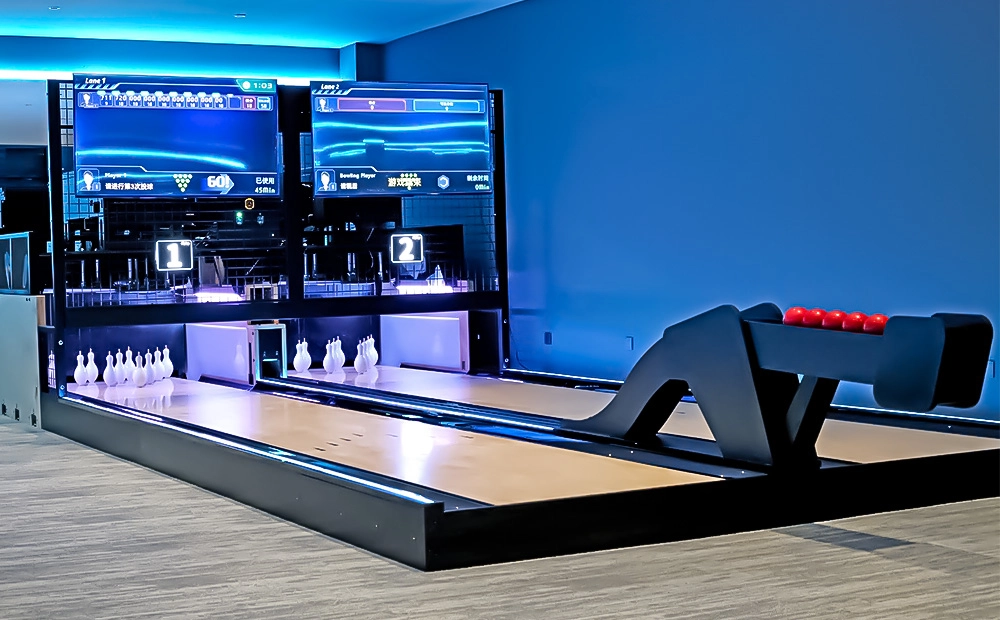
Flying Smart Duckpin Bowling
The innovative design of Flying Smart Duckpin Bowling (FSDB) makes it perfect for places like bars, billiard halls, and game centers. It makes people want to come back more often and spend more money. FSDB is fun and competitive, so it will become a new focus for social activities.
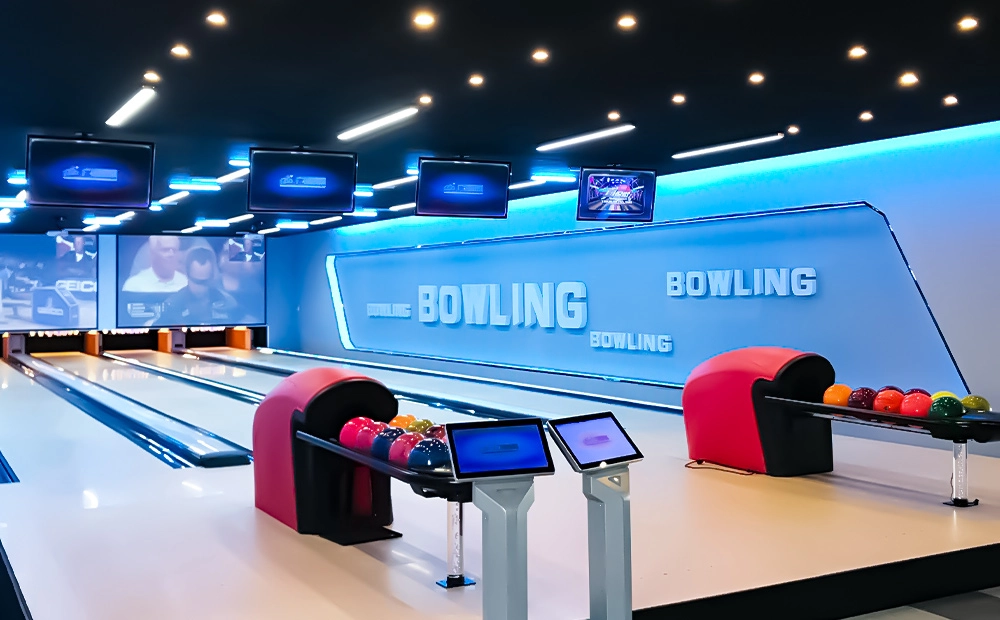
Flying Classic Standard Bowling
Flying Classic Standard Bowling (FCSB) employs the World Standard Competition Scoring System to deliver a more professional bowling experience, enabling bowlers to enjoy a professional-standard match at their convenience.
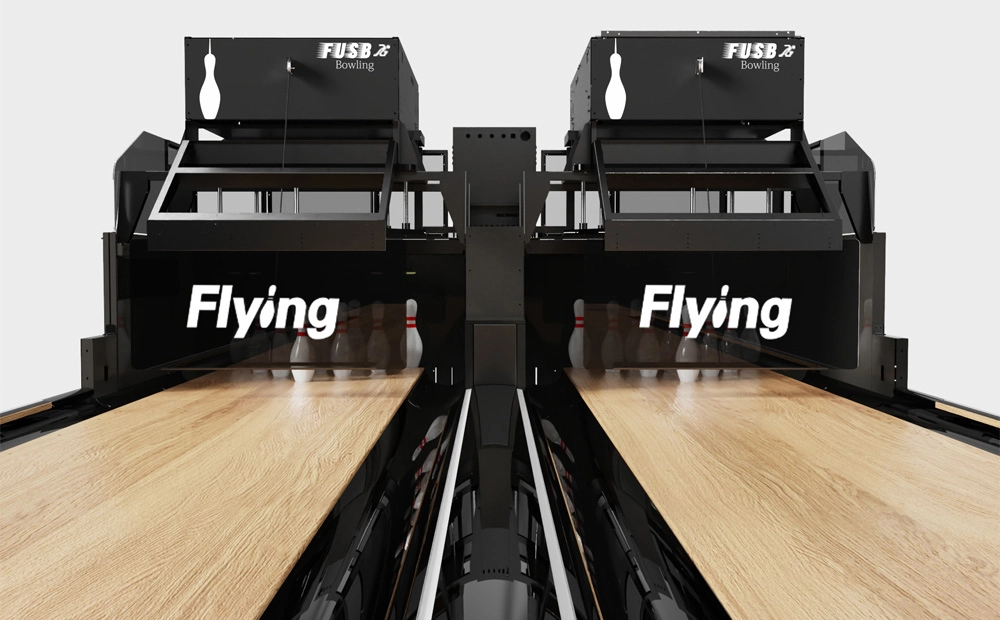
Flying Ultra Standard Bowling
Flying Ultra Standard Bowling (FUSB) Upgraded Version
The string pinsetter uses the latest technology. It offers a more enjoyable bowling experience thanks to its innovative designs and modern technology.
Ready to Build Your Bowling Center?
Share your details, and we’ll provide tailored solutions and expert guidance to help you take your bowling center to the next level.

Professional Bowling Alley Equipment Manufacturer, a one-stop solution provider for bowling alleys.
Facebook
YouTube
Linkedin
Twitter