















How much does it cost to open a bowling alley in 2025? — full startup budget
- Startup Budget Breakdown for a Modern Bowling Center in 2025
- Why a clear bowling alley cost estimate matters before you start
- Overview of what drives bowling alley cost
- Itemized cost breakdown — per-lane and project-level (2025 estimates)
- Sample project-level total budgets (2025)
- Technology choice: string pinsetter vs traditional — impact on bowling alley cost and operations
- Operating assumptions, revenue drivers and breakeven considerations
- Site, lease & construction: what to budget and negotiate
- Financing, incentives and grants
- Why partnering with an experienced bowling equipment manufacturer matters
- Flying Bowling — equipment, credibility and localized support
- Checklist: documents and vendor questions before you commit
- Common negotiation points to reduce bowling alley cost
- FAQs — common reader questions about bowling alley cost (2025)
- 1. How much does it cost to build one bowling lane in 2025?
- 2. Can I open a small 8-lane bowling alley under $500,000?
- 3. Are string pinsetters reliable for commercial use?
- 4. What ongoing costs should I budget for after opening?
- 5. Do I need special permits or licenses?
- 6. How long does construction & installation take?
- 7. What is the return on investment (ROI) timeline for a typical center?
- Contact & next steps — get a precise cost estimate
- References and authoritative sources
Startup Budget Breakdown for a Modern Bowling Center in 2025
Primary keyword: bowling alley cost
Why a clear bowling alley cost estimate matters before you start
Opening a bowling alley is capital intensive and operationally complex. Investors and operators need realistic, verifiable startup numbers so they can secure financing, design a feasible business model, and choose the right equipment (lanes, pinsetters, scoring systems). This guide breaks down every major cost category for 2025, compares technology choices that materially affect cost (string pinsetter vs traditional), and gives sample budgets for small, medium and large projects. All ranges are based on industry references, manufacturer quotes and market checks as of late 2025.
Overview of what drives bowling alley cost
Major drivers of bowling alley cost include:
- Real estate (purchase or leasehold improvements)
- Lane systems, pinsetters and approach installation
- Scoring, automation and AV systems
- Food & beverage and kitchen build-out
- Furniture, fixtures & equipment (FFE)
- Arcade / entertainment add-ons
- Permits, licensing, insurance and professional fees
- Working capital (payroll, marketing, utilities for initial months)
Itemized cost breakdown — per-lane and project-level (2025 estimates)
Below is an industry-practical table with low/typical/high ranges in USD for 2025. Per-lane costs vary by technology choices (string vs traditional pinsetter), lane surface (synthetic vs wood), and region.
| Item | Typical Unit | Low (USD) | Typical (USD) | High (USD) | Notes / Source |
|---|---|---|---|---|---|
| Lane surface & installation | per lane | 10,000 | 16,000 | 25,000 | Synthetic lanes are standard; includes approach and lane finish |
| Pinsetter (string) | per lane | 5,000 | 7,500 | 10,000 | Lower capital, lower maintenance; growing in market (Flying Bowling) |
| Pinsetter (traditional ball/spotter) | per lane | 12,000 | 18,000 | 30,000 | Higher upfront & maintenance costs; legacy systems |
| Ball return & lane machinery | per lane | 1,500 | 3,000 | 5,000 | Includes ball return, pit equipment, lane oiling machine connections |
| Scoring, displays & software | per lane | 1,200 | 2,500 | 4,000 | Includes player displays, kiosk, POS integration |
| Seating & furniture | per lane (share) | 500 | 1,500 | 3,000 | Benches, scorer consoles, retail counters |
| Lighting & AV (cosmic packages) | project | 10,000 | 40,000 | 150,000 | Scale depends on entertainment ambitions |
| F&B kitchen & bar | project | 50,000 | 150,000 | 400,000 | Small cafe vs full-service kitchen |
| Arcade & attractions | project | 20,000 | 100,000 | 500,000 | Depends on size & redemption systems |
| Leasehold improvements / construction | project | 100,000 | 600,000 | 2,000,000 | Highly regional; includes structural changes, bathrooms, HVAC |
| Permits, insurance, legal & design | project | 5,000 | 50,000 | 150,000 | Building permits, liquor license, architect fees |
| Working capital (3–6 months) | project | 50,000 | 250,000 | 750,000 | Payroll, utilities, initial marketing |
Sample project-level total budgets (2025)
Using the table above and typical service choices, here are three practical scenarios you will see in 2025.
| Project | Lanes | Equipment choice | Estimated total cost (USD) |
|---|---|---|---|
| Small community center | 8 lanes | String pinsetters, basic F&B | 250,000 — 750,000 |
| Medium entertainment center | 24 lanes | Mixed (string lanes), full F&B, arcade | 1,200,000 — 4,000,000 |
| Large modern bowling destination | 36–48 lanes | High Quality systems, full-service kitchen, large arcade | 3,000,000 — 8,000,000+ |
Technology choice: string pinsetter vs traditional — impact on bowling alley cost and operations
One of the most consequential decisions for both initial cost and long-term operating cost is whether to install string pinsetters or traditional free-fall pinsetters.
| Factor | String Pinsetter | Traditional Pinsetter |
|---|---|---|
| Upfront cost per lane | Lower (see per-lane ranges above) | Higher |
| Maintenance | Lower parts & labor; easier to source parts | Higher — older tech with specialized repairs |
| Guest perception | Now widely accepted; many leagues and youth centers use them | Traditional preferred by some leagues and competitions |
| Energy & footprint | Typically more energy-efficient | Higher footprint & energy |
Choosing string pinsetters can reduce initial capex significantly and reduce downtime/cost of ownership. For many new-build centers, string systems provide a faster path to profitability.
Operating assumptions, revenue drivers and breakeven considerations
After capex, the next question is “How long until I break even?” Break-even depends on gross margin, lane utilization, and ancillary revenue (F&B, arcade, events). Key metrics to model:
- Average revenue per lane per day (grip on walk-in, parties, leagues)
- Occupancy rate (peak vs off-peak)
- Average spend per customer on food & bev and retail
- Fixed monthly costs (rent, loan servicing, utilities, payroll)
Example simplified model (illustrative):
- 24 lanes, average occupancy 45% over 360 days/year, 6 people per lane rotation, avg spend on bowling per person $6 (game + shoe share) = => substantial revenue, supplemented by F&B and parties.
Because of variability (location, local competition, pricing strategy), operators often build conservative (base case) and aggressive (optimistic) scenarios. Many well-run centers aim to recover initial capex in 4–8 years; smaller venues with low capex can approach breakeven in 2–4 years.
Site, lease & construction: what to budget and negotiate
Real estate is a major variable. Key actions to reduce bowling alley cost:
- Negotiate build-out allowances with landlords — many landlords will fund a portion of specialized improvements
- Choose buildings with existing high ceilings and clear span (minimize structural work)
- Plan HVAC correctly — lane areas require good ventilation and consistent temperature
Typical leasehold improvements can range from modest ($100k) to extensive ($2M+) depending on building condition.
Financing, incentives and grants
Financing options include equipment loans, SBA loans (in the U.S.), landlord financing, and investor equity. Check for local economic development incentives — certain markets offer grants or tax incentives for entertainment destinations that create jobs.
Why partnering with an experienced bowling equipment manufacturer matters
Choosing the right vendor for lanes, pinsetters, scoring, and installation reduces risk and total cost of ownership. Vendors that provide design, installation and aftersales support simplify timelines and help control capex and operational downtime.
Flying Bowling — equipment, credibility and localized support
Since 2005, Flying Bowling has been researching and developing the latest and most advanced bowling equipment. We provide everything you need for your bowling alley, from equipment to design and construction.
As a leading bowling equipment manufacturer and solutions provider in the domestic industry, we sell over 2,000 lanes a year worldwide, breaking the monopoly on traditional pinsetter equipment, enriching the international market, and offering our customers a wider range of options. Additionally, through Flying's European Division, we have a sales office, permanent showroom, and 24/7 technical support to ensure customized solutions with the highest standards of quality and efficiency. Flying Bowling's European branch specializes in providing localized services to customers in Europe.
Our bowling equipment has been certified by major global organizations, including CE and RoHS. We have a 10,000-square-meter workshop where we make bowling equipment. We make and sell bowling string pinsetters, bowling ball return machine systems, bowling scoring systems, etc.; bowling equipment; and building and modernizing standard and duckpin bowling alleys.
Highlights of Flying Bowling advantages:
- Product breadth: string pinsetters, ball return systems, scoring systems, duckpin solutions
- Manufacturing capacity: 10,000 m² workshop enabling faster lead times and QC
- Volume and market reach: >2,000 lanes/year sold globally
- Certifications: CE, RoHS — compliance for international markets
- European Division: localized sales office, showroom and 24/7 technical support
- End-to-end solutions: equipment supply, layout & design, installation and after-sales support
Typical customer benefits from choosing Flying Bowling include lower total cost of ownership (especially with string pinsetters), predictable lead times, and robust technical support for opening and operating a bowling alley with modern automation.
Visit the company website for product details and contact: https://www.flybowling.com/
Checklist: documents and vendor questions before you commit
Ask vendors and your project team for:
- Detailed equipment quotes (per-lane breakdown)
- Installation schedule and responsibilities
- Warranties and spare parts availability
- References from recently completed projects
- Maintenance cost estimates (annual)
Common negotiation points to reduce bowling alley cost
- Request multi-year service packages
- Bundle lanes, pinsetters and scoring for discount pricing
- Negotiate shipping & installation terms
- Structure payments to align with project milestones
FAQs — common reader questions about bowling alley cost (2025)
1. How much does it cost to build one bowling lane in 2025?
Per-lane installed cost (equipment only) in 2025 typically ranges from about $20,000 to $65,000 depending on lane surface and pinsetter technology. String pinsetters reduce this to the lower end of the range; traditional systems push you toward the higher end.
2. Can I open a small 8-lane bowling alley under $500,000?
Yes, in many markets an 8-lane community center with string pinsetters, a modest F&B setup and minimal arcade can be opened for $250k–$750k. Cost depends on leasehold improvements and local construction pricing.
3. Are string pinsetters reliable for commercial use?
Yes. In recent years string pinsetter technology has matured and is used widely in family entertainment centers, youth programs and many commercial centers. They lower maintenance and initial investment while offering good guest experience. Look for vendors with proven installations and local support.
4. What ongoing costs should I budget for after opening?
Major ongoing costs include rent/loan servicing, payroll, utilities, lane maintenance (oil & materials), parts and technical service, and F&B supplies. Plan 3–6 months working capital to cover these expenses while ramping up revenue.
5. Do I need special permits or licenses?
Yes — building permits, occupancy certificates, health permits for F&B, and liquor licenses (if applicable). Requirements vary by jurisdiction; consult local authorities early in the project.
6. How long does construction & installation take?
Typical timeline from groundbreaking to opening is 4–9 months for a medium-sized center. Lead times for equipment delivery and site readiness are the two biggest schedule risks.
7. What is the return on investment (ROI) timeline for a typical center?
ROI depends on location and management. Many well-run centers target 4–8 years for payback on initial investment; lower-capex operations may approach breakeven in 2–4 years.
Contact & next steps — get a precise cost estimate
If you are planning a bowling alley project and need precise capex modeling, equipment selection guidance or turnkey installation, Flying Bowling offers design consultation, equipment quotations and localized installation packages. For tailored proposals and to review floor plans, contact Flying Bowling through https://www.flybowling.com/ — their European Division also provides localized showroom visits and 24/7 technical support.
References and authoritative sources
- Bowling Proprietors' Association of America (BPAA) — industry resources and market information. https://bpaa.com/ (Accessed 2025-12-10)
- United States Bowling Congress (USBC) — industry rules, trends and standards. https://bowl.com/ (Accessed 2025-12-10)
- Flying Bowling official website — product and company information. https://www.flybowling.com/ (Accessed 2025-12-10)
- U.S. Bureau of Labor Statistics — Construction and CPI indicators for 2024–2025 cost trends. https://www.bls.gov/ (Accessed 2025-12-10)
- Statista — historical counts and market charts for bowling centers (market snapshot). https://www.statista.com/ (Accessed 2025-12-10)
- Industry press and manufacturer whitepapers on string pinsetters vs traditional systems — market comparison and maintenance trends. Representative examples available at vendor sites and trade publications (Accessed 2025-12-10)
For a customized, verifiable cost estimate for your location (including CAD layouts, full equipment list and installation schedule), reach out to Flying Bowling via https://www.flybowling.com/ — they can supply per-lane quotes, lead times and turnkey project plans.
Note: All cost ranges are estimates and should be validated with local contractors, suppliers and regulatory authorities. Regional pricing, tariffs, shipping and labor availability in 2025 will influence final budgets.
Buying Quality Bowling Equipment
Technology
Is there any charge for remote technical guidance?
Free lifetime remote video diagnostic service to quickly resolve software/settings issues
Products
Is your equipment suitable for beginners?
Our equipment is easy to operate and equipped with auxiliary aiming lines, so even those who are new to bowling can quickly get started.
Can you provide customized bowling alley design solutions?
Yes, we provide full customization services from space planning, equipment selection to theme design.
Are environmentally friendly materials used?
All wood products are USBC certified, the paint complies with EU REACH standards, and environmental testing reports are provided
Company
Do you have independent R&D capabilities?
We have set up an independent R&D department and have launched a number of new equipment and innovative technologies such as the smart scoring system, Flying Smart Duckpin, and oil drop machine in the past three years.
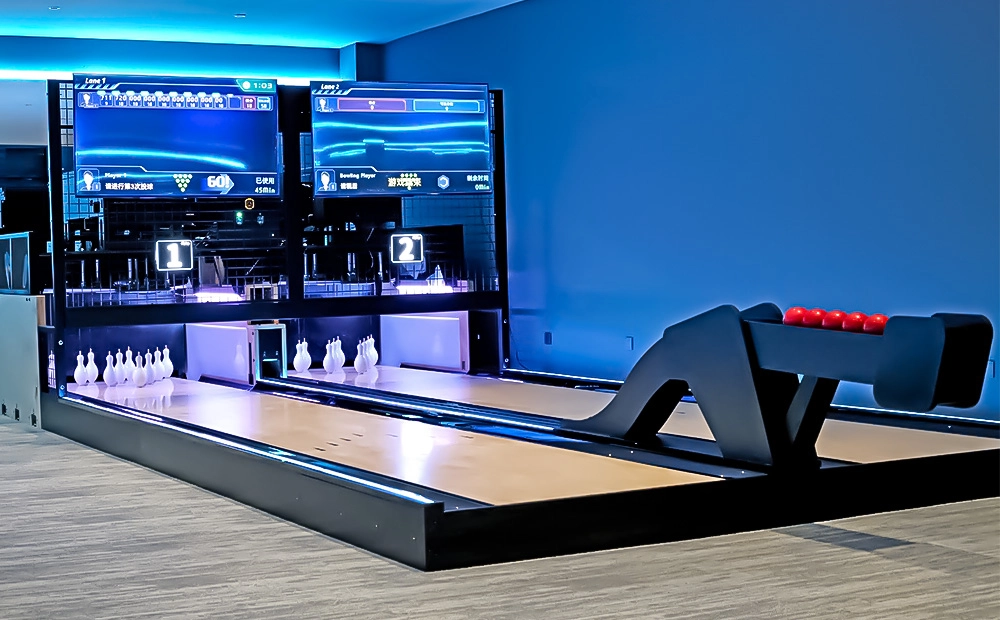
Flying Smart Duckpin Bowling
The innovative design of Flying Smart Duckpin Bowling (FSDB) makes it perfect for places like bars, billiard halls, and game centers. It makes people want to come back more often and spend more money. FSDB is fun and competitive, so it will become a new focus for social activities.
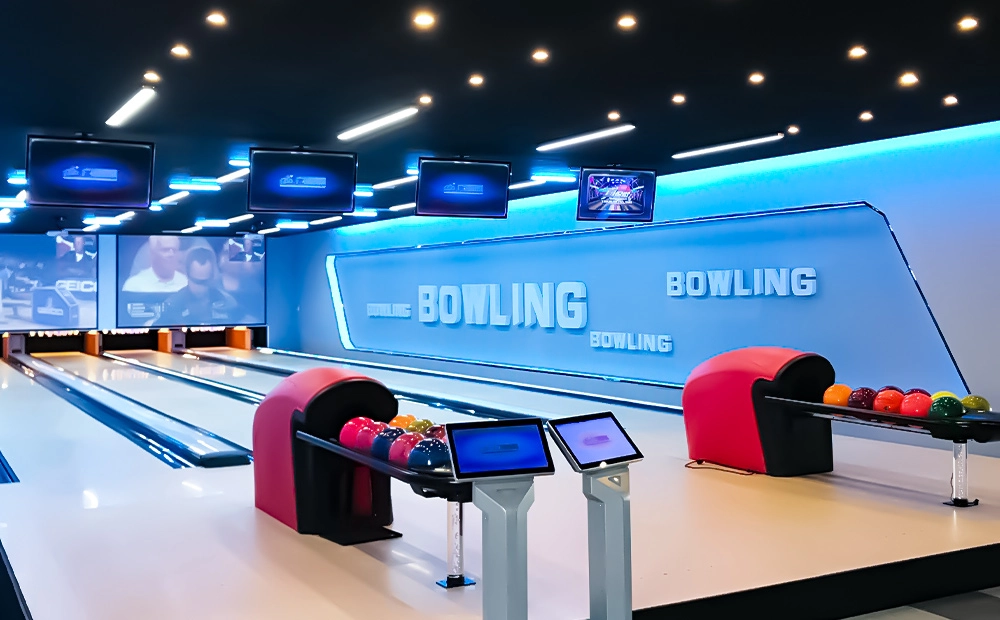
Flying Classic Standard Bowling
Flying Classic Standard Bowling (FCSB) employs the World Standard Competition Scoring System to deliver a more professional bowling experience, enabling bowlers to enjoy a professional-standard match at their convenience.
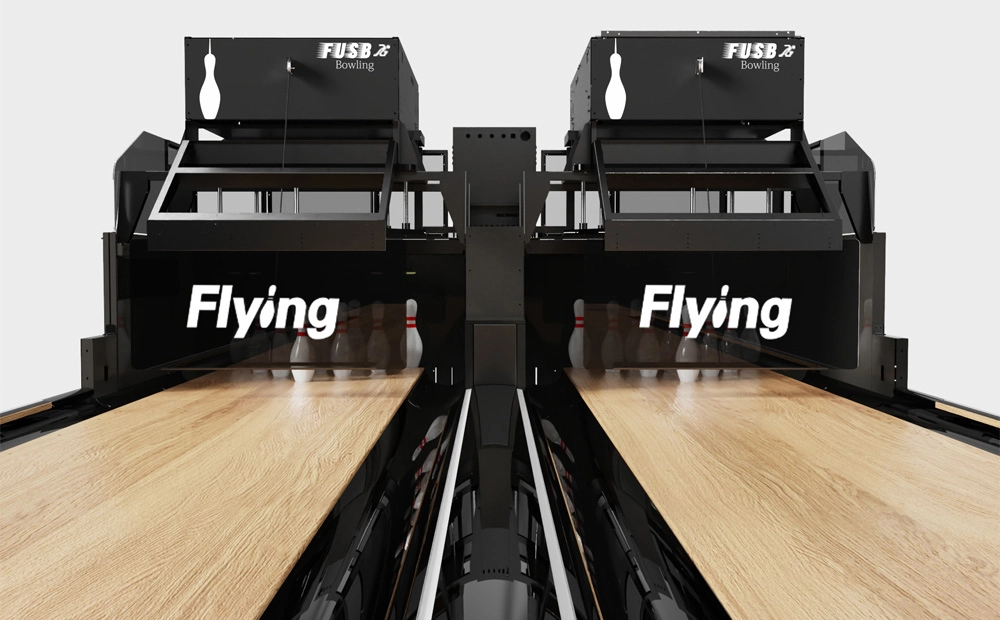
Flying Ultra Standard Bowling
Flying Ultra Standard Bowling (FUSB) Upgraded Version
The string pinsetter uses the latest technology. It offers a more enjoyable bowling experience thanks to its innovative designs and modern technology.
Ready to Build Your Bowling Center?
Share your details, and we’ll provide tailored solutions and expert guidance to help you take your bowling center to the next level.

Professional Bowling Alley Equipment Manufacturer, a one-stop solution provider for bowling alleys.
Facebook
YouTube
Linkedin
Twitter