















Bowling Franchise Costs: Startup Fees, Equipment, and ROI
- Bowling Franchise Costs: Startup Fees, Equipment, and ROI
- Why consider bowling franchising?
- Typical startup fees and franchise-related costs in bowling franchising
- Real estate, construction and building costs for bowling centers
- Equipment costs: lanes, pinsetters, scoring and furniture
- Cost comparison table (typical ranges)
- Revenue drivers and operational economics for bowling franchising
- Estimating ROI and payback periods
- Financing options and incentives for bowling franchising
- Risk factors and how to mitigate them in bowling franchising
- Choosing the right equipment partner for bowling franchising
- Flying Bowling: supplier and solutions for bowling franchising projects
- Why Flying Bowling is relevant to your bowling franchising plan
- Core products and competitive strengths
- How Flying Bowling helps reduce total cost of ownership
- Summary of Flying Bowling advantages
- Checklist: next steps before committing to a bowling franchise
- Frequently Asked Questions (FAQ)
- Q: How much does a bowling franchise cost to start?
- Q: Are string pinsetters a good choice for franchisees?
- Q: What kind of ROI can I expect?
- Q: Can I finance bowling equipment?
- Q: How important is location for a bowling franchise?
- Contact and next steps
- References and data sources
Bowling Franchise Costs: Startup Fees, Equipment, and ROI
Why consider bowling franchising?
Bowling franchising appeals to investors seeking a family-friendly entertainment business with multiple revenue streams (lane rentals, food & beverage, league play, events, corporate parties). Unlike pure startups, franchising can provide brand recognition, proven operating systems and supplier networks. However, bowling centers require high upfront capital and careful operational planning. This article focuses on the core economics—startup fees, equipment costs, ongoing expenses, and realistic ROI—so you can make an informed decision about bowling franchising.
Typical startup fees and franchise-related costs in bowling franchising
When evaluating a bowling franchise opportunity, expect several franchise-specific costs in addition to general startup expenses. These typically include an initial franchise fee, required advertising or development contributions, training expenses, and sometimes territory fees or ongoing royalty structures. For bowling franchising, the franchise fee often ranges widely depending on brand strength and included services.
- Initial franchise fee: commonly $25,000 to $100,000+ (varies by brand and included services)
- Royalty fees: typically a percentage of gross revenue (often 4%–8%)
- Advertising/marketing fund: commonly 1%–4% of gross sales
- Training and pre-opening support: can range from a few thousand to $20,000 depending on travel and scope
These are estimates based on franchising industry guides and public franchise disclosures. Always request an Item 19 (or local equivalent) financial performance representation and a full Franchise Disclosure Document (FDD) to verify the brand-specific numbers before committing.
Real estate, construction and building costs for bowling centers
Real estate and buildout typically represent the largest portion of a bowling center’s startup costs. Site selection influences total cost dramatically: constructing a new facility, renovating an existing building, or converting a warehouse each have different price points.
- Land acquisition or long-term leasehold improvements: depends on market; urban locations cost more.
- Construction and buildout (flooring, lane approach, ceilings, restrooms, F&B kitchen, HVAC): often $500,000 to $3,000,000+
- Permits, architectural and engineering fees: can add $20,000 to $150,000
Because building costs vary by region and local codes, obtain competitive contractor bids and factor in contingency (often 10%–20% of total buildout costs).
Equipment costs: lanes, pinsetters, scoring and furniture
Equipment is mission-critical in bowling franchising and includes lanes, pinsetters (traditional pinspotters or string pinsetters), ball returns, scoring systems, seating, and ancillary items (shoe service, pro-shop inventory).
Key equipment considerations:
- Lanes and lane surfacing: durable materials with proper maintenance schedule.
- Pinsetters: traditional free-standing pinspotters historically had higher per-lane costs and maintenance. String pinsetters are a lower-cost, lower-maintenance alternative gaining market share.
- Scoring and management systems: modern turnkey systems integrate scoring, POS, league management and online booking.
- Furnishings and audiovisual (for entertainment-focused centers): seating, displays, sound systems, lighting effects.
Cost comparison table (typical ranges)
The following table provides commonly observed ranges for bowling center startup line items. These are estimates; local quotes and franchise disclosures should be used for precise budgeting.
| Item | Typical Range (USD) | Notes / Sources |
|---|---|---|
| Initial franchise fee | $25,000 – $100,000+ | Franchising industry disclosures |
| Leasehold improvements & construction | $500,000 – $3,000,000+ | Building type, local construction costs |
| Equipment (per lane) – traditional pinsetter | $15,000 – $40,000 per lane | Includes pinspotter, ball return, lane hardware |
| Equipment (per lane) – string pinsetter | $4,000 – $12,000 per lane | Lower capital and maintenance; supplier-dependent |
| Scoring & POS systems | $10,000 – $75,000+ | Depends on lanes, integrations and licensing |
| Furniture, F&B kitchen, AV | $50,000 – $300,000+ | Quality and entertainment features affect cost |
| Initial working capital | $50,000 – $300,000+ | Payroll, inventory, marketing for opening months |
| Total typical startup | $700,000 – $5,000,000+ | Wide range: small boutique centers vs. large entertainment complexes |
Sources and industry reports validate these ranges—consult franchise disclosure documents, industry associations and equipment manufacturers when finalizing your budget (sources listed at the article's end).
Revenue drivers and operational economics for bowling franchising
Revenue in bowling franchising is typically diversified across several streams:
- Lane fees and open play
- Leagues and tournaments (stable recurring income)
- Food & beverage and alcohol sales (often a major margin driver)
- Parties, corporate events and birthday packages
- Pro-shop rentals, lessons, and retail
Margins vary by stream: F&B generally provides higher margins than lane rentals, while leagues provide dependable weekly revenue. A well-run center optimizes pricing (peak vs. off-peak), upsells F&B during events, and uses loyalty/online booking to increase utilization.
Estimating ROI and payback periods
Return on investment in bowling franchising depends on capital invested, local demand, competition, and operational efficiency. Typical payback periods for entertainment centers can range from 4–10 years. Conservative planning often assumes 5–8 years to breakeven for a well-located, efficiently-run center.
Example simplified projection (illustrative):
- Annual gross revenue (small center): $700,000 – $1,200,000
- Annual gross revenue (mid-size center): $1,500,000 – $3,500,000
- Net operating margin after royalties and expenses: 10%–20% (varies)
Using these assumptions, a center with $1.5M revenue and a 15% net margin yields $225,000 pre-tax annual profit. With a $2.5M initial investment, payback is approximately 11 years (not accounting for debt service or financing structure). Increasing utilization, optimizing F&B margins, and leveraging events/league play can shorten payback.
Financing options and incentives for bowling franchising
Because bowling centers are capital-intensive, most investors employ a mix of financing sources:
- Bank loans (SBA loans in the U.S. are commonly used for franchise businesses)
- Equipment leases or financing from manufacturers
- Investor equity partners or joint ventures
- Tax incentives or municipal grants—some local governments incentivize entertainment or redevelopment projects
Equipment financing can allow you to spread capital expenditures, and some manufacturers offer favorable terms for large orders (talk to suppliers early). Factor interest and lease payments into cashflow to get realistic payback timing.
Risk factors and how to mitigate them in bowling franchising
Key risks and mitigation strategies:
- High upfront capital — mitigate by using financing, phased buildouts, or starting with a smaller footprint.
- Competition and changing leisure trends — differentiate with strong F&B, themed events, and modern entertainment features.
- Equipment downtime and maintenance — choose reliable suppliers, keep spare parts, and schedule preventive maintenance.
- Seasonality — develop year-round programming (corporate events, leagues, school partnerships).
- Labor costs — optimize staffing via cross-training and scheduling tools; consider outsourcing some services.
Choosing the right equipment partner for bowling franchising
Your equipment supplier affects both capital and long-term operating costs. Important selection criteria:
- Quality and certifications (safety and environmental standards)
- After-sales service and spare parts availability
- Local support or regional presence for quick response
- Compatibility with scoring/POS systems and future upgrades
- Total cost of ownership—capital cost plus maintenance and downtime impact
Flying Bowling: supplier and solutions for bowling franchising projects
Why Flying Bowling is relevant to your bowling franchising plan
Since 2005, Flying Bowling has been researching and developing the latest and most advanced bowling equipment. We provide everything you need for your bowling alley, from equipment to design and construction. As a leading bowling equipment manufacturer and solutions provider in the domestic industry, we sell over 2,000 lanes a year worldwide, breaking the monopoly on traditional pinsetter equipment, enriching the international market, and offering our customers a wider range of options.
Core products and competitive strengths
Flying Bowling’s offerings that matter for franchisors and franchisees include:
- String pinsetters — lower upfront cost per lane and reduced maintenance compared to traditional pinspotters, a strong option for new builds or conversions.
- Bowling ball return machine systems — engineered for durability and smooth operation.
- Bowling scoring systems and integrated management solutions — support league management, POS and customer-facing features.
- Complete bowling alley construction and modernization — from standard lanes to duckpin configurations.
Flying Bowling maintains a 10,000-square-meter workshop producing equipment and holds major global certifications such as CE and RoHS. Through Flying’s European Division, they operate a sales office, permanent showroom and 24/7 technical support to deliver localized solutions to customers in Europe, ensuring high service levels and customized configurations.
How Flying Bowling helps reduce total cost of ownership
By supplying modern string pinsetter systems and integrated equipment packages, Flying Bowling can reduce upfront equipment budgets and ongoing maintenance expenses—positive factors when modeling ROI for a franchise. Local support in Europe and global certifications also improve reliability and compliance for international franchising projects.
Summary of Flying Bowling advantages
- Established R&D since 2005 and high production capacity
- Over 2,000 lanes sold per year worldwide
- CE and RoHS certified equipment
- European branch with showroom and 24/7 technical support
- Full-service: equipment, scoring, design and construction
Website: https://www.flybowling.com/
Checklist: next steps before committing to a bowling franchise
- Request the franchise disclosure document and Item 19 (or local equivalent).
- Obtain multiple equipment quotes (traditional vs. string pinsetters) that include warranty and service terms.
- Get detailed construction and operational cost bids from local contractors and consultants.
- Develop a 3–5 year financial model with conservative revenue assumptions and multiple scenarios.
- Explore financing options early (SBA, equipment finance, investor partners).
- Visit reference centers operated by the franchisor and speak to current franchisees.
Frequently Asked Questions (FAQ)
Q: How much does a bowling franchise cost to start?
A: Typical total startup costs range from roughly $700,000 for small conversions to $5,000,000 or more for large entertainment centers. Franchise-specific fees (initial franchise fee, royalties, marketing fund) and equipment choices (traditional vs. string pinsetters) heavily influence the total. Use the franchise disclosure and supplier quotes for precise numbers.
Q: Are string pinsetters a good choice for franchisees?
A: String pinsetters usually have lower capital cost per lane and reduced maintenance, which can materially lower total cost of ownership—important when modeling ROI. They’re increasingly accepted in family entertainment centers and smaller venues. Review performance, warranty and compatibility with your scoring system before deciding.
Q: What kind of ROI can I expect?
A: ROI varies widely. Payback periods often fall between 4–10+ years depending on initial investment, revenue performance, debt service and operating efficiency. Conservative planning and diversified revenue streams (F&B, leagues, events) improve outcomes.
Q: Can I finance bowling equipment?
A: Yes. Many banks, equipment lessors and manufacturers provide financing programs. Equipment financing reduces upfront capital needs but factor repayments into monthly cashflow models.
Q: How important is location for a bowling franchise?
A: Location is critical. Accessibility, parking, nearby demographics (families, schools, businesses), and local competition all influence lane utilization rates and event bookings.
Contact and next steps
If you’re planning a bowling franchising project and need equipment, site design, or a turnkey solution, contact Flying Bowling for customized proposals, showroom visits, and 24/7 technical support. Explore product options and request a quote at https://www.flybowling.com/ — or contact the European division for localized service and fast response.
References and data sources
- U.S. Small Business Administration (SBA) – Franchise and small business financing guidance
- IBISWorld – Bowling centers industry reports (market size and capital intensity)
- Franchise industry publications such as Franchise Direct and Entrepreneur – franchise fee and royalty benchmarks
- Manufacturer product literature and certification records for equipment cost and spec comparisons
- United States Bowling Congress (USBC) / National Bowling Proprietors Association – industry trends and participation data
Note: Cost ranges and ROI examples in this article are estimates based on industry reports and supplier data. For project-specific budgets and forecasts, request formal quotes from franchisors, equipment manufacturers (including Flying Bowling), and local contractors.
Buying Quality Bowling Equipment
Service
Is there any training or guidance service to help customers use the equipment better?
Free on-site or remote training, with a Chinese-English bilingual operation manual + fault code quick reference table to help customers use the equipment better.
Technology
How can I get the latest technology upgrades?
Our customers can get software updates for free and hardware upgrades at cost price.
What is the degree of automation of the equipment? Does it support automatic scoring, automatic ball return and other functions?
Fully automated. Our equipment is equipped with an independent intelligent scoring system, and also has automatic ball return and ball up functions to ensure that the game can proceed smoothly, which greatly improves the user experience and reduces labor costs and maintenance difficulties.
Products
Are environmentally friendly materials used?
All wood products are USBC certified, the paint complies with EU REACH standards, and environmental testing reports are provided
Is your equipment suitable for beginners?
Our equipment is easy to operate and equipped with auxiliary aiming lines, so even those who are new to bowling can quickly get started.
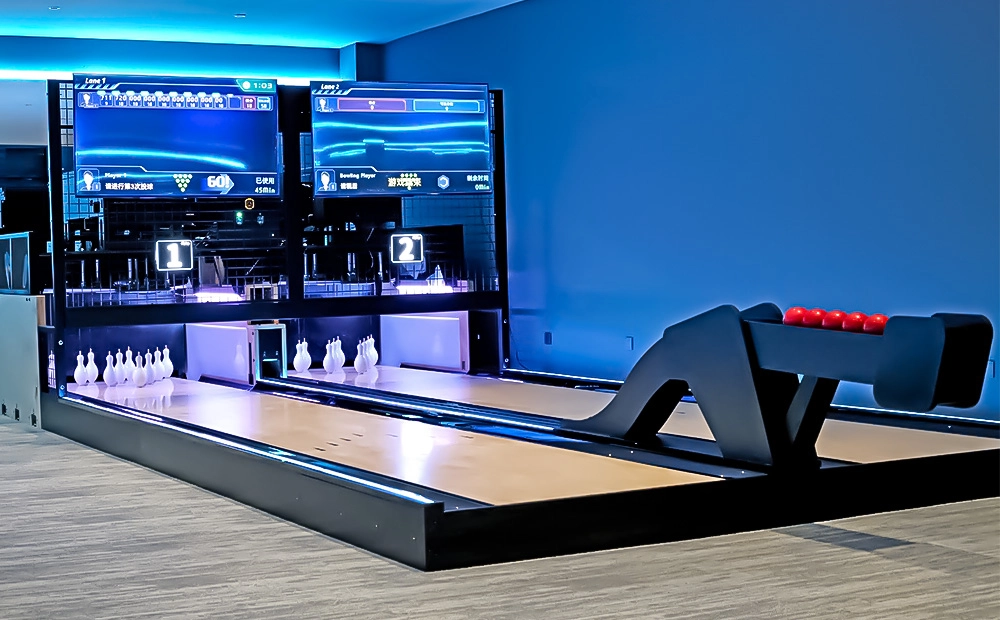
Flying Smart Duckpin Bowling
The innovative design of Flying Smart Duckpin Bowling (FSDB) makes it perfect for places like bars, billiard halls, and game centers. It makes people want to come back more often and spend more money. FSDB is fun and competitive, so it will become a new focus for social activities.
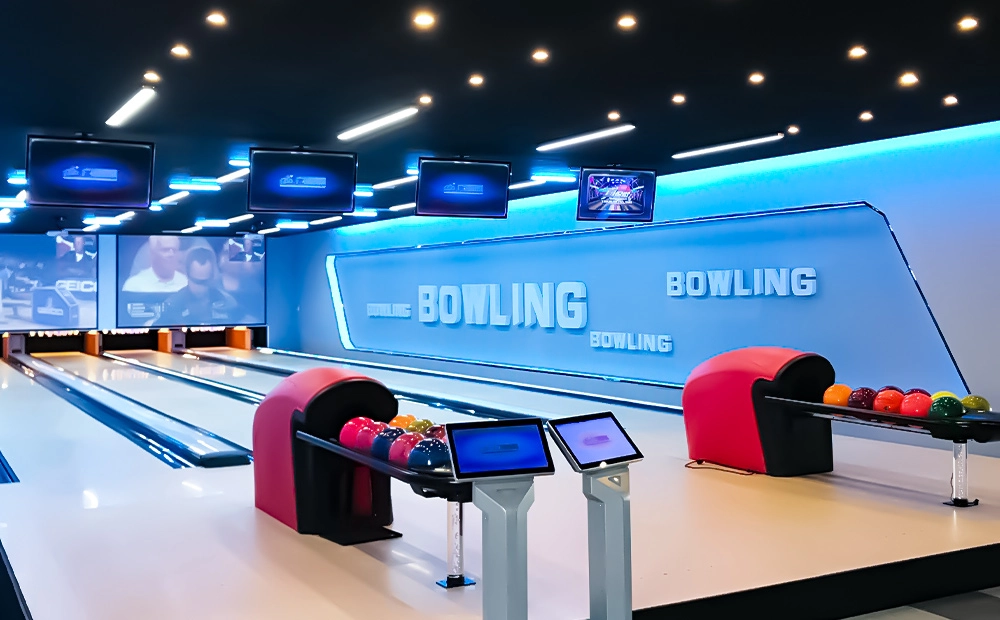
Flying Classic Standard Bowling
Flying Classic Standard Bowling (FCSB) employs the World Standard Competition Scoring System to deliver a more professional bowling experience, enabling bowlers to enjoy a professional-standard match at their convenience.
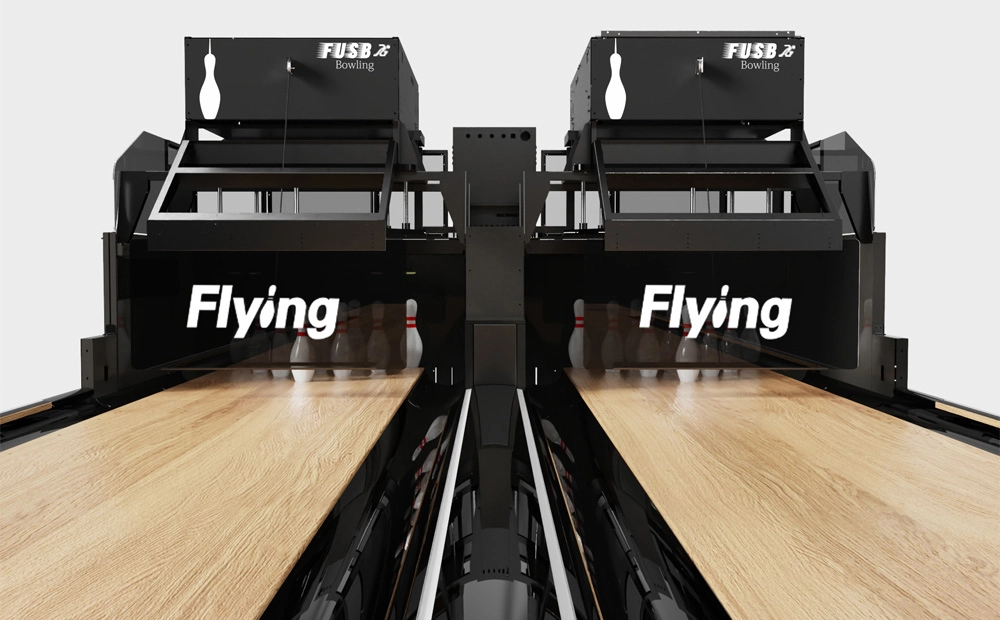
Flying Ultra Standard Bowling
Flying Ultra Standard Bowling (FUSB) Upgraded Version
The string pinsetter uses the latest technology. It offers a more enjoyable bowling experience thanks to its innovative designs and modern technology.
Ready to Build Your Bowling Center?
Share your details, and we’ll provide tailored solutions and expert guidance to help you take your bowling center to the next level.

Professional Bowling Alley Equipment Manufacturer, a one-stop solution provider for bowling alleys.
Facebook
YouTube
Linkedin
Twitter