















Bowling alley construction costs by size and location | Insights by Flying Bowling

Monday, September 22, 2025
Explore the factors influencing bowling alley construction costs, including size, location, and equipment choices. Learn how to plan your investment effectively.

Bowling Alley Construction Costs Guide

A practical reference for investors, developers, and venue operators planning a new bowling facility.


1. What are the average construction costs for a bowling alley?

Construction cost depends on two decisions that dwarf all others: whether you're building from scratch or converting an existing space, and where the project is located.

New construction runs $180–$300 per square foot for entertainment-grade fit-out in most US markets (HomeGuide, 2024). In high-cost urban markets (New York, San Francisco, coastal cities), expect $280–$400/sq ft. In lower-cost regions (Midwest, Southeast), $150–$220/sq ft is achievable.

Retail conversion — fitting out a former big-box store, warehouse, or entertainment center — runs $120–$220/sq ft and saves 25–35% versus new construction. It also opens 6–12 months faster. Most first-time operators choose this path.

To put those numbers in context:

  • A 10,000 sq ft facility (roughly 6–8 lanes with F&B): $1.2M–$3M in construction alone
  • A 20,000 sq ft facility (12–16 lanes, full FEC): $2.4M–$6M in construction alone

These figures cover the building shell, structural work, HVAC, electrical, plumbing, and interior fit-out. They do not include equipment, land, professional fees, or working capital — each of which adds meaningfully to the total.


2. How does the number of lanes affect construction costs?

Each lane requires a room footprint of approximately 95–100 ft in depth and 12–14 ft in width. Two lanes sharing a central ball return need 20–24 ft of width. The practical floor area per lane — including the approach, lane surface, pinsetter zone, and a proportional share of seating and concourse — runs roughly 1,200–1,500 sq ft per lane.

This means:

  • 4 lanes: ~5,000–7,000 sq ft of lane area (plus kitchen, bar, restrooms, office, storage)
  • 8 lanes: ~10,000–13,000 sq ft of lane area
  • 12 lanes: ~15,000–18,000 sq ft of lane area

More lanes also means more equipment. At mid-range commercial specification (synthetic lanes, string pinsetters, touchscreen scoring, commercial seating), each fully installed lane costs $45,000–$80,000 in equipment alone. A 12-lane center carries $540,000–$960,000 in equipment before the building is considered.

The positive side of scale: per-lane equipment cost drops as lane count increases, because volume pricing on equipment packages applies and shared infrastructure (one HVAC system, one kitchen, one POS system) serves more lanes.


3. How does location influence construction costs?

Location affects costs through three distinct channels:

Labor rates. Construction labor is the largest variable in per-square-foot cost. Union labor markets (New York, Chicago, Boston, Los Angeles) run 30–50% higher than non-union markets in the same state. Research local prevailing wage rates before finalizing a budget.

Land cost. In prime suburban or urban locations, land acquisition alone can add $500,000–$3M+ to project cost before a shovel hits the ground. Many operators avoid this by leasing — monthly rent of $25–$60/sq ft per year in good suburban locations is manageable against the revenue a well-run center generates, and it preserves capital for equipment and working capital.

Local permitting and code compliance. Entertainment venues trigger specific requirements in most jurisdictions: noise ordinances (which drive acoustic treatment costs), fire suppression beyond standard commercial requirements, alcohol licensing, ADA accessibility for approach areas and scoring consoles, and zoning variances if the site isn't pre-approved for entertainment use. In some markets, a contested zoning variance adds $10,000–$40,000 in legal fees and 6–12 months to the timeline. Research this before committing to a site.

Rule of thumb: Take your base construction cost estimate and add 15–25% for projects in high-cost urban markets, or subtract 15–20% for projects in lower-cost rural or secondary markets.


4. What are the key equipment costs?

Equipment is the most predictable cost category — manufacturers publish pricing and it varies less by region than construction does. The numbers below reflect new equipment at mid-range commercial specification.

Lane surface: $10,000–$15,000 per lane for synthetic HPL or SPL panels. Lifespan 20–30 years with annual conditioning and resurfacing every 5–10 years. Traditional wood costs $15,000–$18,000/lane but requires resurfacing every 2–5 years — higher long-term maintenance cost.

String pinsetter: $8,000–$12,000 per lane (QubicaAMF Frameworx, US Bowling HPL, Flying Bowling AEROPIN). Annual maintenance $200–$600/lane. USBC-certified for most formats. This is the standard choice for new FEC and boutique venue projects.

Free-fall pinsetter: $15,000–$25,000+ per lane (Brunswick GS Series, AMF 82-70XLi). Annual maintenance $1,500–$3,500/lane. Requires a certified mechanic for service. Appropriate for venues where traditional sanctioned league bowling is the primary revenue driver.

Ball return system: $3,000–$6,000 per lane for above-ground systems. Underground/concealed returns add $2,000–$4,000 per lane.

Scoring system: $4,000–$8,000 per lane for standard touchscreen systems with lane management, mobile score viewing, and food ordering integration. Confirm annual software licensing fees before signing — some systems charge $125–$210/lane/month, which compounds significantly over a 10-year ownership period.

Furniture and seating: $2,000–$5,000 per lane. Lounge-style seating (sofas, high-tops) consistently outperforms fixed-seat configurations on food and beverage revenue — worth the premium.

All-in installed cost per lane (surface + pinsetter + ball return + scoring + furniture, fully installed): $45,000–$80,000 at mid-range commercial specification. Economy builds with refurbished equipment: $25,000–$35,000/lane. Premium boutique builds with interactive projection, custom furniture, and concealed ball returns: $80,000–$120,000+/lane.

Additional equipment beyond lanes:

  • Kitchen equipment (full-service): $80,000–$400,000
  • Bar setup: $30,000–$150,000
  • Arcade equipment: $50,000–$200,000
  • POS and lane management software: $5,000–$30,000
  • Security system: $5,000–$25,000
  • Lighting and AV: $20,000–$150,000

5. What are the operational costs to plan for?

Operational costs are what determine whether a well-built facility becomes a profitable business. The most common planning failure is underestimating these before opening.

Staffing is typically the largest ongoing expense. A 12-lane FEC with a bar and kitchen needs at minimum: a general manager, 2–3 front desk/lane staff per shift, kitchen staff, and a part-time maintenance person. Expect $400,000–$700,000/year in total labor cost for a facility of this size, depending on market and hours of operation.

Rent or debt service is the second largest. At $35/sq ft/year on a 20,000 sq ft lease, annual rent is $700,000. On a $4M construction loan at 7% over 15 years, annual debt service is approximately $430,000. Either way, this is a fixed cost that runs whether the venue is full or empty.

Utilities for a bowling facility run higher than standard commercial space due to 24-hour HVAC requirements for lanes and equipment. Expect $5,000–$15,000/month depending on facility size and local utility rates.

Equipment maintenance per lane per year: $500–$1,500 for lane conditioning (oil and cleaner), plus pinsetter maintenance ($200–$600/lane for string; $1,500–$3,500/lane for free-fall). A 12-lane center with string pinsetters spends $8,400–$24,600/year on lane and pinsetter maintenance alone.

Marketing and events should be budgeted at 3–8% of revenue. A center targeting $1.5M annual revenue should plan $45,000–$120,000/year for marketing, league programming, corporate event sales, and birthday party operations. This is not optional — it's what fills the lanes during off-peak hours.

Insurance for a bowling and entertainment venue with liquor service: $30,000–$80,000/year depending on coverage, venue size, and claims history.

Working capital reserve: Before opening, hold 3–6 months of operating expenses in liquid reserves — approximately $150,000–$300,000 for a 12-lane FEC. This is the most frequently omitted item in first-time operator budgets and one of the leading causes of first-year failure.


6. What does total investment look like by project size?

These figures combine equipment and construction for realistic all-in project costs. They exclude land, liquor licensing, pre-opening working capital, and contingency reserve (add 10–15% for contingency on all estimates).

4-lane boutique venue (retail conversion, leased):

  • Construction/renovation: $500,000–$900,000
  • Equipment: $180,000–$320,000
  • Additional systems (kitchen, bar, AV): $150,000–$300,000
  • Professional fees and permits: $60,000–$150,000
  • Total: $890,000–$1.67M

8-lane family entertainment center (retail conversion):

  • Construction/renovation: $900,000–$2M
  • Equipment: $360,000–$640,000
  • Additional systems: $250,000–$500,000
  • Professional fees and permits: $100,000–$250,000
  • Total: $1.6M–$3.4M

12-lane traditional bowling center (new construction):

  • Building construction: $2.5M–$5M
  • Equipment: $540,000–$960,000
  • Additional systems: $300,000–$600,000
  • Professional fees and permits: $250,000–$600,000
  • Total: $3.6M–$7.2M

24-lane large entertainment center (new construction):

  • Building construction: $5M–$10M+
  • Equipment: $1.1M–$1.9M
  • Additional systems: $500,000–$1M+
  • Professional fees and permits: $500,000–$1M
  • Total: $7.1M–$13.9M+

7. What return on investment should I expect?

Per BPAA 2024 Industry Report (312 reporting venues), median-performing venues generate approximately $73,000 per lane per year across all revenue streams: $32,000 from lane play, $24,000 from food and beverage, $11,000 from events, and $6,000 from arcade and other sources. Top-quartile venues generate approximately $136,000/lane/year.

At those revenue figures:

  • A 12-lane center at median performance: ~$876,000/year total revenue
  • A 12-lane center at top-quartile performance: ~$1,632,000/year total revenue

With a 20–30% EBITDA margin (industry benchmark for well-run facilities), annual operating profit ranges from $175,000–$263,000 at median to $326,000–$490,000 at top-quartile.

At a total investment of $3M for a 12-lane retail conversion:

  • Median performance payback: 11–17 years
  • Top-quartile performance payback: 6–9 years

The "3–5 year payback" figures sometimes cited in industry marketing apply to boutique venues in high-traffic urban markets achieving top-quartile revenue — not to median operators. Build your financial model on median BPAA figures as the base case, and treat top-quartile as your upside scenario.


8. What are the most common budgeting mistakes?

Confusing equipment cost with project cost. A supplier quote for lane equipment ($45,000–$80,000/lane) covers hardware only. It excludes building construction, shipping, installation labor, HVAC, permits, professional fees, and working capital. The all-in project cost is typically 3–5 times the equipment-only quote.

Omitting working capital. The period between construction completion and cash-flow stability takes 3–6 months. Without a reserve of $150,000–$300,000, many first-year operators face cash crises before they have a chance to build their customer base.

Ignoring liquor license cost and timeline. Alcohol typically accounts for 30–40% of an FEC's revenue. License cost varies from $5,000 in some states to $300,000+ in quota-controlled states (Florida, Pennsylvania). The timeline in contested markets can exceed 12 months. Research this before selecting a site — it can make or break project feasibility.

Skipping a contingency reserve. Every construction project encounters surprises. Budget a minimum 10–15% contingency on all cost estimates. Projects without contingency consistently face scope reduction or delayed openings when inevitable surprises arise.

Underestimating professional fees. Architectural design, structural engineering, MEP engineering, and permit fees typically run 8–15% of construction cost. On a $2M renovation, that is $160,000–$300,000 — large enough to materially affect project viability if omitted from the initial budget.


9. How can I optimize the investment?

Choose the right building strategy first. This decision — new construction vs. retail conversion vs. ground-up lease — has a bigger impact on total cost than any equipment choice. Retail conversion is usually the right answer for first-time operators: lower risk, faster opening, less capital required.

Use string pinsetters for new builds. The $8,000–$12,000/lane purchase price and $200–$600/lane/year maintenance cost compares favorably to $15,000–$25,000/lane and $1,500–$3,500/lane/year for free-fall. On a 12-lane center over 10 years, the difference is $180,000–$360,000 in maintenance and energy savings.

Invest in guest experience, not mechanical upgrades guests never see. The highest-ROI investments are lounge seating, lane-side food ordering, interactive scoring, and good lighting. A venue with standard string pinsetters and excellent lounge seating consistently outperforms one with premium mechanical equipment and basic chairs.

Get a market feasibility study before finalizing your budget. A specialist FEC consultant charges $3,000–$8,000 for a market study. This study tells you whether your specific location supports the revenue projections your financial model requires — and it is the cheapest insurance available against building in the wrong place.

Plan equipment procurement in parallel with construction. Equipment lead times from major manufacturers run 3–4 months minimum. Place your order when construction begins, not when it finishes. Delays in equipment delivery are one of the most common causes of opening date slippage.

You May Also Like

Flying Bowling - duckpin bowling (3)

Flying Smart Duckpin Bowling

The innovative design of Flying Smart Duckpin Bowling (FSDB) makes it perfect for places like bars, billiard halls, and game centers. It makes people want to come back more often and spend more money. FSDB is fun and competitive, so it will become a new focus for social activities.
Flying Smart Duckpin Bowling
Flying Bowling - Standard Bowling equipment

Flying Classic Standard Bowling

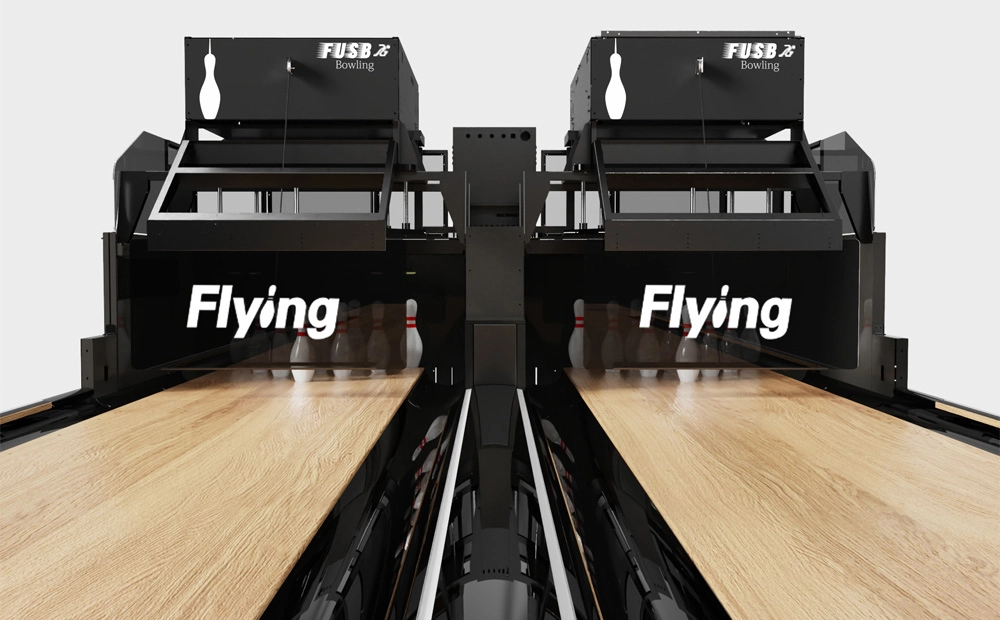
Flying Classic Standard Bowling (FCSB) employs the World Standard Competition Scoring System to deliver a more professional bowling experience, enabling bowlers to enjoy a professional-standard match at their convenience.
Flying Classic Standard Bowling
Flying Bowling - STRING PINSETTER · AEROPIN-4

AEROPIN: USBC-Certified Commercial Bowling String Pinsetter for High-Traffic Venues

The AEROPIN is Flying Bowling's highest-specification string pinsetter, purpose-built for bowling center investors and operators who cannot afford downtime. Fully USBC-certified (Permit SP-11), it meets the strictest international competition standards while delivering the operational economics that protect your bottom line — a 10,000+ hour MTBF, sub-8-second pin cycle, and 15% lower energy consumption versus traditional systems.

Whether you are breaking ground on a new facility or modernizing an existing center, the AEROPIN integrates into your project as a complete, turnkey solution. Flying Bowling handles equipment supply, lane installation, commissioning, and after-sales support across 40+ countries — so your venue opens on schedule and runs without interruption from day one.

AEROPIN: USBC-Certified Commercial Bowling String Pinsetter for High-Traffic Venues
Flying Bowling - 8

Get in touch

Contact us

If you contact us now for more details, we can provide you with a custom bowling alley service.

Our service team will get back to you within 24 hours, normally!

Name must not exceed 100 characters.
Please enter a valid phone number!
Invalid email format or length exceeds 100 characters. Please re-enter.
Company Name must not exceed 150 characters.
Project Details must not exceed 3000 characters.

Let's Get Started

See for yourself. Book your personalized Flying Bowling demo today and see how we can elevate your venue!

Flying Bowling - phone (1)

0086 - 150 1310 7020

How can we help?

Hi,

If you are interested in our bowling equipment or have any questions, please be sure to let us know so we can serve you better.

×
Name must not exceed 100 characters.
Please enter a valid phone number!
Invalid email format or length exceeds 100 characters. Please re-enter.
Company Name must not exceed 150 characters.
Project Details must not exceed 3000 characters.

Send my project request

Hi,

If our bowling equipment meets your expectations, please leave me a message to get the best quote and product information.

×
Name must not exceed 100 characters.
Please enter a valid phone number!
Invalid email format or length exceeds 100 characters. Please re-enter.
Company Name must not exceed 150 characters.
Project Details must not exceed 3000 characters.

Build a center

Hi,

If you have a new project coming up or an old project that needs to be remodeled, or are interested in or have any questions about our bowling equipment, be sure to let us know so we can better serve you.

Name must not exceed 100 characters.
Please enter a valid phone number!
Invalid email format or length exceeds 100 characters. Please re-enter.
Company Name must not exceed 150 characters.
Project Details must not exceed 3000 characters.
×