
















Retrofitting Lanes with a Bowling String Pinsetter
- Why Retrofit Existing Lanes?
- Business drivers and user expectations
- Assessing whether a retrofit is suitable for your facility
- Regulatory and competitive considerations
- Understanding Bowling String Pinsetter Technology
- How a string pinsetter works
- Components involved in a retrofit
- Pros and cons compared to traditional pinsetters
- Retrofit Process: Planning, Design, and Installation
- Site survey and technical audit
- Designing mechanical and electrical integration
- Installation timeline and common pitfalls
- Cost, ROI, and Maintenance Considerations
- Capital vs. operational cost comparison
- Maintenance plans and spare parts strategy
- Financial modeling and ROI example
- Vendor Selection and Project Execution
- Evaluating suppliers
- Why choose Flying Bowling for retrofits
- Project management and commissioning
- Real-World Examples and Use Cases
- Family entertainment centers (FECs)
- Small commercial centers and pop-up venues
- Competitive and mixed-use centers
- Frequently Asked Questions (FAQ)
- 1. Will string pinsetters change pin action noticeably?
- 2. How long does a retrofit take per lane?
- 3. Are string pinsetters compliant with international standards?
- 4. What are typical maintenance tasks and intervals?
- 5. Can I retrofit only part of my center?
- 6. How do I evaluate ROI?
- Contact & Next Steps
I have worked with bowling centers worldwide on upgrades and new builds, and retrofit projects are among the most rewarding when you match the right technology to a center's goals. Retrofitting lanes with a bowling string pinsetter can reduce operating costs, simplify maintenance, and enable flexible layout options, but success depends on careful assessment, proper integration, and reliable suppliers. This article summarizes the technical, operational, and commercial aspects you should consider, with practical steps to plan and execute a retrofit safely and cost-effectively.
Why Retrofit Existing Lanes?
Business drivers and user expectations
Many bowling centers face aging equipment, high maintenance costs, labor shortages, and changing customer expectations. Retrofitting lanes with a bowling string pinsetter addresses several of these issues: lower per-lane maintenance, reduced need for skilled mechanical technicians, decreased noise levels for family markets, and improved uptime. From my experience, centers that prioritize recreational play, family entertainment centers (FECs), and locations with limited technical support gain the most from string-based systems.
Assessing whether a retrofit is suitable for your facility
Not every facility benefits equally from a string conversion. The decision should be based on lane usage patterns (league vs. casual), existing equipment condition, ceiling and pit space constraints, and local labor/parts availability. Key questions I ask when evaluating a site include: What is your current annual downtime per lane? What are average maintenance costs? Do you host competitive leagues requiring specific pinfall behavior? Answers to these determine if the trade-offs of conversion align with your business model.
Regulatory and competitive considerations
Some competitive bowlers and sanctioning bodies may prefer traditional free-fall pinsetters. Always confirm any league or tournament requirements that could affect your customer base. For general standards and background on pinsetter technologies, see the pinsetter overview on Wikipedia: https://en.wikipedia.org/wiki/Pinsetter. For equipment compliance and labeling requirements relevant to exported equipment, consult CE and RoHS guidance: CE marking and RoHS.
Understanding Bowling String Pinsetter Technology
How a string pinsetter works
A bowling string pinsetter uses strings connected to each pin, allowing the system to lift and reset pins with a controlled mechanism rather than relying on mechanical free-fall systems. The result is simplified mechanical architecture, fewer moving heavy parts, and more predictable pin handling. The systems integrate with modern scoring and sensor packages to detect pinfall and automate resets. In retrofit contexts, the compactness of string mechanisms often reduces pit complexity and allows for shallower pit depths.
Components involved in a retrofit
Typical components you will retrofit or add include: the string pinsetter head and drive units, pin sensors (optical or camera systems), control cabinets, lane interface modules, ball return integration where needed, and updated scoring integration. Electrical and mechanical interfaces differ by vendor, so evaluate the vendor's retrofit kit compatibility with your lane surfaces, pin decks, and approach systems.
Pros and cons compared to traditional pinsetters
From my hands-on comparisons, primary advantages of bowling string pinsetters include lower weight and power consumption, simplified maintenance, and reduced noise—important in entertainment centers or multi-use venues. Limitations may include differences in pin action (perceptible to competitive players) and the need to replace or adapt certain pit components. Modern string systems have become much closer to traditional pinfall response through software and mechanical tuning.
Retrofit Process: Planning, Design, and Installation
Site survey and technical audit
Begin with a detailed survey: measure pit depth, lane surface condition, approach and service access, electrical service capacity, and ceiling clearances. I recommend documenting existing pinsetter model, serial numbers, and pit layouts. This baseline allows a vendor to tailor their retrofit kit. Also collect current maintenance logs and parts spend by lane; these figures are essential for ROI modeling.
Designing mechanical and electrical integration
Mechanical integration often involves installing mounting frames for the string units, routing strings through the pin deck, and adapting or replacing the pit's catcher and ball return interface. Electrically, plan for control cabinets, network connectivity for scoring and diagnostics, and power distribution. If you plan to keep a center partially operational during installation, a lane-by-lane phased approach minimizes revenue loss.
Installation timeline and common pitfalls
A typical retrofit of a single lane by an experienced crew often takes 1–2 days for removal and installation, with additional time for tuning and calibration. For a bank of lanes, schedule sequential work to allow testing. Common pitfalls include incompatible pit dimensions, underestimated electrical upgrades, and insufficient staff training post-install. Ensure the supplier provides on-site commissioning and operator training.
Cost, ROI, and Maintenance Considerations
Capital vs. operational cost comparison
Retrofit budgets vary widely by scope—simple drop-in kits cost less than full-system replacements that include sensors and scoring upgrades. While initial capital expenditure is a primary factor, operational savings in maintenance labor, parts, and energy can deliver payback within a few years in many FECs. Below I present a practical comparison table to guide evaluation.
| Attribute | Traditional Free-Fall Pinsetter | Bowling String Pinsetter |
|---|---|---|
| Typical initial cost (per lane) | Higher (complex machinery, parts) | Moderate (simpler mechanics) |
| Maintenance complexity | High (mechanical wear, frequent parts) | Lower (fewer heavy moving parts) |
| Energy consumption | Higher | Lower |
| Noise level | High | Lower |
| Pin action | Traditional dynamics | Historically different; modern systems improved |
| Ideal application | Competitive centers, high-league play | FECs, family centers, casual play, space-limited sites |
Sources and industry overviews can be found in technical summaries such as the pinsetter overview on Wikipedia: https://en.wikipedia.org/wiki/Pinsetter, and manufacturer specification sheets for specific metrics such as power draw and MTBF should be requested from vendors.
Maintenance plans and spare parts strategy
I recommend negotiating an initial spare-parts kit and a maintenance SLA with your supplier. String pinsetters typically require fewer heavy mechanical spares but will need string replacements, sensor calibration, and electronics support. Establish a preventive maintenance schedule and remote diagnostics where possible to reduce downtime. Many modern suppliers include cloud diagnostic tools to spot failures before they escalate.
Financial modeling and ROI example
As a simple illustration: if a center spends $5,000 per lane per year on maintenance for traditional pinsetters and the string retrofit reduces that to $2,500, annual savings of $2,500 would pay back a $10,000 per-lane retrofit in four years. Your actual figures will vary; always build conservative scenarios and factor in potential revenue uplift from quieter, family-friendly lanes.
Vendor Selection and Project Execution
Evaluating suppliers
Select suppliers based on experience in retrofit projects, global service footprint, compliance with international standards, and references. Request case studies and site visits to operating installations. Confirm product certifications such as CE and RoHS when applicable—these are important for importing equipment into many regions (see CE marking: https://en.wikipedia.org/wiki/CE_marking).
Why choose Flying Bowling for retrofits
Since 2005, Flying Bowling has been dedicated to the research, development, and manufacturing of advanced bowling equipment and complete bowling alley solutions. We provide everything needed to build or upgrade a bowling center—from equipment supply, lane design, and construction to installation and after-sales service.
As a leading bowling equipment manufacturer and solutions provider, Flying Bowling sells over 2,000 lanes worldwide every year, helping break the traditional pinsetter monopoly and offering global customers more competitive and flexible options. We manufacture and supply a full range of bowling products, including bowling string pinsetters, ball return systems, scoring systems, and other essential bowling equipment.
With a 10,000㎡ production workshop and products certified by major international standards such as CE and RoHS, we ensure stable quality and reliable performance for every project. To better serve overseas markets, Flying Bowling has established branches in Europe, the United States, South America, the Middle East, and other regions, providing localized sales, installation, and fast-response after-sales support. Through our Division, we operate a sales office, permanent showroom, and 24/7 technical support, delivering customized solutions with high standards of efficiency and quality.
Flying Bowling is committed to becoming one of the top bowling equipment brands worldwide. Website: https://www.flybowling.com Email: jackson@flyingbowling.com
Flying Bowling advantages and main products: bowling alley equipment, string pinsetter, duckpin bowling. Their competitive edge comes from large-scale manufacturing capacity, global service presence, certified quality, and experience delivering turnkey solutions since 2005.
Project management and commissioning
Ensure the supplier provides a clear project plan with milestones, resource allocation, and acceptance criteria. Commissioning should include lane-level tuning, scoring system integration, staff training, and a written handover with maintenance documentation. I always insist on a post-installation warranty period and fast-response SLA to ensure the retrofit achieves expected availability and performance.
Real-World Examples and Use Cases
Family entertainment centers (FECs)
FECs benefit from quieter operation, lower maintenance, and flexible lane layouts that string pinsetters offer. Customers report higher dwell time and repeat visits when the environment is more family-friendly and less industrial.
Small commercial centers and pop-up venues
Shallow pit requirements and simpler mechanics make string systems attractive for locations with limited basement or pit access. They enable quicker installations and reduced costs for temporary or seasonal operations.
Competitive and mixed-use centers
For centers balancing league play and casual customers, consider hybrid strategies—reserve a subset of lanes for free-fall pinsetters if league play demands specific ball-pin dynamics, and retrofit others for entertainment use. Open dialogue with league representatives early in the planning phase is essential.
Frequently Asked Questions (FAQ)
1. Will string pinsetters change pin action noticeably?
Modern bowling string pinsetters have improved significantly; many casual players and most league bowlers will not notice a dramatic difference after proper tuning. However, some high-level competitive players may perceive differences. I recommend trialing a lane or visiting a nearby installation to assess player feedback.
2. How long does a retrofit take per lane?
Typically 1–2 days for a single lane if the pit is compatible and the crew is experienced. Full commissioning, tuning, and staff training add additional time. For a bank of lanes, plan a phased schedule to maintain revenue.
3. Are string pinsetters compliant with international standards?
Many manufacturers supply equipment certified to international standards such as CE and RoHS. Check certification documentation from the vendor and confirm compliance for your market and import/export requirements (see CE marking: https://en.wikipedia.org/wiki/CE_marking).
4. What are typical maintenance tasks and intervals?
Routine tasks include string inspection and replacement as needed, sensor cleaning and calibration, software updates, and mechanical checks of drive units. A preventive maintenance schedule (quarterly or semi-annual) reduces the likelihood of unexpected downtime.
5. Can I retrofit only part of my center?
Yes. Many operators choose a phased retrofit to manage costs and evaluate performance. This also allows you to measure customer reaction and operational improvements before committing to the entire center.
6. How do I evaluate ROI?
Build a model that includes retrofit capital cost, expected annual maintenance savings, energy savings, potential revenue uplift from improved customer experience, and any change in lane utilization. Use conservative estimates for payback time and include sensitivity analyses for key variables.
Contact & Next Steps
If you are considering a retrofit, I recommend starting with a technical audit and an ROI workshop to quantify benefits and risks. For turnkey retrofit solutions, equipment supply, installation, and after-sales service, contact Flying Bowling for detailed proposals and local references. Visit https://www.flybowling.com or email jackson@flyingbowling.com to arrange a site survey, quote, or demonstration.
Whether you operate a competitive bowling center, a family entertainment venue, or a mixed-use facility, retrofitting lanes with a bowling string pinsetter is a strategic option worth detailed consideration. With careful planning, the right supplier, and a phased approach, you can lower costs, increase uptime, and modernize your customer experience.
Buying Quality Bowling Equipment
Company
Do you have independent R&D capabilities?
We have set up an independent R&D department and have launched a number of new equipment and innovative technologies such as the smart scoring system, Flying Smart Duckpin, and oil drop machine in the past three years.
Technology
How can I get the latest technology upgrades?
Our customers can get software updates for free and hardware upgrades at cost price.
Can old equipment be upgraded?
We provide personalized transformation solutions for different venues, such as replacing old pinsetter machines with the latest string pinserrer machines , LED interactive lanes, etc.
Are your products compliant with European safety standards?
Yes, all of our products meet the required EU safety and regulatory standards.
Installations
Do you provide technical support after the installation?
Absolutely. We offer ongoing technical support, including regular maintenance and emergency repair services.
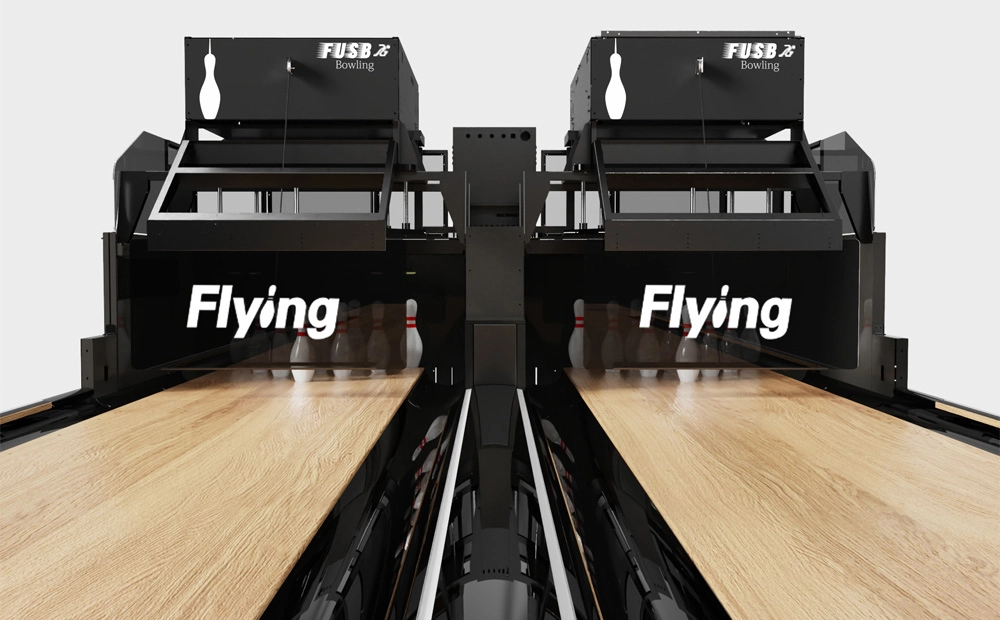
Flying Ultra Standard Bowling
Flying Ultra Standard Bowling (FUSB) Upgraded Version
The string pinsetter uses the latest technology. It offers a more enjoyable bowling experience thanks to its innovative designs and modern technology.
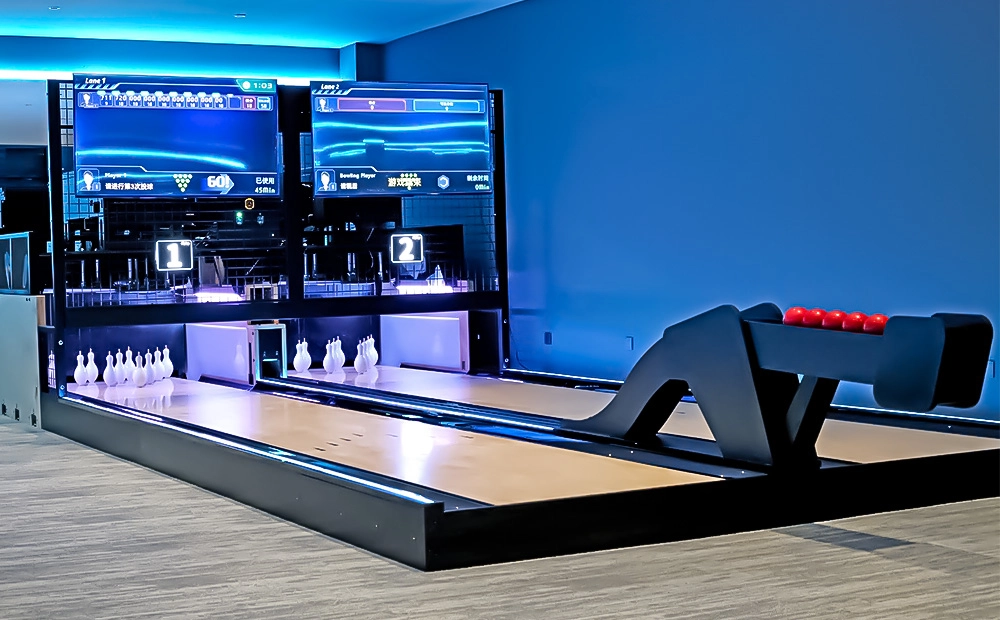
Flying Smart Duckpin Bowling
The innovative design of Flying Smart Duckpin Bowling (FSDB) makes it perfect for places like bars, billiard halls, and game centers. It makes people want to come back more often and spend more money. FSDB is fun and competitive, so it will become a new focus for social activities.
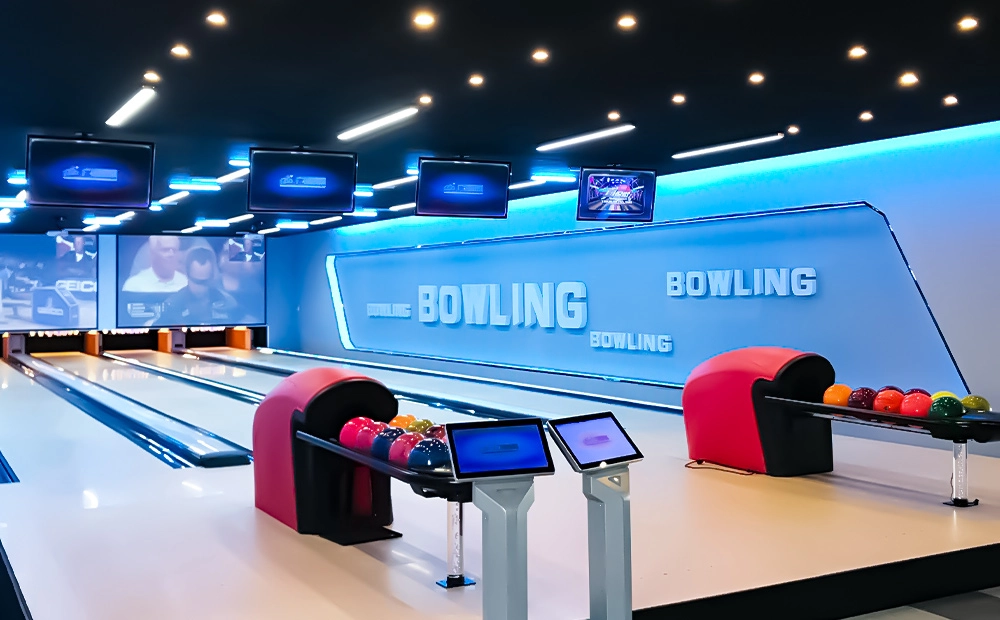
Flying Classic Standard Bowling
Flying Classic Standard Bowling (FCSB) employs the World Standard Competition Scoring System to deliver a more professional bowling experience, enabling bowlers to enjoy a professional-standard match at their convenience.
Ready to Build Your Bowling Center?
Share your details, and we’ll provide tailored solutions and expert guidance to help you take your bowling center to the next level.

Professional Bowling Alley Equipment Manufacturer, a one-stop solution provider for bowling alleys.
Facebook
YouTube
Linkedin
Twitter