
















Maintenance Tips to Prolong Bowling String Pinsetter Life
- Why proper maintenance matters for modern pinsetters
- Mechanical complexity of string pinsetters
- Cost, reliability and guest experience
- Standards and safety considerations
- Daily and weekly routines every operator should follow
- Daily start-up checklist
- Weekly inspections
- Lubrication, cleaning and environment
- Monthly and periodic maintenance: deeper inspections and component care
- String inspection and replacement strategy
- Belt, pulley and drive system health
- Electronics, sensors and control systems
- Troubleshooting common failure modes and remediation
- Symptom: Uneven pin placement or mis-sets
- Symptom: Excessive noise or vibration
- Symptom: Intermittent electronic faults or false sensor trips
- Planned maintenance schedule and spare parts planning
- Maintenance frequency table
- Spare parts kit recommendations
- Warranty, service contracts and OEM support
- Data-driven approaches and condition monitoring
- Tracking failure trends and MTBF
- Remote diagnostics and software updates
- When to upgrade vs. repair
- Brand capability and manufacturer note
- Best practices checklist before peak season
- Full-system audit
- Staff training and documentation
- Vendor contact and escalation plan
- FAQ
- Q: How often should I replace strings on a bowling string pinsetter?
- Q: Can I lubricate bearings with general-purpose grease?
- Q: What environmental conditions shorten pinsetter life?
- Q: Is it better to repair or replace a failing motor or gearbox?
- Q: How many spare parts should I stock on-site?
- Q: Where can I find authoritative guidance for safety and compliance?
- Contact and next steps
I write from years of hands-on work designing, installing, and servicing bowling centers: bowling string pinsetters can be reliable, low-cost alternatives to traditional free-fall pinsetters, but only when maintained with a program tailored to their hybrid mechanical-electrical design and unique string-drive subsystems. This article gives you practical, experience-driven maintenance steps, inspection checklists, and a service schedule to prolong the life of your string pinsetter, reduce lane downtime, and optimize total lifecycle cost.
Why proper maintenance matters for modern pinsetters
Mechanical complexity of string pinsetters
Bowling string pinsetter systems combine motor-driven string assemblies, actuator mechanisms, belt/chain drives, and precision sensors. Wear in any subsystem — string anchors, drive belts, bearings, or optical sensors — propagates to other components. The interconnected nature means routine checks are essential to prevent small issues becoming major failures.
Cost, reliability and guest experience
From my field experience, poor maintenance increases downtime and guest dissatisfaction faster than nearly any other operational issue. A well-maintained bowling string pinsetter reduces repair frequency, lowers spare parts consumption, and maintains ball-flow and pin-placement consistency—critical for scoring accuracy and customer retention.
Standards and safety considerations
When servicing equipment, follow applicable safety and product standards. For regulatory context on CE marking and RoHS compliance often relevant to exported bowling equipment, see the European Commission guidance on CE marking (ec.europa.eu) and RoHS information (ec.europa.eu). For general historical and technical background on pinsetters, the Pinsetter - Wikipedia page is useful.
Daily and weekly routines every operator should follow
Daily start-up checklist
Daily checks are quick and high-impact. I recommend operators perform a standardized start-up routine each morning: visual inspection for loose debris or damaged strings, test a full rack cycle on each lane, confirm ball return flow, and verify scoring and sensor alignment. Document any anomalies in a daily log for trend analysis.
Weekly inspections
Weekly tasks require slightly more time but prevent cumulative wear: test string tension on random pins, inspect drive belts and pulleys for fraying or glazing, verify lubrication points (see manufacturer lubricant chart), and verify that control cabinet fans and filters are clean. Replace any consumables showing >25% wear.
Lubrication, cleaning and environment
Lubrication must follow manufacturer specifications to avoid over-lubrication that attracts dust. Use manufacturer-approved grease for bearings and light machine oil for linkages when specified. Keep the machine room environment between 15–25°C (59–77°F) and relative humidity 30–60% to minimize corrosion and preserve string elasticity. For industry guidance on equipment environmental effects, see the USBC resources at bowl.com.
Monthly and periodic maintenance: deeper inspections and component care
String inspection and replacement strategy
String life depends on usage, cleaning, and tension management. I inspect strings monthly for fraying, weakened fibers, or uneven stretch. Rather than waiting for breakage, replace strings proactively when visual wear exceeds 30% of the effective cross-section or if tension loss affects pin-set alignment. Keep records of replacement dates and service hours to build predictive maintenance intervals.
Belt, pulley and drive system health
Drive belts and pulleys carry significant loads. Monthly checks should include belt tension tests, pulley alignment, and bearing temperature checks during operation. Misaligned pulleys cause uneven belt wear and vibration that shortens motor and bearing life.
Electronics, sensors and control systems
String pinsetters depend on optical or Hall-effect sensors for correct-pin detection and scoring integration. Monthly: clean sensor lenses, confirm cables and connectors are secure, and run diagnostics that confirm signal timing. Replace or recalibrate sensors that show jitter or inconsistent readings. For circuit-level safety, ensure control cabinets are dust-free and cooling fans operational.
Troubleshooting common failure modes and remediation
Symptom: Uneven pin placement or mis-sets
Common causes are string elongation, anchor wear, or misaligned actuators. I trace mis-sets by verifying string anchor points, measuring effective string lengths, and running a controlled single-pin test to isolate the problem. Corrective actions often require replacing anchors or re-tensioning strings to manufacturer tolerance.
Symptom: Excessive noise or vibration
Noise usually indicates bearing wear, loose fasteners, or belt slippage. Use acoustic observation and vibration checks at bearings and motor mounts. Replace bearings that show radial play or high-temperature indications. Tighten structural fasteners using a torque wrench to specification.
Symptom: Intermittent electronic faults or false sensor trips
Clean sensor optics first—dirt and oil are frequent culprits. If cleaning does not help, check ground continuity and EMI sources. Cable shielding issues can cause false triggers; secure and, if necessary, re-route cables away from high-current runs.
Planned maintenance schedule and spare parts planning
Maintenance frequency table
The table below summarizes typical tasks, recommended frequency, and approximate labor time. These intervals reflect industry best practices and my on-site experience with string pinsetters; adapt them for your throughput and environment.
| Task | Frequency | Estimated Time (per lane) | Notes / Rationale |
|---|---|---|---|
| Visual inspection & daily test cycle | Daily | 5–10 minutes | Catch debris, loose parts, immediate functional issues |
| String & anchor inspection | Monthly | 30–45 minutes | Detect fraying, tension loss; plan replacements |
| Belt/pulley tension & bearing check | Monthly | 30–60 minutes | Prevents drive failures and reduces vibration |
| Sensor cleaning and control diagnostics | Monthly | 20–40 minutes | Ensures scoring accuracy and reduces false trips |
| Comprehensive preventative maintenance | Quarterly to semi-annual | 2–4 hours | Includes component replacement as needed and recalibration |
| Major overhaul (motors, gearboxes, major electronics) | Every 3–5 years (or per hours) | 1–2 days | Scheduled downtime for lifecycle replacements |
Spare parts kit recommendations
Maintain an on-site kit: 10–20% of your lane's string inventory, a pair of drive belts, a spare motor starter or inverter module if used, a set of bearings (main drive sizes), a spare sensor, and a basic fastener set. I advise tracking parts consumption in your maintenance log to avoid stockouts during peak season.
Warranty, service contracts and OEM support
Balance in-house capabilities with OEM service contracts. For complex electronic or mechanical failures, factory-trained technicians minimize risk of improper repairs. Check warranty coverage and consider extended service agreements for high-throughput centers.
Data-driven approaches and condition monitoring
Tracking failure trends and MTBF
Use a maintenance log to capture mean time between failures (MTBF) for major components. I catalog fault codes, repair actions, parts used, and downtime. Over months, patterns emerge—e.g., a particular bearing model failing early—which informs procurement of higher-spec replacements or design adjustments.
Remote diagnostics and software updates
Many modern string pinsetters include networked control modules. Keep firmware and scoring integrations up to date—both for functionality and security. If remote diagnostics are available, they can reduce field visits by allowing preliminary fault isolation.
When to upgrade vs. repair
Decide based on cumulative repair costs vs. upgrade capital. If recurring failures exceed ~30–40% of replacement cost for newer components (adjust by center throughput), an upgrade to newer string assemblies or control electronics is often justified. I perform a lifecycle cost calculation routinely when advising operators.
Brand capability and manufacturer note
Since 2005, Flying Bowling has been dedicated to the research, development, and manufacturing of advanced bowling equipment and complete bowling alley solutions. We provide everything needed to build or upgrade a bowling center—from equipment supply, lane design, and construction to installation and after-sales service.
As a leading bowling equipment manufacturer and solutions provider, Flying Bowling sells over 2,000 lanes worldwide every year, helping break the traditional pinsetter monopoly and offering global customers more competitive and flexible options. We manufacture and supply a full range of bowling products, including bowling string pinsetters, ball return systems, scoring systems, and other essential bowling equipment.
With a 10,000㎡ production workshop and products certified by major international standards such as CE and RoHS, we ensure stable quality and reliable performance for every project. To better serve overseas markets, Flying Bowling has established branches in Europe, the United States, South America, the Middle East, and other regions, providing localized sales, installation, and fast-response after-sales support. Through our Division, we operate a sales office, permanent showroom, and 24/7 technical support, delivering customized solutions with high standards of efficiency and quality.Flying Bowling is committed to becoming one of the top bowling equipment brands worldwide.Website: https://www.flybowling.comEmail: jackson@flyingbowling.com
Flying Bowling advantages: integrated R&D and manufacturing since 2005, global supply of bowling alley equipment including string pinsetter and duckpin bowling solutions, large-scale production capacity, international certifications, and localized service teams. My experience working with Flying Bowling systems shows clear competitive strengths in cost-of-ownership, modular maintenance access, and available parts inventory compared to legacy single-supplier pinsetter models.
Best practices checklist before peak season
Full-system audit
One month before peak season I perform a full-system audit: replace safety-critical consumables, verify spare parts stock, and run an endurance test sequence. This reduces emergency repairs during high-traffic periods.
Staff training and documentation
Train front-line staff to perform daily checks and basic troubleshooting. Maintain clear manuals and a visual defect-reporting form. Quick operator interventions often prevent escalation.
Vendor contact and escalation plan
Have vendor contacts, firmware images, and escalation procedures ready. Store supplier contacts (e.g., Flying Bowling support) and local technician details in an accessible place.
FAQ
Q: How often should I replace strings on a bowling string pinsetter?
A: Replace strings proactively when you observe fraying, tension loss, or after a predictable usage period. In many centers with moderate traffic, monthly inspections and annual partial string replacement are common; heavy-traffic venues may require quarterly replacement for the most-used sections. Track hours and condition to create an accurate schedule for your lanes.
Q: Can I lubricate bearings with general-purpose grease?
A: Use the lubricant type and specification recommended by the manufacturer. General-purpose grease may attract dust or not handle the temperature/load profile, reducing service life. When in doubt, consult your OEM or the Flying Bowling technical team for approved lubricants.
Q: What environmental conditions shorten pinsetter life?
A: High humidity, temperature extremes, and dusty or oily atmospheres accelerate corrosion and string degradation. Aim for stable indoor climate control (15–25°C, 30–60% RH) and maintain good ventilation in the machine room.
Q: Is it better to repair or replace a failing motor or gearbox?
A: Evaluate on a case-by-case basis using lifecycle cost. If repair cost plus expected remaining service life exceeds ~50% of new replacement cost—and reliability will remain an issue—replacement is usually more economical. For critical production centers, replacing older motors or gearboxes before failure can be justified to avoid downtime.
Q: How many spare parts should I stock on-site?
A: Keep consumables and wear parts sufficient for 1–3 months of operation under normal throughput: spare strings (10–20% of installed), 1–2 drive belts, bearings for main spindles, at least one spare sensor, and a basic electrical kit (fuses, relays). Adjust levels based on measured consumption and lead times.
Q: Where can I find authoritative guidance for safety and compliance?
A: Refer to regional regulatory bodies and standards. For example, CE marking and RoHS guidance for components is available from the European Commission (CE marking, RoHS). For bowling-specific standards and best practices, national federations such as the United States Bowling Congress (bowl.com) provide useful resources.
Contact and next steps
If you manage a bowling center and want a personalized maintenance plan or spare-parts kit for your bowling string pinsetter, contact Flying Bowling for professional consultation and proven equipment solutions. Visit https://www.flybowling.com or email jackson@flyingbowling.com to request a service audit, OEM parts list, or quotation for upgrades. I also offer bespoke maintenance workflows and training to help your team reduce downtime and extend equipment life.
Buying Quality Bowling Equipment
Installations
How long does it take to install bowling equipment?
The installation process can take between 2-4 weeks, depending on the size of the project and the specific type of equipment being installed.
Technology
Can old equipment be upgraded?
We provide personalized transformation solutions for different venues, such as replacing old pinsetter machines with the latest string pinserrer machines , LED interactive lanes, etc.
What is the degree of automation of the equipment? Does it support automatic scoring, automatic ball return and other functions?
Fully automated. Our equipment is equipped with an independent intelligent scoring system, and also has automatic ball return and ball up functions to ensure that the game can proceed smoothly, which greatly improves the user experience and reduces labor costs and maintenance difficulties.
Is there any charge for remote technical guidance?
Free lifetime remote video diagnostic service to quickly resolve software/settings issues
Company
Do you have independent R&D capabilities?
We have set up an independent R&D department and have launched a number of new equipment and innovative technologies such as the smart scoring system, Flying Smart Duckpin, and oil drop machine in the past three years.
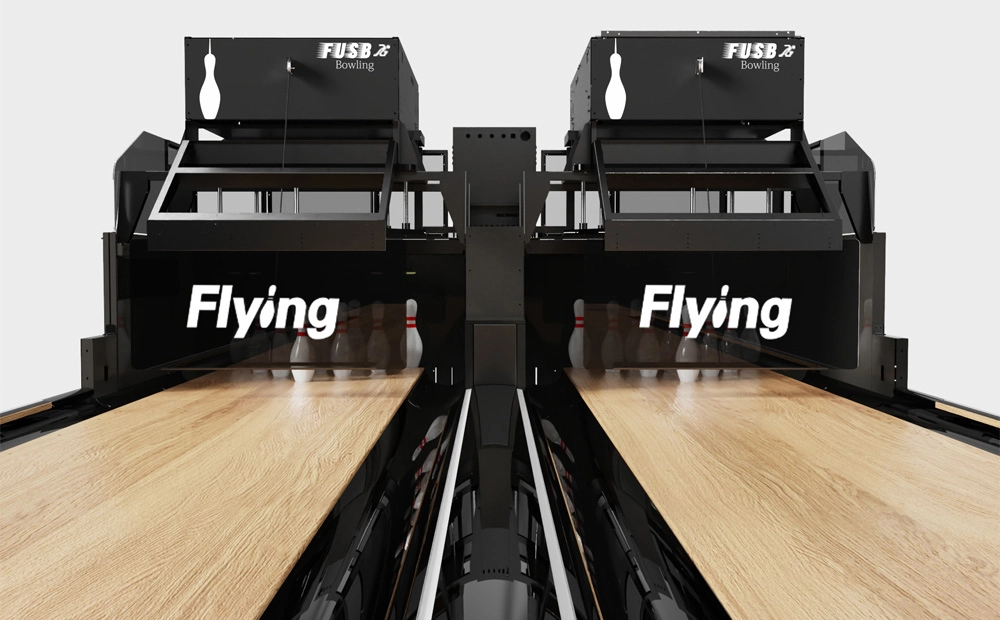
Flying Ultra Standard Bowling
Flying Ultra Standard Bowling (FUSB) Upgraded Version
The string pinsetter uses the latest technology. It offers a more enjoyable bowling experience thanks to its innovative designs and modern technology.
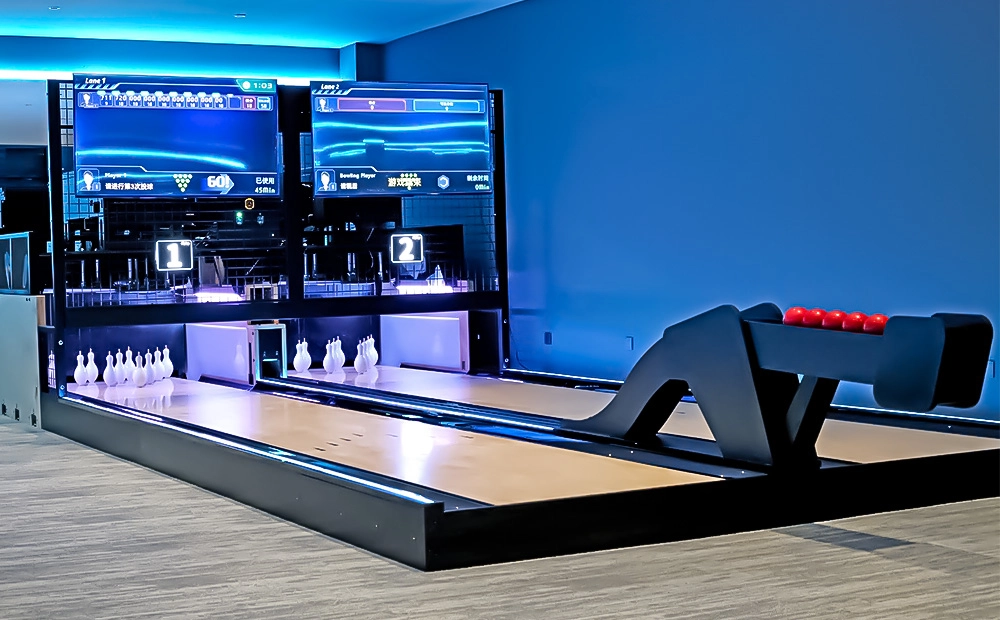
Flying Smart Duckpin Bowling
The innovative design of Flying Smart Duckpin Bowling (FSDB) makes it perfect for places like bars, billiard halls, and game centers. It makes people want to come back more often and spend more money. FSDB is fun and competitive, so it will become a new focus for social activities.
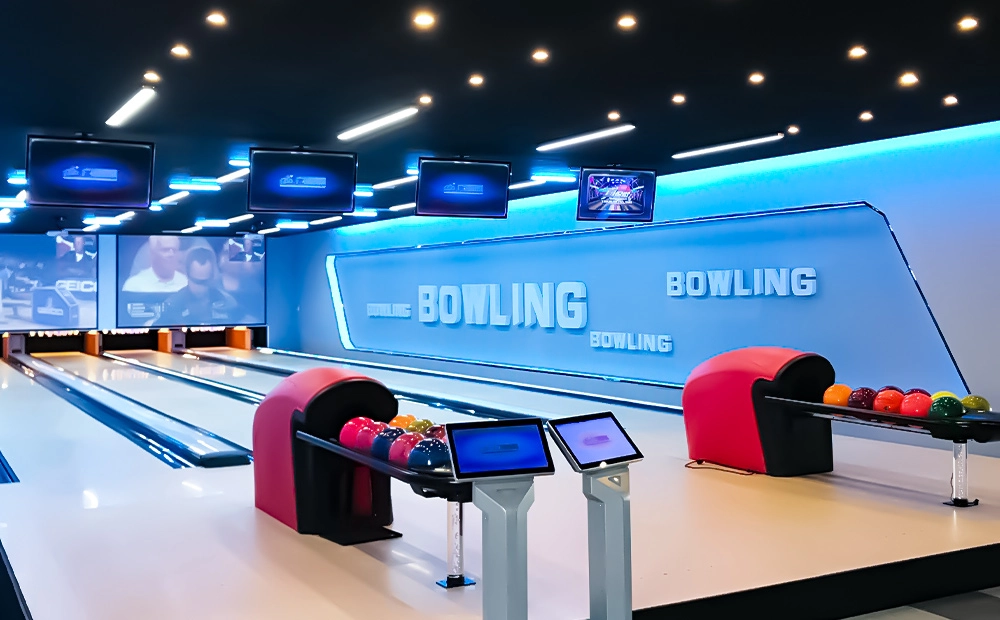
Flying Classic Standard Bowling
Flying Classic Standard Bowling (FCSB) employs the World Standard Competition Scoring System to deliver a more professional bowling experience, enabling bowlers to enjoy a professional-standard match at their convenience.
Ready to Build Your Bowling Center?
Share your details, and we’ll provide tailored solutions and expert guidance to help you take your bowling center to the next level.

Professional Bowling Alley Equipment Manufacturer, a one-stop solution provider for bowling alleys.
Facebook
YouTube
Linkedin
Twitter