














The Ultimate Bowling Scoring System Guide: Master the Math for a Perfect 300
- What Is the Bowling Scoring System?
- Key Concepts
- Key Takeaways: Bowling Math at a Glance
- Decoding the Symbols: How to Read a Score Sheet
- Step-by-Step: Calculating Strikes and Spares
- The 10th Frame: Why It Breaks the Rules
- Traditional vs. World Bowling (Current Frame) Scoring
- Advanced League Math: Handicaps and Averages
- Expert Tips to Improve Your Game via Math
- Conclusion
- How is a strike calculated in bowling?
- What is the maximum score in a single frame of bowling?
- How does the 10th frame work differently?
- What is the difference between a spare and a strike?
- How do you calculate bowling handicap?
- What does an open frame mean in bowling?
- Why is a perfect bowling game 300 points?
- What is the World Bowling scoring system?
What Is the Bowling Scoring System?
The bowling scoring system is a cumulative mathematical framework where players aim to knock down 10 pins over 10 frames to achieve a maximum score of 300. The objective is to maximize points through 'bonuses' earned from Strikes and Spares, rather than just counting simple pinfall.
While knocking down pins seems simple, the ten-pin bowling rules involve specific calculations that reward strings of successful shots. Understanding this math is crucial because it dictates your strategy, especially in the 10th frame. At Flying Bowling Co., Ltd., we have designed scoring systems since 2005 that handle these complex calculations automatically, but knowing the logic gives players a significant mental advantage.
Key Concepts
- Frames: A game consists of 10 frames.
- Max Score: A Perfect Game is 300 points (12 consecutive strikes).
- Objective: Chain strikes together to multiply points.
Key Takeaways: Bowling Math at a Glance
Bowling math relies on a bonus system where marks (strikes and spares) borrow points from future throws to increase the current frame's value. A Strike (X) is worth 10 points plus the next two rolls, while a Spare (/) is worth 10 plus the next single roll.
To quickly estimate your score potential, remember these values:
- Strike (X): 10 points + sum of next 2 rolls (Max 30).
- Spare (/): 10 points + sum of next 1 roll (Max 20).
- Open Frame: Sum of pins knocked down (e.g., 7 + 2 = 9).
- The 10th Frame: The only frame where you can roll up to three balls.
Decoding the Symbols: How to Read a Score Sheet
Bowling score sheets use specific symbols to represent the outcome of each delivery, condensing the game's action into a grid format. The most common symbols are the 'X' for a strike, a '/' for a spare, and a dash or number for open frames.
Modern automated scoring systems, like the ones we manufacture at Flying Bowling, display these instantly, but manual scoring requires recognizing these marks:
- 'X' (Strike): You knocked down all 10 pins on the first ball. No second ball is thrown in this frame (except the 10th).
- '/' (Spare): You knocked down all remaining pins on the second ball.
- '-' (Miss/Gutter): A dash indicates zero pins were hit on a specific delivery.
- F (Foul): You crossed the foul line; the delivery counts as 0 points.
Step-by-Step: Calculating Strikes and Spares
Calculating bowling scores involves looking ahead to future rolls; a strike's final value is not determined until the player has bowled two more times. This bowling score calculator logic is why three strikes in a row (a Turkey) creates exponential score growth compared to alternating strikes and spares.
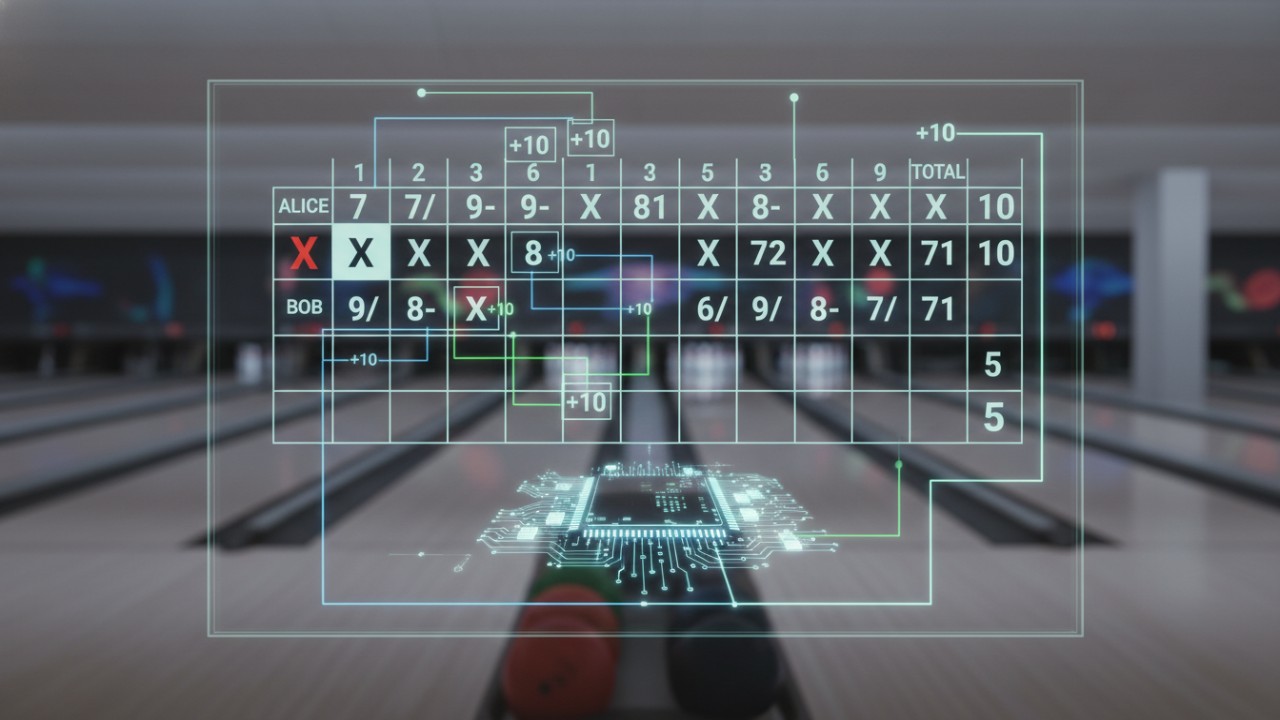
Here is how the calculation works in practice:
The Strike Multiplier:
- Rule: 10 + Next 2 Rolls.
- Example: You roll a Strike (Frame 1). Next, you roll a 7 and a 2 (Frame 2).
- Frame 1 Score: 10 + 7 + 2 = 19.
- Frame 2 Score: 19 + 9 = 28.
The Spare Bonus:
- Rule: 10 + Next 1 Roll.
- Example: You roll a 9 and a Spare (Frame 1). Next ball is a 6 (Frame 2).
- Frame 1 Score: 10 + 6 = 16.
- Frame 2 Score: 16 + 6 + (2nd ball of frame 2) = Running Total.
Compound Scoring (The Turkey):
- Frame 1: X
- Frame 2: X
- Frame 3: X
- Frame 1 Score: 10 + 10 + 10 = 30.
As verified by the United States Bowling Congress (USBC), this compounding effect is the only way to reach high scores like 200+. A game of all 9-spares (a "Clean Game") scores 190, while a game of alternating strikes can score much higher.
The 10th Frame: Why It Breaks the Rules
The 10th frame is unique because it allows for up to three deliveries to ensure the final strike or spare receives its full bonus calculation. It does not grant "extra frames," but rather "fill balls" that exist solely to complete the math for the 10th frame's mark.
- Strike in the 10th: You get two more balls. If you roll three strikes (XXX), you score 30 points for that frame.
- Spare in the 10th: You get one more ball.
- Open in the 10th: The game ends after two balls.
Common Misconception: If you strike on the fill ball (the 3rd shot of the 10th frame), you do not get another shot. The game ends immediately.
Traditional vs. World Bowling (Current Frame) Scoring
Current Frame Scoring, also known as the World Bowling system, is a simplified method where a strike is automatically awarded 30 points and a spare is awarded points based on the current frame's first ball. This system eliminates the need to wait for subsequent rolls to update the score, making it friendlier for TV audiences.
While traditional ten-pin bowling rules are standard for leagues, the current frame scoring system is gaining traction in international events. According to Inside The Games, this shift aims to make the sport more understandable for casual viewers.
Comparison:
- Traditional: Strike = 10 + Next 2 rolls (Variable).
- Current Frame: Strike = 30 points (Fixed).
- Strategy Shift: In Current Frame scoring, a string of strikes is not required to maximize the value of a single strike, changing the perfect game strategy significantly.
Advanced League Math: Handicaps and Averages
Bowling handicap is a leveling mechanism calculated by subtracting a player's average from a "basis score" (often 200 or 210) and multiplying the result by a percentage (usually 90% or 100%). This allows bowlers of different skill levels to compete fairly against one another.
For league secretaries and players, calculating bowling handicap correctly is vital. The formula is:
Handicap = (Basis Score - Player Average) x Percentage
Real-World Example:
- Basis: 200
- Your Average: 150
- Percentage: 90% (0.9)
- Math: (200 - 150) x 0.9 = 50 x 0.9 = 45.
- Result: You get 45 free pins added to your score every game.
At Flying Bowling, our global client base—ranging from local alleys in South America to large centers in Europe—relies on our software to automate these league handicaps, ensuring fair play without manual errors.
Expert Tips to Improve Your Game via Math
Improving your bowling score often requires a mathematical approach to risk management, such as deciding when to convert a difficult split or simply going for count (pinfall). Understanding the scoring system helps you recognize when a "safe" spare is more valuable than a risky strike attempt.
As a premier bowling equipment manufacturer, we see how technology aids this strategy. Our USBC-certified string pinsetters and scoring consoles provide real-time stats, helping players identify which frames they consistently leave open.
- Strategic Risk: If you are on a string of strikes, focus entirely on the pocket. An open frame after a string of strikes costs you 20+ potential points.
- Equipment Check: Always verify your automated score. While our Flying Bowling systems are rigorous, older systems can miscount pins.
- Mental Edge: Don't obsess over the 300. Focus on "filling frames" (getting marks). A clean game (no opens) guarantees a score of roughly 180-200, which wins most league matches.
Conclusion
Mastering the bowling scoring system transforms the sport from a simple physical game into a strategic mathematical challenge. Whether you are calculating a handicap for league night or aiming for that elusive 300, understanding how strikes, spares, and the 10th frame interact gives you a decisive edge. From the traditional 10-pin rules to the modern current frame scoring system, the math remains the foundation of your perfect game strategy.
Contact us today to equip your center with the latest scoring systems and string pinsetters.
How is a strike calculated in bowling?
A strike is worth 10 points plus the total pinfall of your next two deliveries. This bonus mechanic is why consecutive strikes are necessary for high scores.
What is the maximum score in a single frame of bowling?
The maximum score for a single frame is 30 points. This is achieved only if a player rolls three consecutive strikes (a Turkey), making the first strike worth 10+10+10.
How does the 10th frame work differently?
In the 10th frame, if you roll a strike or spare, you are awarded bonus 'fill balls' to complete the scoring calculation, allowing up to three rolls total. These are not extra frames, but continuation shots for the 10th frame.
What is the difference between a spare and a strike?
A strike clears all pins on the first ball (10 + next 2 rolls), while a spare clears them in two attempts (10 + next 1 roll). A strike offers a higher scoring potential due to the double bonus.
How do you calculate bowling handicap?
Handicap is calculated by subtracting your average from a 'basis score' (e.g., 200) and multiplying the result by a percentage (usually 90%). This levels the playing field for bowlers of different averages.
What does an open frame mean in bowling?
An open frame occurs when a player fails to knock down all 10 pins within two attempts, resulting in zero bonus points. The score for that frame is simply the number of pins knocked down.
Why is a perfect bowling game 300 points?
A perfect game consists of 12 consecutive strikes. Since each strike frame is worth 30 points (10+10+10), 10 frames x 30 points = 300.
What is the World Bowling scoring system?
The World Bowling (Current Frame) system simplifies scoring by awarding 30 points for a strike and varying points for spares immediately, without waiting for subsequent rolls to determine the frame's value.
Buying Quality Bowling Equipment
Installations
Do you provide technical support after the installation?
Absolutely. We offer ongoing technical support, including regular maintenance and emergency repair services.
Service
If there is a problem with the equipment, how long will it take you to respond?
We promise to provide a solution within 12 hours (24 hours for overseas customers), and serious failures will be handled first.
What is the warranty on your bowling equipment?
We provide a standard 1-year warranty on all equipment, with extended warranties available upon request.
Company
Are there any successful cases for reference?
We have built a variety of projects such as commercial venues, hotel entertainment centers, etc. for global customers. The case library can be provided in a targeted manner (including pictures/videos)
Products
Can I choose the color and brand logo of the equipment?
Personalized customization is supported, including lane color, LOGO, theme lighting system, etc.
Flying Smart Duckpin Bowling
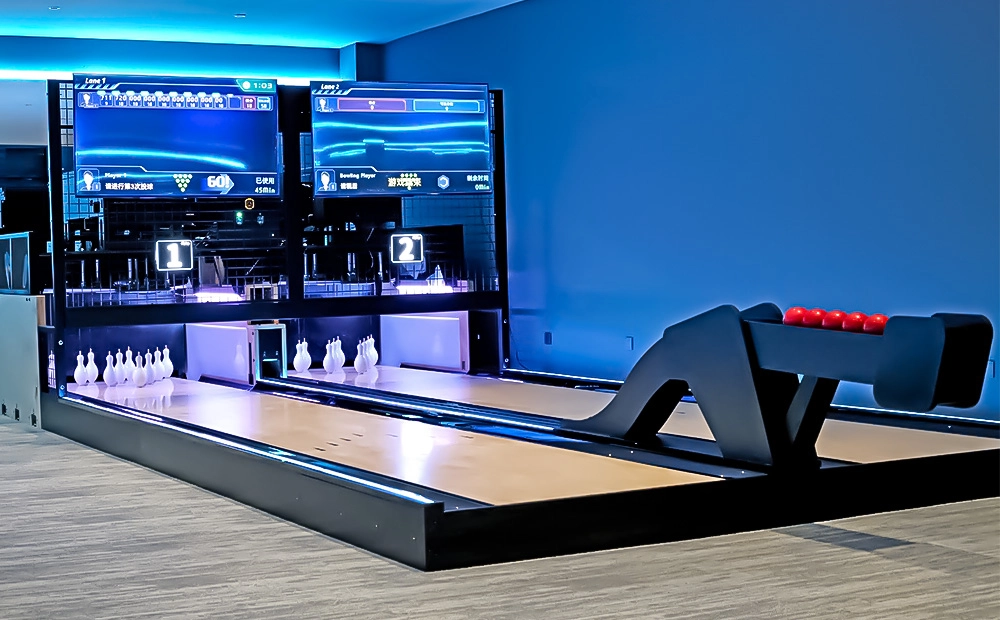
The innovative design of Flying Smart Duckpin Bowling (FSDB) makes it perfect for places like bars, billiard halls, and game centers. It makes people want to come back more often and spend more money. FSDB is fun and competitive, so it will become a new focus for social activities.
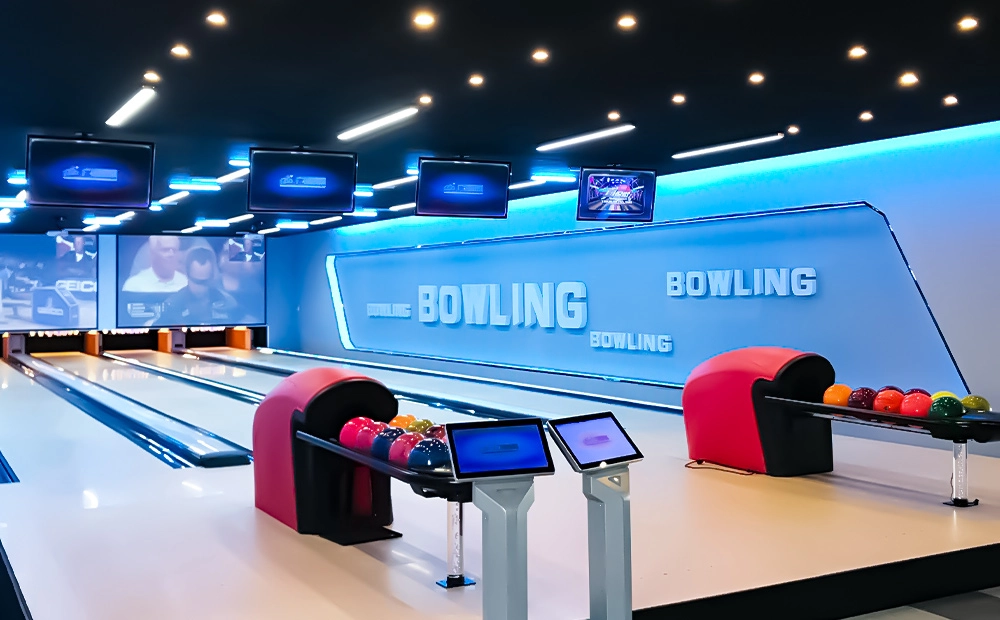
Flying Classic Standard Bowling
Flying Classic Standard Bowling (FCSB) employs the World Standard Competition Scoring System to deliver a more professional bowling experience, enabling bowlers to enjoy a professional-standard match at their convenience.
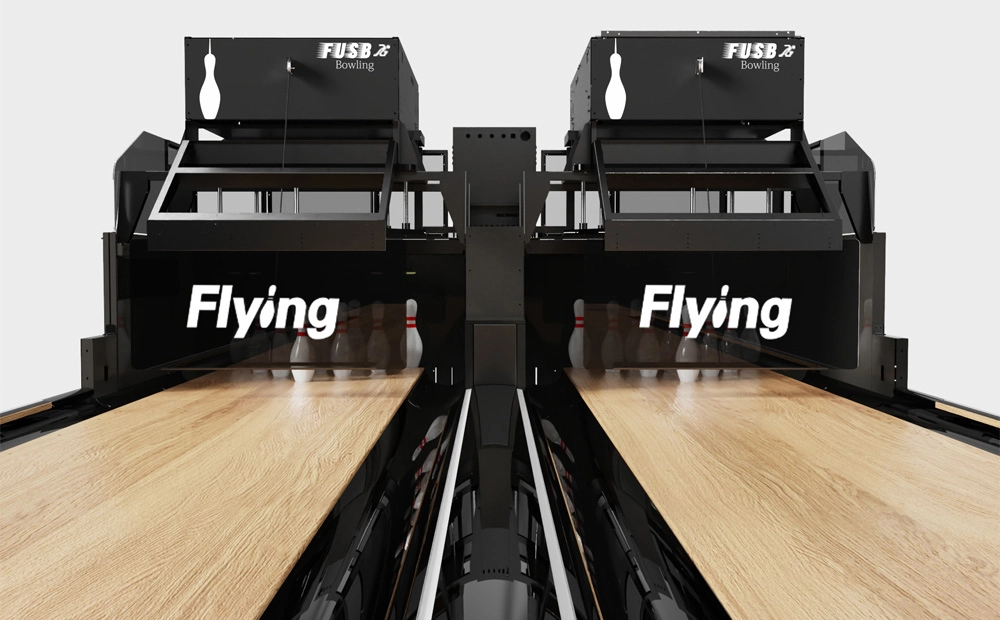
Flying Ultra Standard Bowling
Flying Ultra Standard Bowling (FUSB) Upgraded Version
The string pinsetter uses the latest technology. It offers a more enjoyable bowling experience thanks to its innovative designs and modern technology.
Ready to Build Your Bowling Center?
Share your details, and we’ll provide tailored solutions and expert guidance to help you take your bowling center to the next level.

Professional Bowling Alley Equipment Manufacturer, a one-stop solution provider for bowling alleys.
Facebook
YouTube
Linkedin
Twitter